

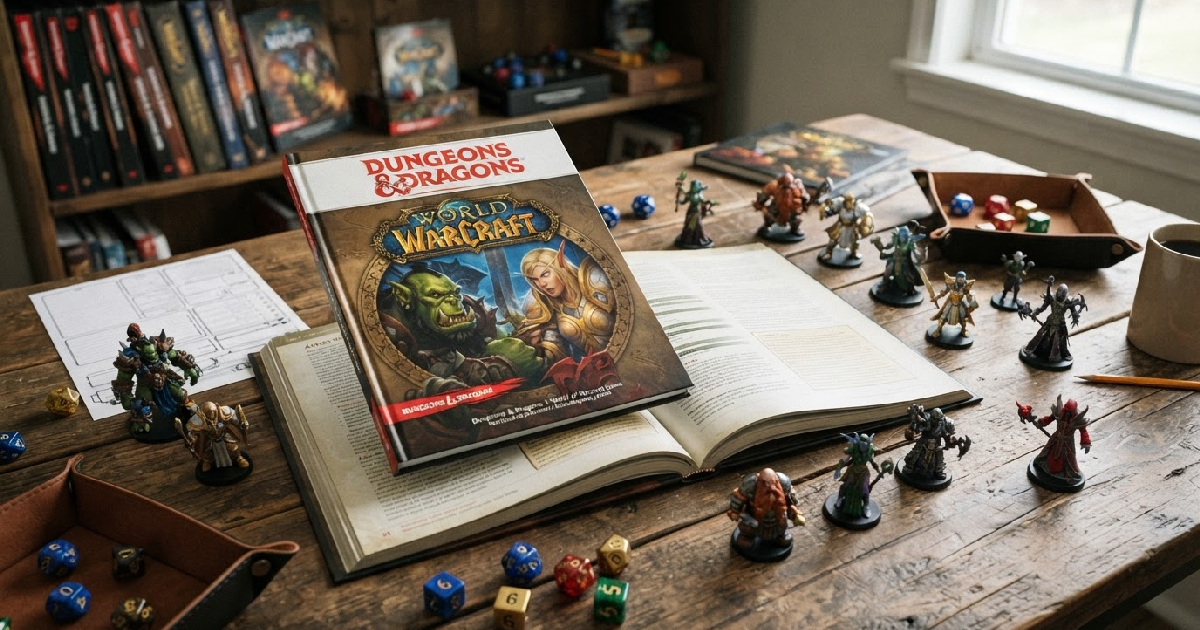
Wizards of the Coast unveils Dungeons & Dragons World of Warcraft expansion
The long-anticipated Dungeons & Dragons World of Warcraft crossover is officially happening, confirmed by Wizards of the Coast and Blizzard Entertainment, Inc. This comprehensive collaboration brings the expansive world of Azeroth to the D&D tabletop, marking a significant moment for both fantasy franchises.
It arrives as a 256-page “gameplay expansion book,” or sourcebook, serving as the inaugural entry under the new “D&D Universes Beyond” label. This strategic move mirrors a successful crossover model previously implemented for *Magic: The Gathering*, aiming to broaden D&D’s appeal and reach new players.
D&D Universes Beyond initiative launched at Gen Con
Wizards of the Coast, a subsidiary of Hasbro Inc., officially announced this major crossover at Gen Con 2026. The “Universes Beyond” initiative extends the popular tabletop RPG into beloved fictional settings beyond its traditional realms.
This strategy isn’t entirely new for Wizards of the Coast, who’ve seen considerable success with similar crossovers in their popular card game, *Magic: The Gathering*. The goal is clearly to draw in new players while offering fresh experiences to its long-time community.
Strategic vision behind D&D’s crossovers
Dan Ayoub, D&D franchise head, articulated the initiative’s goal for the Dungeons & Dragons World of Warcraft project. He stated it would extend “Dungeons & Dragons into even more worlds we love,” highlighting a deliberate effort to leverage established intellectual properties.
This approach isn’t just about expanding market share. It’s also about enriching the storytelling potential of D&D and connecting with diverse fan bases who might already be deeply invested in the lore of other franchises. The successful integration of existing worlds into tabletop formats has become a key industry trend.
By bringing *World of Warcraft* into the D&D fold, Wizards of the Coast is tapping into a massive, dedicated fanbase. This move could introduce thousands of *WoW* players to the joys of tabletop role-playing, something that both companies hope will significantly grow their respective communities.
New player options for Azerothian adventurers
The upcoming 256-page sourcebook is packed with new content for D&D players, focusing heavily on character customization and immersion. It introduces 11 new species, meticulously designed to represent every playable *World of Warcraft* race found in the sprawling online game.
These include popular choices like Orcs and Elves, featuring new lineages to reflect *WoW*’s five distinct elf kinds, allowing for nuanced character backgrounds. Players will also gain the ability to embody more exotic races such as Dracthyr, Pandaren, Earthen, Troll, and Haranir, offering unprecedented depth in character creation.
For long-time *WoW* enthusiasts, the inclusion of previously cosmetic-only races as playable species is a significant development. It opens up new storytelling possibilities, letting players embody creatures they’ve only encountered as non-player characters or in fleeting appearances.
This careful adaptation ensures that the unique identities and abilities of *World of Warcraft* races translate authentically into the D&D ruleset. It means adventurers can truly feel like they are bringing a piece of Azeroth to their tabletop campaigns.
Expanding character specializations with iconic WoW classes
Beyond new species, the expansion delivers nine unique subclasses, carefully crafted to translate *World of Warcraft*’s diverse classes and specializations into D&D mechanics. Six of these are brand-new options, providing fresh tactical and role-playing opportunities for players.
The book also includes three updated versions of existing D&D characters, reimagined to align with *WoW*’s iconic archetypes. This allows players to channel the dark power of a Death Knight, manipulate shadow magic as a Priest of Shadow, or unleash demonic fury as a Demon Hunter in their campaigns.
Each subclass aims to capture the essence of its *World of Warcraft* counterpart, from specific combat styles to thematic spells and abilities. This level of detail is crucial for making the crossover feel genuine and not just a superficial reskin.
Players will find that their chosen subclass not only reflects a *WoW* specialization but also integrates seamlessly with D&D’s core gameplay. It promises a truly hybrid experience, blending the best of both fantasy worlds.
Game Master resources for crafting authentic WoW campaigns
For Dungeon Masters looking to craft their own Azerothian adventures, the Dungeons & Dragons World of Warcraft sourcebook provides essential Game Master resources. It introduces 26 new *WoW*-inspired magic items, ranging from potent enchantments to legendary artifacts.
These items are designed to evoke the rich history and unique magic of *World of Warcraft*. They can serve as powerful rewards, plot devices, or challenging objectives within a campaign, adding layers of authenticity to the tabletop experience.
Additionally, the book adapts seven iconic *World of Warcraft* dungeons for the D&D ruleset. This offers GMs pre-built challenges and environments, allowing players to explore familiar locales like the Deadmines or the Scarlet Monastery in a brand new, interactive way.
Adapting these dungeons requires careful consideration of their original mechanics and narrative. It means GMs can run adventures that feel truly rooted in *WoW* lore, providing a sense of nostalgia and discovery simultaneously. These resources will significantly reduce preparation time for GMs.
Creative minds express excitement for the collaboration
The development team behind this groundbreaking crossover shows considerable enthusiasm for the project. James Wyatt, Principal Game Designer for D&D, expressed his personal connection to the initiative.
Wyatt revealed he’d played *World of Warcraft* “almost since the beginning” and had been adapting it to tabletop for “almost as long.” This personal investment suggests a deep understanding and respect for *WoW* lore, vital for an authentic adaptation.
His long history with both games ensures that the project is handled with genuine passion and an intricate knowledge of what makes each unique. This level of personal connection bodes well for the quality and fidelity of the final product.
Holly Longdale, Executive Producer and Vice President, World of Warcraft, also highlighted the shared philosophy of both games. She noted that “World of Warcraft and Dungeons & Dragons are both built on a powerful idea: give players a world full of possibility, then let them make the story their own.”
This statement underscores the collaborative, player-driven narrative central to both franchises. It implies that the crossover isn’t just about porting mechanics but about fostering the same sense of freedom and agency players expect from *WoW* and D&D.
Such synergy between the creative visions of Wizards of the Coast and Blizzard Entertainment, Inc. promises a product that honors the spirit of both IPs. It’s a testament to the shared foundations of fantasy role-playing that have captivated millions for decades.
Broader impact on tabletop role-playing and IP crossovers
This Dungeons & Dragons World of Warcraft crossover signals a significant evolution in Wizards of the Coast’s strategy for its flagship tabletop RPG. Adopting the “Universes Beyond” model, first successful with *Magic: The Gathering*, could open doors for D&D to explore an even wider array of popular media properties.
The success of similar ventures in *Magic: The Gathering* suggests a fertile ground for D&D, potentially introducing new players to the joys of tabletop role-playing. Such partnerships reflect a broader trend in the gaming industry, where established intellectual properties seek new avenues for engagement and expansion across different mediums.
Integrating such a massive and distinct world like *World of Warcraft* into D&D’s framework could set a precedent for future collaborations with other video game franchises. It’s a move that enriches D&D’s storytelling potential by offering new settings and narrative hooks.
This allows players who’ve explored Azeroth for decades to tell their own epic tales with D&D’s robust ruleset, extending their engagement with the beloved universe. It also extends Blizzard’s IP into new mediums, reaching audiences who might not engage with traditional MMOs but are keen on narrative-driven tabletop experiences.
The implications for community engagement and cross-pollination of fandoms are substantial. It mirrors the way dramatic upsets and crossovers drive interest in other competitive fields, creating buzz and attracting new participants. This collaboration is more than just a product launch; it’s a cultural event for fantasy gaming.
Ultimately, this expansion reinforces the idea that D&D is a versatile system capable of hosting countless narratives. It provides a blueprint for how iconic video game worlds can seamlessly transition to the tabletop, offering fans a fresh perspective on their favorite universes. This trend suggests a future where the boundaries between different media continue to blur, creating richer, more interconnected fan experiences across the gaming world.