

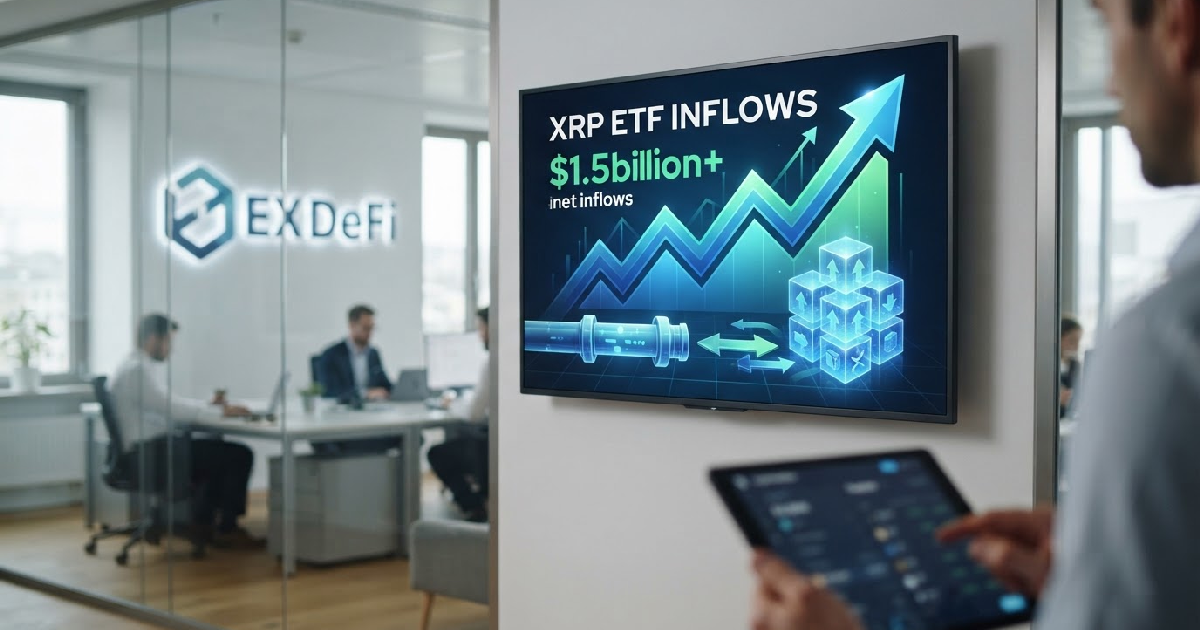
XRP ETF Inflows Surpass $1.5 Billion; EX DeFi Platform Offers New Daily Yield Paths
XRP exchange-traded funds (ETFs) have hit a major milestone, with cumulative net inflows surpassing $1.5 billion as of July 29, 2026. This significant influx underscores a growing confidence among institutional investors in the digital asset.
As traditional financial players increasingly allocate capital to XRP through regulated products, a separate but related trend sees a platform called EX DeFi promoting alternative strategies, claiming XRP holders could earn up to $10,000 daily through cloud mining and yield platforms.
Institutional Demand Fuels XRP ETF Surge
The convergence of these developments signals a maturing market for XRP, moving beyond speculative price action towards more diversified and regulated investment avenues. While retail investors grapple with market volatility, institutional funds are steadily incorporating XRP into their portfolios, recognizing its evolving regulatory standing.
The rapid growth in XRP ETF inflows, now exceeding $1.5 billion, reflects a powerful endorsement from institutional investors. This consistent capital flow highlights a shift in how major financial entities view and integrate digital assets like XRP. They’re making considered allocation decisions, moving away from short-term momentum plays.
On July 29 alone, XRP spot ETFs recorded $584,710 in daily net inflows, with Franklin Templeton’s XRPZ being the sole recipient of fresh capital. Just one day later, on July 30, inflows surged to $5.98 million, bolstered by contributions from Bitwise XRP, which added $3.03 million, and Franklin XRPZ, which saw an additional $2.95 million. These figures paint a clear picture of sustained interest.
A Growing Roster of XRP ETFs Drives Assets
The total net assets held across XRP spot ETFs also signal robust growth, nearing the $1 billion mark by July 29, reaching $988.7 million. This came after CryptoRank reported total net assets at approximately $997 million just weeks prior, on July 17, indicating consistent accumulation. Daily trading volume for XRP ETFs has also been substantial, hitting $10.35 million on July 29, 2026.
The landscape of XRP investment vehicles has broadened considerably over the past year. Following its approval in July 2025, the ProShares Ultra XRP ETF (UXRP), a 2x leveraged fund, began trading. This was a pivotal moment, opening the door for more complex exposure to XRP through futures contracts on NYSE Arca.
The fourth quarter of 2025 then saw a wave of spot XRP ETF launches that fundamentally changed institutional access. Canary Capital’s XRPC debuted on Nasdaq on November 13, 2025, marking the most successful ETF launch of the year by first-day trading volume across all asset classes. Bitwise’s XRP ETF followed on November 20, 2025, and Grayscale’s GXRP listed on NYSE Arca on November 24, 2025.
Franklin Templeton’s XRPZ and 21Shares’ TOXR also launched in short order, adding to the competitive field. Even earlier, REX-Osprey’s XRPR had been offering spot exposure since September 18, 2025.
By early March 2026, five spot XRP ETFs were trading in the U.S., a number that has since grown to seven, collectively managing $1.53 billion in Assets Under Management (AUM) and holding 773 million XRP tokens in custody.
Beyond Price Action: The EX DeFi Approach to XRP Yields
While institutional interest via ETFs is on the rise, a different segment of the market is exploring alternative ways for XRP holders to generate returns beyond mere price appreciation. EX DeFi, a UK-headquartered platform, is at the forefront of this movement, offering cloud mining and yield aggregation mechanisms.
The platform positions itself as a more intuitive and convenient way to engage with digital assets, aiming to enhance the efficiency of asset utilization within the XRP ecosystem. EX DeFi suggests that for users with sufficient capital, their model holds the potential for higher daily returns.
The claim that XRP holders could earn up to $10,000 daily from these strategies has naturally captured investor attention, though specific mechanisms and guarantees warrant close examination.
EX DeFi’s Regulatory Framework and Security Measures
EX DeFi emphasizes its adherence to European regulatory frameworks, including Markets in Crypto-Assets (MiCA) and Markets in Financial Instruments Directive II (MiFID II). This commitment to regulatory compliance is crucial in the often-unregulated DeFi space, aiming to foster greater transparency, operational standards, and user protection.
The MiCA framework, for instance, established comprehensive, EU-wide rules for crypto assets, covering trading, issuance, and service provision, with provisions applying in stages since June 2024 for stablecoins and December 2024 for crypto-asset service providers.
The platform also boasts a multi-layered security architecture designed to safeguard user assets. This includes annual financial and security compliance audits conducted by PwC, digital asset custody insurance from Lloyd’s of London, and enterprise-grade network protection by Cloudflare.
Additionally, EX DeFi employs McAfee® security systems, multi-layered encryption, AI-powered intelligent risk control, and two-factor authentication (2FA) verification, all aimed at mitigating risks in the volatile digital asset landscape.
EX DeFi supports a range of mainstream digital assets beyond XRP, including BTC, ETH, USDT, USDC, DOGE, LTC, and SOL. This broad support aims to provide users with flexible and convenient digital asset service experiences, allowing them to diversify their holdings and yield-earning strategies.
The Regulatory Clarity Paving XRP’s Path
The current surge in XRP ETF inflows isn’t a sudden phenomenon; it’s the culmination of years of legal and regulatory battles. The U.S. Securities and Exchange Commission (SEC) filed a lawsuit against Ripple Labs, the company behind XRP, in December 2020, alleging unregistered securities offerings. This cast a long shadow over XRP’s market standing and adoption prospects.
However, a landmark ruling by Judge Analisa Torres in July 2023 provided crucial clarity, stating that programmatic sales of XRP on exchanges did not constitute securities offerings. While direct institutional sales were deemed securities, the distinction was a significant win for Ripple.
The lawsuit officially concluded in August 2025, with Ripple agreeing to a $125 million civil penalty, significantly less than the SEC’s initial $2 billion demand, and both parties dropping appeals.
This resolution, coupled with a joint statement from the SEC and Commodity Futures Trading Commission (CFTC) on March 17, 2026, classifying XRP as a “Digital Commodity,” was a watershed moment. This clear regulatory definition removed a major hurdle, effectively opening the gates for U.S.
pension funds, insurers, and family offices to confidently allocate to XRP-backed products like ETFs. The SEC’s framework for crypto ETFs, established earlier with Bitcoin and Ethereum, provided a template for XRP’s integration.
The CBOE Rule Proposal further streamlined the process, creating an “express lane” for crypto ETFs if their underlying assets had traded as regulated futures for at least six months. XRP futures, which began trading on CME in May 2025 and on Bitnomial in March 2025, met this prerequisite, compressing the review process for spot ETFs to approximately 75 days.
XRP Ledger Activity and Future Potential
Beyond its investment products, the underlying utility of XRP and the XRP Ledger (XRPL) continues to grow. The XRPL has processed over 4 billion transactions since its inception, demonstrating its robustness and efficiency as a blockchain for payments and other applications.
Real-world asset tokenization on XRPL has also expanded significantly, now exceeding $474 million, with the total represented value approaching $1.5 billion. This utility underpins the long-term value proposition for XRP.
Daily transactions on the XRPL hit 3 million on March 15, 2026, a threefold increase from mid-2025 averages. This surge is attributed to the growth in Automated Market Maker (AMM) pools, tokenized assets, and RLUSD-denominated settlement flows. Such organic network activity reinforces the notion that XRP is not merely a speculative asset but a functional digital currency with an expanding ecosystem.
Market Dynamics and Broader Investment Trends
The influx of institutional capital into XRP ETFs comes at a time when the broader cryptocurrency market is navigating complex dynamics. As of July 31, 2026, XRP itself is down 1% and trading along the lower boundary of a descending channel that has been in place since May.
Key resistance levels for XRP include the 20-day Exponential Moving Average (EMA) at $1.0930, the 50-day EMA at $1.1267, the 100-day EMA at $1.2105, and the 200-day EMA at $1.4071.
Conversely, critical support levels are noted at $1.05, representing the channel floor, and a psychological support at $1.00. Should the $1.05 level fail on a daily close, the descending channel projects a potential target of $0.90 to $0.95. This technical analysis highlights that even with strong institutional adoption, XRP is not immune to market fluctuations.
The broader trend of institutional adoption, exemplified by firms like Goldman Sachs disclosing a $153.8 million position in spot XRP ETFs through its Q4 2025 13F filing, reflects a significant shift. Goldman Sachs alone accounts for approximately 73% of the top 30 institutional holders, who collectively control over $211 million in XRP ETF exposure.
ARK Invest has also allocated nearly 20% of its CoinDesk 20 ETF to XRP, making it the third-largest holding.
This institutional embrace of crypto assets marks a maturation of the market, moving digital currencies from niche speculation to legitimate portfolio components. As more traditional players enter, driven by regulatory clarity and competitive offerings like EX DeFi, the overall financial landscape continues to evolve, presenting both opportunities and challenges for retail and institutional investors alike.
The dual focus on regulated investment products like XRP ETFs and innovative yield-generating platforms such as EX DeFi indicates a comprehensive approach to digital asset management. Investors are clearly looking for both capital appreciation and sustainable income streams, reflecting a more sophisticated understanding of the crypto market’s potential and inherent risks.