

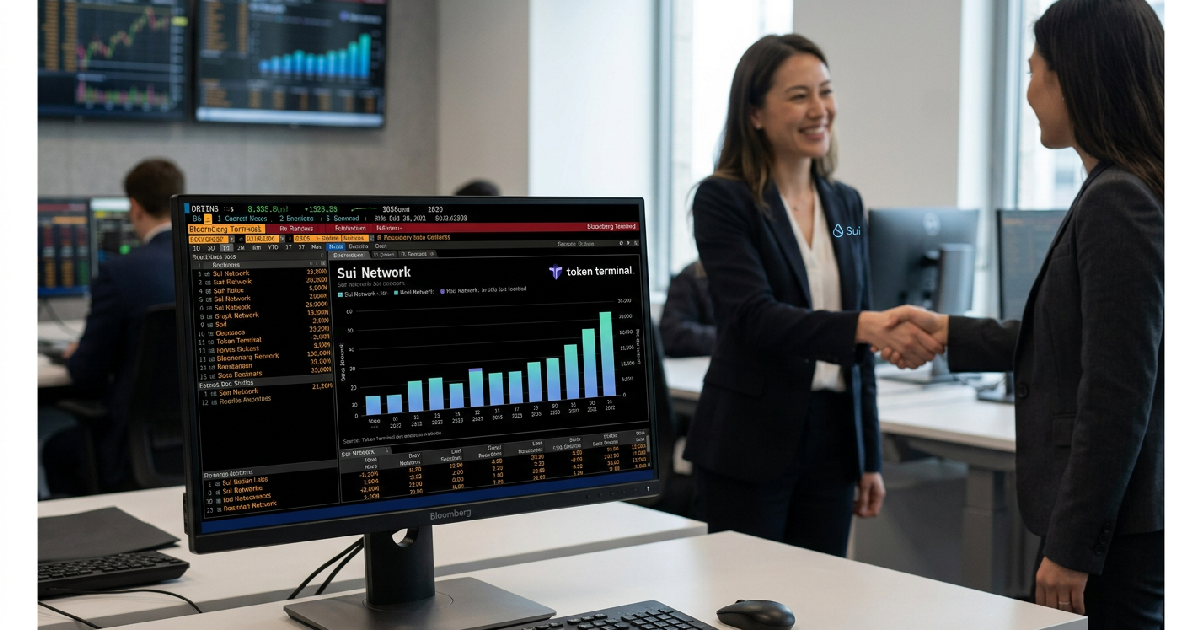
Sui Network finalizes data partnership with Token Terminal on June 26, 2026
The Sui Network and Token Terminal finalized a data partnership on June 26, 2026, to integrate the blockchain’s on-chain metrics into institutional research workflows. This integration allows professional investors to access standardized financial data from the Sui network through professional platforms, including the Bloomberg Terminal.
By providing auditable metrics such as daily active users, ecosystem total value locked (TVL), and revenue-style breakdowns, the collaboration aims to reduce friction for institutional due diligence.
Sui aims for institutional visibility in a complex market
This technical move comes as professional capital allocators demand higher transparency in the digital asset space. For Mysten Labs, the team behind the Sui blockchain, the priority is establishing institutional-grade visibility rather than driving immediate token price action.
Professional users can now perform cross-chain comparisons using Token Terminal’s infrastructure, which tracks and aggregates data across more than 100 blockchain ecosystems and over 1,200 applications. The focus remains on providing clean, comparable metrics that align with the rigorous standards of traditional finance.
Bridging the gap for unique blockchain architecture
Sui has established a specific position in the Layer 1 landscape by utilizing an object-centric architecture and the Move programming language. While these technical choices offer performance benefits, they often make it difficult for standard analytics tools to provide accurate reports, as many platforms are built for account-based systems like Ethereum or Solana.
The partnership with Token Terminal is designed to tailor analytics specifically to Sui’s unique architecture, translating it into a format that institutional researchers can easily analyze. This goes beyond a one-size-fits-all approach, recognizing the distinct nature of Sui’s underlying technology.
The demand for auditable on-chain data
The integration ensures that several critical metrics are now available for real-time monitoring. These include active addresses, fee structures, and smart contract deployments. For institutional allocators, having access to these data points through a third-party provider adds a layer of accountability that self-reported data often lacks.
This initiative responds directly to the growing demand for comprehensive blockchain analytics within the financial sector. As the crypto market matures, institutions require reliable, unbiased data to make informed decisions and manage risk effectively.
Key metrics introduced through the partnership
Beyond the already mentioned active addresses and smart contract deployments, the partnership also brings detailed insights into daily active users, total value locked (TVL), and crucially, revenue-style breakdowns. These metrics offer a holistic view of the Sui Network’s economic activity and growth.
These specific numbers will be available for cross-chain comparison, which is essential for institutional investors evaluating potential allocations. It provides a common language for comparing performance across diverse blockchain ecosystems, which has traditionally been a challenge. New federal rules and regulatory pressures are only increasing the need for clear comparability.
Context of Sui’s institutional push
Sui launched its mainnet in May 2023 and has since been actively pursuing institutional credibility. This partnership with Token Terminal is a continuation of that strategy, building on previous collaborations designed to bolster its appeal to a wider range of professional investors.
For example, Sui has partnered with Crypto.com for custody solutions and integrated stablecoins to enhance its financial infrastructure. These moves collectively aim to mature the Sui ecosystem and make it more amenable to traditional finance models.
Prior partnerships supporting ecosystem growth
Further demonstrating its commitment to institutional engagement, Sui partnered with Franklin Templeton Digital Assets on November 22, 2024. That collaboration focused on supporting ecosystem builders and deploying novel technologies on the Sui blockchain.
These strategic alliances underscore Sui’s long-term vision to become a preferred platform for institutional participants. They highlight an underlying effort to align with traditional financial standards, which is a major draw for large-scale investors.
Understanding market implications for Sui
It allows for a more sober assessment of network health, particularly during periods where Bitcoin prices remain sensitive to broader risk appetite and macroeconomic shifts. The transparency offered by this new data integration provides a clearer signal than relying on speculative narratives.
Market participants should distinguish between infrastructure support and immediate market pumps. While the Token Terminal integration provides better visibility, it does not inherently guarantee that SUI price action or TVL will spike immediately. Instead, it offers a clearer lens through which to view the market.
Avoiding speculative assumptions in a volatile market
In an environment where liquidity can be thin and investor sentiment is fragile, having reliable, third-party data is a critical tool for risk management. Traders should avoid the mistake of assuming that integration leads directly to mass adoption. Instead, this should be viewed as the construction of the “pipes and plumbing” necessary for future institutional participation.
Large-scale institutions often spend months in the due diligence phase before committing capital. Providing them with the verifiable tools to perform that research is a long-term strategy designed to build a more resilient and mature ecosystem over time. It’s about laying the groundwork for sustained, rather than instantaneous, growth. Other crypto tokens have seen surges, but transparency is key to consistent growth.
The team and technology behind Sui
Sui was founded by a team with significant experience in the blockchain space: Evan Cheng, Sam Blackshear, Adeniyi Abiodun, and George Danezis. These individuals were part of Meta’s (formerly Facebook) Novi Financial team, where they worked on the Diem stablecoin and the Move programming language.
This background suggests a strong foundational understanding of scalable blockchain infrastructure and financial applications. Mystic Labs developed the Sui blockchain, emphasizing its unique object-centric architecture for high performance and efficiency.
The Move programming language advantage
Sui’s blockchain runs on the Move programming language, a Rust-based language originally developed for the Diem project. Move is designed for secure resource management and verifiable program execution, which sets it apart from other languages commonly used in blockchain development.
This object-centric architecture and Move language allow for parallel transaction execution, providing higher throughput and lower latency compared to many existing blockchains. This technical edge, coupled with improved data visibility, could be a compelling factor for institutions looking for robust and efficient platforms.
Future outlook and accountability
The partnership aims to strengthen the analytical infrastructure available to the broader blockchain community. By providing standardized, institutional-grade on-chain metrics, it offers clean, comparable data that traditional finance expects. This reduces the bespoke analytical effort previously required for understanding unique blockchain architectures like Sui’s.
Furthermore, this collaboration introduces a layer of accountability through third-party analytics reporting. This independent verification can help reassure institutional allocators, who are typically wary of self-reported data in less regulated markets.
Verifying the integration for lasting impact
The next crucial step for the market will be to verify the official announcements from the Sui Foundation and examine Token Terminal’s integration materials. It’s important to see how these signals translate into tangible infrastructure support rather than simply immediate adoption metrics.
Integration stories can sometimes be overstated, so a careful assessment of the actual implementation and continued data flow will be vital. Ultimately, this partnership positions Sui to offer a more transparent and analyzable environment for sophisticated investors, fostering trust and potentially paving the way for deeper institutional engagement in the long run.