

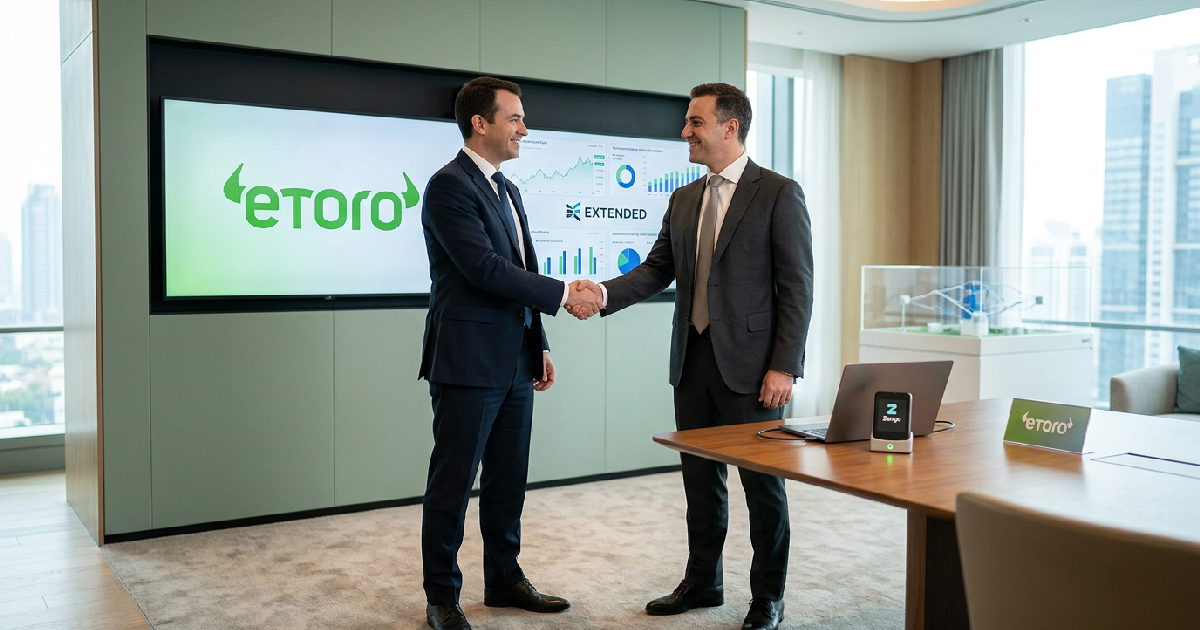
Social trading platform backs Extended onchain exchange
eToro, a prominent social trading and multi-asset brokerage, has made a strategic investment in Extended, an onchain perpetual futures exchange. This funding round also initiates a crucial partnership with Zengo, the self-custody crypto wallet eToro acquired earlier this year. While neither eToro nor Extended publicly disclosed the exact investment amount, CoinDesk reported the round totaled $12.5 million.
This move significantly bolsters eToro’s ambition to bridge traditional financial assets with decentralized trading environments. It aims to expand access to global financial markets through next-generation on-chain infrastructure. The strategic alliance highlights the increasing convergence between conventional brokerage services and the rapidly evolving decentralized finance (DeFi) sector.
eToro’s strategic push into onchain derivatives
This latest investment directly continues eToro’s broader strategy to integrate on-chain capabilities into its core offerings. The company previously acquired Zengo, a self-custodial wallet provider, in April. That deal was reportedly worth around $70 million, per Bloomberg and other outlets.
The Zengo acquisition was explicitly aimed at accelerating eToro’s efforts to connect traditional finance with robust on-chain infrastructure. Zengo co-founder and CEO Ouriel Ohayon stated that joining eToro would enable the wallet to expand access to self-custody and on-chain finance. This current partnership with Extended provides a concrete avenue to achieve those goals.
Connecting Zengo’s self-custody with Extended trading
The synergy between Zengo’s self-custodial capabilities and Extended’s derivatives engine is central to eToro’s vision. By pairing these entities, eToro plans to offer onchain perpetuals to its wallet users. This model empowers users to maintain control over their own assets while engaging in sophisticated decentralized trading.
It’s crucial for users prioritizing security and autonomy over their digital holdings. They can now participate in the burgeoning perpetual futures market without relinquishing custody to a centralized exchange. Such developments could significantly alter how retail investors interact with advanced crypto financial products.
Extended: A cross-asset DEX on Starknet
Extended is an innovative perpetuals decentralized exchange (DEX) built on Starknet, a prominent Layer 2 scaling solution for Ethereum. It was founded by former employees of fintech giant Revolut, including its former crypto head Ruslan Fakhrutdinov. Extended brings significant expertise to the DeFi space, committing to scalability and lower transaction costs.
According to its official documentation, Extended supports a wide array of over 100 markets. These span various asset classes, including crypto, equities, foreign exchange, and commodities. This cross-asset capability is precisely the kind of diverse venue eToro has expressed interest in connecting with a self-custody wallet.
The exchange’s broad market coverage positions it as a versatile platform in the decentralized derivatives landscape. Such offerings are becoming increasingly attractive as investors seek more ways to diversify portfolios. This also represents a critical step in democratizing access to complex financial instruments.
Retail brokers accelerate onchain product suites
eToro’s move into onchain derivatives with Extended isn’t an isolated incident; it reflects a broader industry trend. Many traditional and crypto-native platforms are aggressively pushing into on-chain trading. They’re expanding product suites beyond basic spot trading, highlighting DeFi’s growing importance.
Just this week, Robinhood, another major retail brokerage, launched the public mainnet of Robinhood Chain. This Arbitrum-based Layer 2 solution is designed for financial services and real-world assets. Such initiatives underscore a clear industry shift towards building proprietary on-chain infrastructure.
The race to integrate DeFi offerings is driven by several factors. Retail investors increasingly seek yield opportunities, advanced trading strategies, and greater control over assets. Platforms that fail to adapt risk losing market share to more innovative competitors.
This competitive pressure is a powerful catalyst for innovation, even as the broader crypto market navigates shifts in capital. For example, some analysts point to Bitcoin’s recent price drops as reflective of changing investment flows.
Implications for decentralized finance’s future
The strategic investment by eToro in Extended, coupled with the Zengo partnership, signifies a maturing phase for onchain finance. It marks a period where established financial entities aren’t just observing DeFi but actively participating in its development. This engagement helps legitimize the space and accelerate its adoption among a wider user base.
Perpetual futures, in particular, represent a significant segment of the derivatives market, offering continuous trading without expiration dates. Bringing these complex instruments into a self-custodial, on-chain environment makes them more accessible and transparent. This accessibility is key to breaking down barriers between traditional and decentralized systems.
The broader implications of these developments are substantial. As more brokers build out their on-chain capabilities, we can expect to see a blurring of lines between centralized and decentralized finance. This convergence could lead to hybrid models, offering the best of both worlds. It could combine the user experience and regulatory compliance of TradFi with the innovation and transparency of DeFi.
Such partnerships also contribute to the overall resilience and growth of Layer 2 solutions like Starknet. As more projects build and scale on these networks, the underlying infrastructure strengthens. This benefits the entire ecosystem, creating a virtuous cycle of adoption and development, paving the way for more sophisticated on-chain applications.
Key details
The evolving regulatory landscape, as seen with discussions around frameworks like the Clarity Act, will also shape how these platforms operate.
Looking ahead, the emphasis on self-custody within these new offerings is particularly noteworthy. It addresses a core tenet of the crypto ethos, empowering individuals with direct control over their digital wealth. As platforms combine security, decentralization, and ease of use, they will likely capture a significant market share.
And the momentum of specific protocols, such as the recent surges in Near Protocol or Ondo, further underscores the dynamic nature of this ecosystem.
The race among retail brokers to offer comprehensive on-chain product suites is far from over. However, eToro’s latest move firmly places it among the frontrunners. It demonstrates a clear commitment to integrating advanced DeFi capabilities into its platform. This strategy could set a precedent for how other mainstream financial firms approach the integration of decentralized technologies, ultimately shaping the future of global financial markets.