

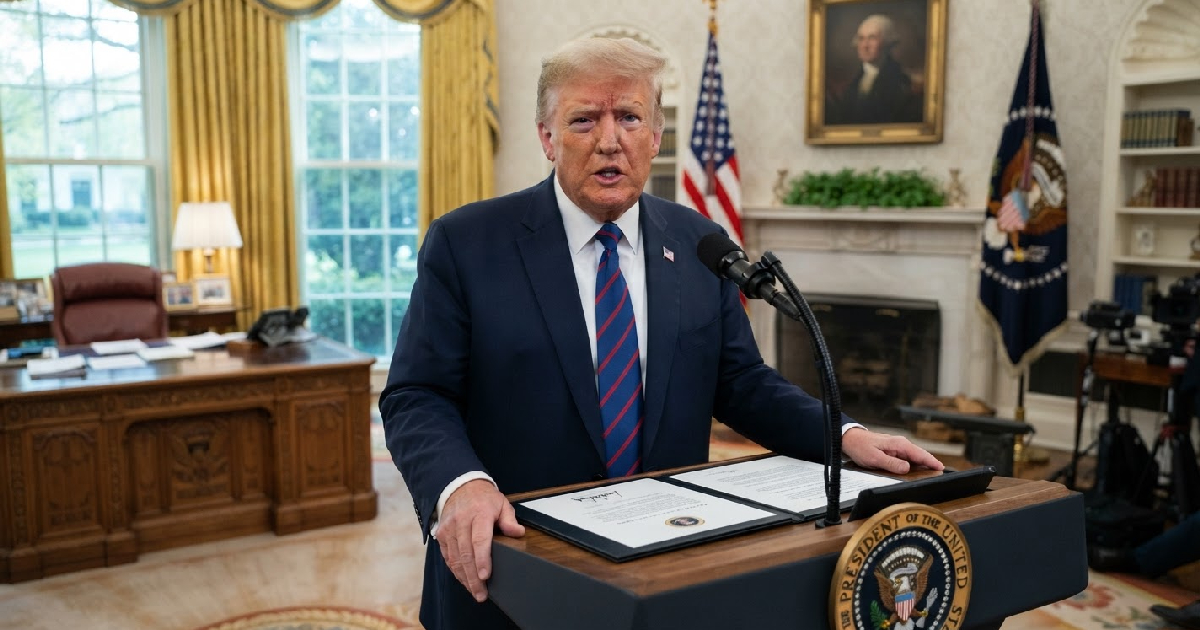
President Donald Trump agrees to crypto ethics rules
President Donald Trump has agreed to new ethics rules embedded within a revised version of the CLARITY Act, a pivotal development that significantly improves the bill’s prospects for passage in the Senate. This comprehensive legislation, unveiled by Senate Republicans on Wednesday, July 22, 2026, aims to establish a federal framework for digital assets in the United States.
The updated act notably prohibits presidents, vice presidents, members of Congress, federal judges, and other senior public officials, along with their spouses, from issuing or sponsoring digital assets for compensation while in office. Mr. Trump’s agreement to these crypto ethics rules, made earlier this week on Monday, July 20, arrives amidst increasing scrutiny of public officials’ involvement in the burgeoning cryptocurrency market.
New CLARITY Act ethics provisions take shape
At the heart of the revised CLARITY Act lies a critical section titled “Ban on certain digital asset transactions.” This provision directly addresses ethical concerns surrounding public officials’ engagement with the digital asset sector. It prevents covered individuals from creating, minting, launching, or controlling the initial sale or distribution of a digital asset for financial gain.
The prohibition extends broadly to sponsoring a digital asset, encompassing agreements to fund, organize, or publicly endorse a token. This includes using a person’s name, image, likeness, or official position in connection with a token’s creation or promotion. These restrictions apply throughout an official’s term and also cover their spouse, reflecting a wide scope of influence.
Defining digital asset issuance and sponsorship
The revised CLARITY Act meticulously defines what constitutes “issuing” or “sponsoring” a digital asset to prevent ambiguity. To “issue” involves the full lifecycle of a token’s initial creation and distribution. This ensures officials cannot directly profit from bringing a new digital asset to market by leveraging their public standing.
Similarly, “sponsor” is an expansive term designed to capture indirect forms of endorsement or financial backing. Officials cannot lend their public credibility or official status to a crypto project in exchange for payment, even if they aren’t directly creating the token. This acknowledges the significant weight public endorsement carries within the digital asset market.
Consequences and compliance paths for officials
Should a digital asset be found to have been issued or sponsored in violation of these strict new ethics provisions, the bill stipulates it cannot be listed for trading on a digital asset intermediary. This effectively renders such a token illiquid and commercially unviable within regulated markets, acting as a powerful disincentive against non-compliance.
The legislation does, however, provide safe harbor provisions. Covered individuals can avoid violation by placing a direct interest in a digital asset into a qualified blind trust, divesting it, or both. These procedures are similar to existing ethics-agreement rules under section 208 of title 18, offering a clear path for compliance without a complete ban on cryptocurrency ownership.
Public officials must either sell their cryptocurrency holdings and equity stakes in crypto companies or place them in blind trusts they do not control. Sales of cryptocurrency assets exceeding $1,000 also require disclosure. Additionally, a carve-out protects the continued use of a covered individual’s name, image, or likeness if it was used by an issuer or intermediary before the person assumed their covered status.
Expanded oversight for digital commodity markets
The ethics language, while crucial, represents only one part of the broader CLARITY Act overhaul. The revised proposal introduces an entirely new regulatory framework for digital commodity intermediaries. This includes exchanges, brokers, dealers, and custodians, which will fall under the expanded oversight of the Commodity Futures Trading Commission (CFTC).
The bill solidifies federal jurisdiction over registered participants in these digital commodity markets. Yet, it thoughtfully preserves state enforcement authority over fraud and generally applicable state laws. This dual approach aims for comprehensive oversight while respecting existing legal frameworks, clarifying federal rules for digital assets.
Clarifying regulatory boundaries for innovation
One notable aspect for innovators is the bill’s explicit statement that non-custodial software developers and blockchain infrastructure providers will not be classified as money transmitters solely for maintaining decentralized networks. This provides a crucial distinction, protecting developers and fostering innovation within the decentralized space.
The legislation also safeguards individuals’ rights to self-custody crypto assets, a fundamental principle for many in the blockchain community. This balance between regulation and innovation underscores a maturing approach to digital asset governance in the United States.
Protecting investors and stablecoin stability
A significant focus of the broader CLARITY Act is investor protection. Senator Cynthia Lummis (R), a key negotiator of the ethics package, has highlighted the act’s design to prevent investor losses. She cited failures like Voyager as motivation, emphasizing the need for robust safeguards in the sector.
This includes requiring crypto firms to keep customer assets separate from company funds, a critical measure to protect individuals in the event of an exchange or custodian’s bankruptcy. Such protections ensure that customer crypto remains their property, rather than becoming part of a failed company’s estate. This builds confidence in the wider crypto market.
New rules for stablecoins and enforcement
The bill also introduces new provisions specifically related to stablecoins. It allows courts to order the seizure, freezing, burning, and reissuance of payment stablecoins in certain circumstances. This provides authorities with tools to manage stability and prevent illicit use.
Crucially, the stablecoin yield provision prohibits interest payments on idle payment-stablecoin balances. However, rewards tied to actual activities like transactions or staking would still be permitted. The bill also provides more funding, blockchain analytics tools, and training for state and local law enforcement, creating a cyber center focused on threats from countries like North Korea and Iran.
Political negotiations pave way for Senate passage
The agreement reached between President Donald Trump and Senate Republicans marks a critical turning point for the CLARITY Act. Senators Cynthia Lummis and Bernie Moreno were instrumental in negotiating the ethics package with the White House. This concession signals a strong desire among key political figures to advance comprehensive crypto legislation.
Treasury Secretary Scott Bessent encapsulated the mood on Capitol Hill, indicating the Senate is “at the 1-yard line” regarding the bill’s passage before the August recess. Summer Mersinger, CEO of the Blockchain Association and former CFTC commissioner, described ethics as “the big elephant in the room” that had previously stalled progress. Such political consensus is vital for impactful political influence.
Diverse lawmaker reactions to crypto ethics
The path to this agreement was not without its political nuances. While President Trump’s endorsement garnered Republican support, some Democratic lawmakers expressed reservations. Senator Elizabeth Warren (D) had previously called on President Trump to voluntarily disclose his crypto earnings for 2026, arguing that Congress required accurate information to consider safeguards effectively.
Senator Angela Alsobrooks (D) warned she would oppose the proposal if the U.S. Department of Justice (DOJ) remained the sole enforcement agency. She advocates for state attorneys general to also have authority, reflecting a broader debate on federal versus state power in regulating the digital asset space.
Ruben Gallego (D) and Senator Alsobrooks were the only two Democrats who supported the bill when it cleared committee with a 15-9 vote in May.
Earlier, in May, Senator Chris Van Hollen (D) had offered an amendment to ban officials and their families from owning or promoting crypto. Republicans ultimately blocked this, showing the legislative give-and-take that shaped the final version of the act.
Temporary restrictions and future outlook for crypto regulation
The ethics provisions within the CLARITY Act are not permanent. They are currently scheduled to sunset at noon on January 20, 2029, coinciding with the end of the current presidential term. Congress, however, retains the power to extend these restrictions should it deem necessary in the future, providing flexibility in response to evolving market dynamics and ethical considerations.
With President Donald Trump’s agreement on the ethics provisions, the CLARITY Act now stands on the precipice of becoming landmark legislation for the U.S. digital asset industry. The increased likelihood of Senate passage before the August recess suggests a bipartisan consensus on the urgent need for a regulatory framework.
This is a crucial step towards providing much-needed certainty for businesses, investors, and consumers in a market often characterized by regulatory ambiguity.