

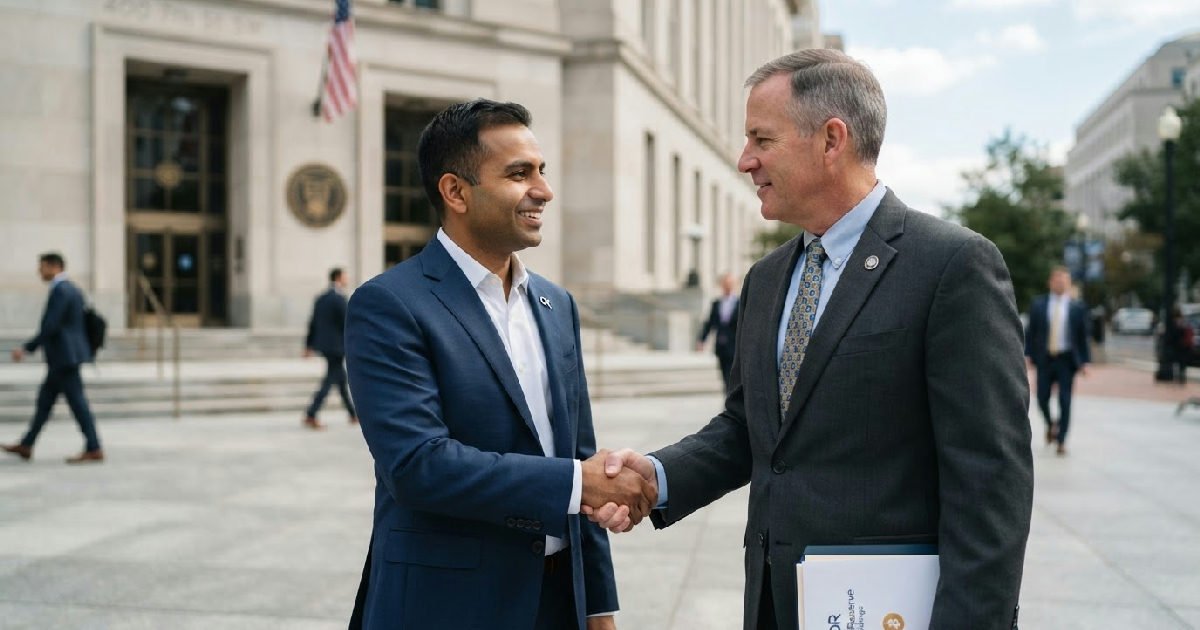
OpenReserve Holdings receives conditional approval for national
OpenReserve Holdings receives preliminary conditional approval from the OCC on September 2, 2026, to establish a full-service national bank. , a fintech startup backed by venture capital giant Andreessen Horowitz (a16z), has received preliminary conditional approval to establish a full-service national bank.
The Office of the Comptroller of the Currency (OCC) granted the approval on September 2, 2026, marking a pivotal moment in the convergence of cryptocurrency and the traditional U.S. financial system. This conditional approval for OpenReserve Holdings receives is a significant step forward for the company.
banking system. The company announced this significant development on September 3, 2026.
Why OpenReserve Holdings receives a national bank charter
The de novo bank, to be named OpenReserve Bank, N.A., will be headquartered in Salt Lake City, Utah, with no branches. This approval follows a review process of just under five months, with OpenReserve having submitted its application on April 13.
Founded in 2025 by Dee Choubey and Richard Correia, who previously worked at MoneyLion, OpenReserve aims to build a blockchain-native institution that offers continuous, 24/7 settlement.
OpenReserve has intentionally pursued a full national bank charter, a more arduous and comprehensive regulatory path than the route taken by many of its crypto-native peers. While firms like Coinbase, Circle, Ripple, Paxos, and BitGo opted for national trust charters allowing custody and fiduciary services, these charters block deposit-taking and lending.
A full national bank charter permits OpenReserve to engage in both activities once final approval is secured.
Co-founder and CEO Dee Choubey stated, “We chose the national bank path deliberately,” emphasizing the foundational importance of supervision, safety and soundness, compliance, and customer confidence to the company’s strategy. This approach means OpenReserve will operate under the same stringent standards as other national banks. The stringent regulatory environment underscores the broader need for robust regulatory efforts within the digital asset space.
This ambitious strategy is backed by a formidable group of investors. OpenReserve completed a $25 million seed round led by a16z crypto, with participation from Coinbase Ventures, Jump Capital, Wintermute Ventures, Clocktower, Quona, Acrew, AAF Management, and Zero Knowledge Ventures. The strong financial backing underscores the belief that a fully regulated, blockchain-native bank can fill a critical gap in the financial market.
Stringent conditions for final approval
The preliminary conditional approval is merely the initial significant hurdle for OpenReserve. Before OpenReserve Bank, N.A. can commence operations, the OCC has stipulated a series of demanding requirements. It must first satisfy the OCC’s preopening requirements and secure final approval.
A critical condition mandates that OpenReserve raise at least $210 million in initial paid-in capital, after deducting organizational and preopening expenses. The bank is also required to maintain a Tier 1 leverage ratio of at least 12% during its first three years of operation.
Failure to meet these financial benchmarks or other conditions within specific timelines — 12 months for capital raise and 18 months to open — will result in the preliminary approval’s expiration.
Beyond capital, OpenReserve must obtain deposit insurance from the Federal Deposit Insurance Corporation (FDIC) and apply for Federal Reserve Bank stock. An independent security review and testing of its electronic banking platform are also mandatory steps. These rigorous requirements signal the OCC’s cautious yet forward-thinking approach to integrating novel financial technologies into the federally supervised banking system.
Building an ‘always-on’ bank and stablecoin infrastructure
OpenReserve’s core business proposition revolves around establishing an “always-on” financial institution that moves beyond the limitations of traditional batch-processing systems like ACH and wire transfers. By leveraging blockchain for settlement, the bank intends to facilitate the instantaneous movement of money for institutional clients, reflecting wider blockchain innovation in the financial sector.
Its business plan focuses on tokenized deposits, treasury management, foreign correspondent banking, and a banking-as-a-service platform for institutional customers.
The bank is designed for continuous settlement, which tokenized deposits and stablecoins make possible, enabling instant money movement and combining continuous money with regulated credit. A significant aspect of this strategy involves a separate, wholly owned subsidiary dedicated to issuing and redeeming U.S. dollar-denominated, reserve-backed stablecoins, including its planned stablecoin, ReserveUSD (rUSD).
This subsidiary, however, still requires a separate application and additional regulatory review from the OCC.
Any stablecoin activities will need to comply with the GENIUS Act, the U.S. federal law governing stablecoin operations that went into effect last year. CEO Dee Choubey describes the strategy as a “dollarization play,” aiming to position OpenReserve as a crucial dollar infrastructure provider for businesses needing seamless access to USD, fiat, stablecoin, and Treasury capabilities.
The path ahead for OpenReserve
The approval of OpenReserve Bank, N.A., assigned charter number 27203, is part of a broader trend where the OCC has received 40 de novo charter applications since 2025, approving 21 of them. This indicates a measured, but steady, integration of innovative financial entities into the regulated banking framework.
The team behind OpenReserve combines extensive traditional finance experience with deep crypto expertise to navigate this complex environment.
Co-founders Dee Choubey and Richard Correia, both former MoneyLion executives, lead a team that includes Chief Technology Officer David Schwed, who previously served as Chief Information Security Officer at Robinhood and Global Head of Digital Assets Technology at BNY. Other key team members mentioned include John Chrystal, Jame Sloan, and Soumya Basu.
With a strong team, clear vision, and a challenging but defined regulatory path, OpenReserve is positioned to become a significant, regulated player in the evolving digital asset economy. For now, all eyes remain on OpenReserve as it works diligently to raise its $210 million in capital and build out the necessary infrastructure.
The company has until September 2027 to secure this capital and until March 2028 to officially launch, making its journey a crucial test case for the future of regulated digital banking in the United States.