

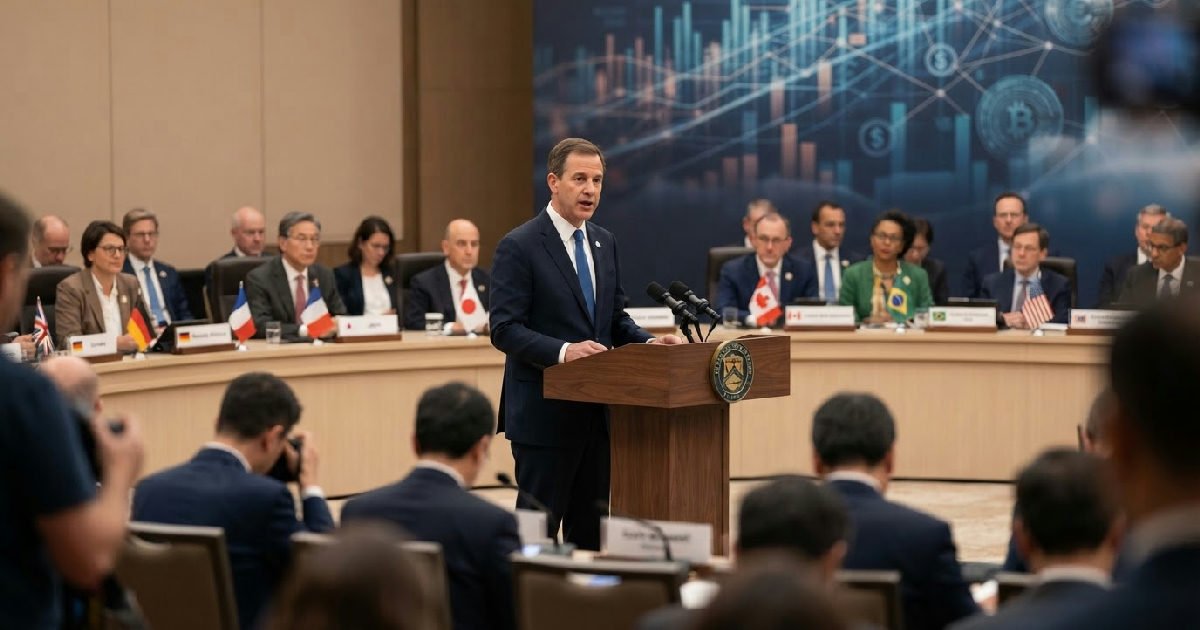
G20 Commits to Clearer Digital Asset Rules Amid Innovation Drive
G20 finance ministers and central bank governors, meeting in Asheville, North Carolina, on August 31 and September 1, 2026, formally pledged to develop clearer regulatory frameworks for digital assets. The commitment aims to foster financial innovation while steadfastly preserving global financial stability and managing inherent cross-border risks. U.S. Treasury Secretary Scott Bessent released the G20 Chair’s statement following the two-day gathering.
This initiative recognizes digital assets as a potent force for economic growth and private-sector development. Officials from member countries have agreed to work towards creating regulatory and supervisory frameworks. These frameworks are designed to offer defined pathways for digital financial innovation, all while maintaining crucial trust in global monetary and payment systems.
Clearer digital asset rules for innovation
The G20’s recent declaration underscores a collective resolve to integrate digital assets responsibly into the global financial architecture. Ministers and governors stated, “We commit to advancing responsible and effective regulatory and supervisory frameworks that preserve financial stability, support economic growth, and establish clear pathways for sound digital financial and digital assets innovation.” This statement reflects a cautious yet optimistic stance towards a rapidly evolving sector.
The commitment places digital asset regulation firmly within the G20’s broader agenda of modernizing financial oversight. This includes critical areas such as financial stability, the adoption of new technologies, and the overhaul of payment infrastructure. For its 2026 presidency, the U.S., under President Donald Trump, prioritized unleashing economic prosperity by limiting regulatory burdens and pioneering innovations in emerging technologies, including digital assets.
Stablecoins Under Scrutiny
Stablecoins received particular attention in the G20 statement, reflecting ongoing concerns about their potential impact on global financial systems. G20 officials are currently awaiting further analysis from the Financial Stability Board (FSB). The FSB is expected to publish findings covering the cross-border implications of global stablecoin arrangements. They will also examine data sources, availability, and potential issues with current regulatory information.
The movement of stablecoins through payment networks, often bypassing conventional international bank transfer infrastructure, has heightened regulatory interest in cross-border use. For example, the People’s Bank of China has been monitoring stablecoin payments. Chinese officials are considering their effect on international networks and the monetary system, even as Beijing maintains restrictions on broader cryptocurrency activity.
They believe stablecoins could assume a larger role in cross-border transactions, necessitating stronger international coordination.
While the G20 statement didn’t propose a universal stablecoin licensing system or a deadline for identical national rules, it emphasizes advancing national regulatory frameworks while considering opportunities and risks across borders. This reflects the diverse approaches being taken globally, even as projects like Hyperliquid joining an index demonstrate growing market recognition for digital assets.
Enhancing Cross-Border Payments Infrastructure
Beyond digital asset regulation, payment infrastructure remains a central focus of the G20’s work. Finance ministers and central bank governors reaffirmed their dedication to the G20 Roadmap for Enhancing Cross-border Payments. They also called for countries to extend the operating hours of large-value payment systems, a move aimed at improving global transaction efficiency.
Officials are pushing jurisdictions to encourage the adoption of the harmonized ISO 20022 messaging standard. This initiative seeks to streamline financial services data transmission across borders, while still respecting domestic laws and data security requirements. Stablecoin use has become increasingly intertwined with these payment issues, highlighting their potential to transform international transactions.
The UK Financial Conduct Authority (FCA) identified cross-border payments as the most compelling practical use case for stablecoins during its Stablecoin Sprint. This finding, based on feedback from banks, payment firms, and crypto companies, suggests stablecoins could be particularly beneficial in markets with limited access to U.S. dollars.
However, the FCA noted less incentive for UK consumers to switch from existing domestic payment methods, though businesses might find stablecoin infrastructure valuable for settlement.
Individual G20 members are adopting varied approaches to integrating crypto into international payment systems. Brazil’s central bank, for instance, moved in May to prohibit virtual assets from settlement within regulated eFX cross-border payment rails. Yet, it permits cryptocurrency transfers outside those supervised channels, showcasing a nuanced regulatory stance.
The G20’s latest position acknowledges these differences, encouraging jurisdictions to weigh cross-border opportunities and challenges within their own regulatory systems.
Diverse National Regulatory Approaches Emerge
While international bodies strive for common standards, several major G20 economies have already advanced with domestic digital asset legislation. This proactive approach by individual nations highlights the urgency felt by some governments to establish clear rules for their respective markets, even as global consensus builds.
In the United States, U.S. Treasury Secretary Scott Bessent had previously identified support for a digital asset ecosystem and improvements to cross-border payments among the priorities for the U.S. G20 presidency. While specific federal frameworks are under discussion, the U.S. continues to explore how best to regulate digital assets.
Across the European Union, the Markets in Crypto-Assets (MiCA) regulation has created a unified licensing and supervision system. This comprehensive framework covers crypto service providers and stablecoin issuers. MiCA regulation came into force in December 2024, aiming to standardize the market. Separately, the growth of products like the Bitwise XRP ETF shows continued expansion in the broader digital asset investment landscape.
Japan continues to refine its digital asset rules, demonstrating a positive outlook on cryptocurrency. The country’s Financial Services Agency has established a dedicated crypto division. This new unit is responsible for cryptocurrency and stablecoin supervision, digital payment planning, and related policy work, indicating a robust governmental commitment to the sector. Japan boasts 3.7 million active crypto asset accounts as of 2022, underscoring significant domestic interest.
Japan regulates stablecoins separately under its payment services framework. While the research highlights Japan’s positive view on cryptocurrency, specific details regarding financial institutions preparing for stablecoin transactions for fiscal 2026 were not provided in the ground truth. The Financial Services Agency (FSA) has supported pilots testing corporate cross-border payments.
South Korea also implemented its Virtual Asset User Protection Act (VAUPA) in July 2024. This legislation requires local cryptocurrency exchanges to keep 80% of user deposits in secure, cold wallets, alongside maintaining reserve funds or insurance. The Financial Services Commission (FSC) actively monitors for illegal trading.
It plans to gradually introduce institutional trading and lay the groundwork for cryptocurrency spot ETFs. Meanwhile, India introduced anti-money laundering regulations and Know Your Customer (KYC) norms under the Prevention of Money Laundering Act (PMLA) in 2023, with the Securities and Exchange Board of India (SEBI) proposing a multi-regulatory framework for cryptocurrencies in 2024.
Combating Illicit Finance in the Digital Realm
Financial crime remains a significant concern for the G20, forming another key part of its digital asset agenda. Officials reiterated their strong support for the Financial Action Task Force (FATF) and urged countries with substantial virtual asset activity to prioritize the effective implementation of FATF standards. This emphasis highlights the international community’s commitment to preventing misuse of digital assets.
The G20 specifically endorsed risk-based supervision covering anti-money laundering (AML), terrorism financing, and proliferation financing. They also drew attention to the growing threat of fraud involving scam compounds and the sophisticated use of artificial intelligence by criminals.
FATF, along with its regional bodies, is charged with overseeing the application of these standards across various jurisdictions, though achieving G20 communiqué consensus on these complex issues can sometimes prove challenging.
The Path Ahead for Global Crypto Governance
The Asheville meeting is a crucial step in the 2026 Finance Track, part of a broader sequence of international engagements. Finance ministers and central bank governors are set to reconvene in Bangkok in October. This will precede the culmination of the U.S.
presidency with the G20 Leaders’ Summit, scheduled for December 14 and 15 in Miami, Florida. These upcoming gatherings will likely build on the commitments made regarding digital assets and cross-border payments.
The current efforts are also informed by a joint roadmap issued in September 2023 by the International Monetary Fund (IMF) and the Financial Stability Board (FSB). This roadmap aims to establish a global framework for cryptoasset regulation, based on the principle of ‘same activity, same risk, same regulation.’
It set a 2025 target for reviewing the implementation of new regulatory and supervisory standards for cryptoassets and global stablecoins. This overarching plan provides a long-term vision for global coordination.
Despite the significant focus on improving cross-border payments, a consolidated progress report in October 2025 indicated that tangible improvements for end-users at the global level had not yet fully materialized. The report suggested it was unlikely that satisfactory improvements would be achieved by the original 2027 timetable.
This indicates that while ambitious goals are set, the practical implementation and real-world impact require sustained effort and adaptive strategies from G20 nations and international bodies.