

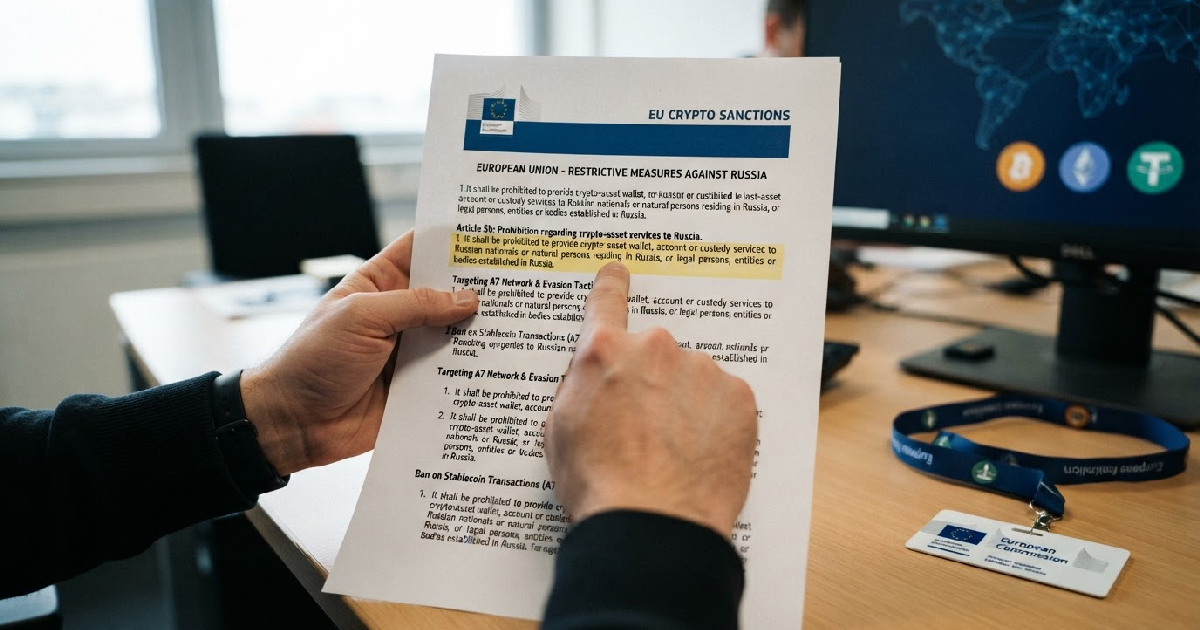
EU escalates crypto bans on 14 firms amid 21st Russia sanctions round
Brussels delivered its 21st package of sanctions against Russia on Thursday, July 23, 2026, marking a significant escalation in efforts to curb the country’s ability to fund its ongoing war in Ukraine. The comprehensive measures, adopted by the European Union (EU), target Russia’s financial and energy sectors, but notably include a sharp focus on cryptocurrency networks suspected of facilitating sanctions evasion.
The package introduces 218 new designations, comprising 170 entities and 48 individuals, bringing the total number of blacklistings to nearly 3,000. Crucially, the EU has established a new authority that allows for a full “third-country ban for crypto asset-services,” a powerful tool aimed at deterring nations and platforms that help Russia circumvent international restrictions.
EU tightens grip on crypto networks for sanctions evasion
The latest punitive measures directly confront Russia’s use of digital assets, a method that has grown more prevalent as traditional financial channels become restricted. Four cryptocurrency platforms linked to the A7 network have been sanctioned, a system reportedly designed for Russian sanctions evasion.
This A7 network, which utilizes the A7A5 stablecoin, has already processed an astounding $120 billion to date. Such a substantial volume highlights the scale of crypto’s role in illicit financial flows, pushing the EU to address this workaround directly.
Beyond the A7 network, the EU also imposed a transaction ban on 14 unnamed cryptocurrency platforms operating out of countries like the United Arab Emirates (UAE), Georgia, Panama, the Marshall Islands, Kyrgyzstan, and Belarus. This move signals a broadened scope, targeting entities in jurisdictions that may have previously offered a haven for such activities.
new authority for third-country crypto bans
A major development in this sanctions round is the introduction of a new legal basis to ban transactions with crypto operators in third countries that assist Russia. This unprecedented authority represents a significant expansion of the EU’s regulatory reach.
It means the EU can now effectively prohibit any transaction between an EU-based operator and a crypto provider deemed to be aiding Russia in evading sanctions. This provision could have far-reaching implications for global crypto service providers, forcing them to meticulously vet their clientele and geographical reach.
The decision underscores the EU’s growing concern that cryptocurrencies are being exploited to undermine the effectiveness of traditional financial sanctions. It also puts pressure on countries like the UAE and others to tighten their own regulatory frameworks around digital assets.
targeting the A7 network and its stablecoin
The specific targeting of the A7 network and its associated A7A5 stablecoin reveals the detailed intelligence gathering behind these sanctions. The network’s reported design for sanctions evasion and its massive transactional volume have made it a prime target.
This crackdown on a specific crypto network, rather than just individual wallets or minor exchanges, shows a more sophisticated approach from EU policymakers. They’re aiming to disrupt the systemic infrastructure that enables large-scale circumvention.
For crypto firms globally, this action serves as a stark warning. Engaging with entities known or suspected to be involved in sanctions evasion, even indirectly through complex networks, now carries significant penalties.
broader financial and energy sector impacts
While crypto measures grabbed headlines, the sanctions package also hit Russia’s traditional financial infrastructure hard. The EU froze assets and prohibited funds for 94 Russian banks and major financial institutions.
An additional 33 Russian credit and financial institutions face an extended transaction ban. These broad financial restrictions aim to further isolate Russia from the global economy. The Moscow Stock Exchange also landed on the sanctions list, deepening financial isolation.
The energy sector, a critical pillar of the Russian economy, also saw its share of restrictions. The Russian oil price cap was frozen at its current level of $44.10 per barrel until July 2027, preventing an automatic increase to around $58.50.
Brussels further blacklisted 41 additional vessels of Russia’s “shadow fleet,” bringing the total to over 670 ships. These vessels face port access bans and prohibitions on receiving services, complicating Russia’s ability to export oil and other goods. Furthermore, new rules empower EU countries to confiscate and sell cargoes from detained shadow-fleet vessels.
scrutiny for third-country crypto firms
The new measures mean greater scrutiny for any crypto firm operating in listed third countries, or indeed anywhere, that conducts business with Russian entities. The EU’s intent is clear: to close all avenues for sanctions evasion.
This puts the onus on crypto providers to implement robust compliance and “know your customer” (KYC) protocols. Failure to do so could result in being cut off from the EU market and potentially facing legal repercussions.
It’s a move that will likely prompt many crypto platforms to re-evaluate their global client base and operational jurisdictions. The pressure is on for them to demonstrate they are not inadvertently facilitating sanctioned activities.
For individuals and institutions dealing with digital assets, this means heightened awareness and due diligence when transacting with entities linked to the targeted countries. It reflects a growing trend of increased regulatory oversight in crypto globally, extending beyond just financial crime to geopolitical concerns.
implications for russia’s nascent crypto regulations
These EU sanctions come just days after Russia’s State Duma passed its first comprehensive framework for crypto regulation, set to take effect on September 1. That legislation was intended to provide a legal structure for exchanges, depositories, and other digital asset providers.
The timing creates an interesting juxtaposition: Russia seeks to legitimize its domestic crypto market while the EU simultaneously moves to restrict its use for international transactions. It suggests a cat-and-mouse game where regulatory efforts on one side are met with counter-measures on the other.
President Volodymyr Zelenskyy of Ukraine thanked EU member states for their resolve, with Acting Foreign Minister Andrii Sybiha welcoming the measures. European Commission President Ursula von der Leyen and High Representative for Foreign Affairs and Security Policy Kaja Kallas also reaffirmed the EU’s commitment to weakening Russia’s war effort.
the ongoing battle against sanctions circumvention
The EU’s 21st sanctions package isn’t just about Russia; it sets a precedent for how global powers might address sanctions circumvention using emerging technologies. By targeting the A7 network and introducing the third-country ban authority, Brussels is sending a clear message.
This message is that the traditional rules of international finance will increasingly extend into the digital asset realm. Countries and companies hoping to leverage crypto’s borderless nature to bypass restrictions will find themselves under intense scrutiny.
The EU’s actions also highlight the growing sophistication of monitoring tools available to governments and compliance agencies. The ability to track and identify networks like A7, processing billions in stablecoins, indicates advanced analytical capabilities.
As the conflict in Ukraine continues, expect to see further refinement of these types of targeted sanctions. The intersection of geopolitics, finance, and decentralized technology is proving to be a complex and evolving battleground for regulatory bodies worldwide.
forward outlook for crypto policy
The EU’s latest move will inevitably shape future crypto policy discussions across the globe. Lawmakers will now have a tangible example of how digital assets can be weaponized for sanctions evasion, prompting further regulatory action.
For legitimate crypto businesses, this means an even stronger emphasis on compliance and transparency. The industry will need to demonstrate its commitment to preventing illicit activities to avoid broader, more restrictive regulations.
The focus on third-country providers also suggests that international cooperation on crypto regulation will intensify. Nations previously seen as less strict on digital asset oversight might now face pressure to align with global anti-money laundering and sanctions enforcement efforts.
Ultimately, the EU’s 21st sanctions package reinforces the idea that no financial system, traditional or digital, can operate entirely outside the reach of international law and political will. Its impact on Russia’s war efforts, and on the broader crypto ecosystem, will be closely watched in the months to come.