

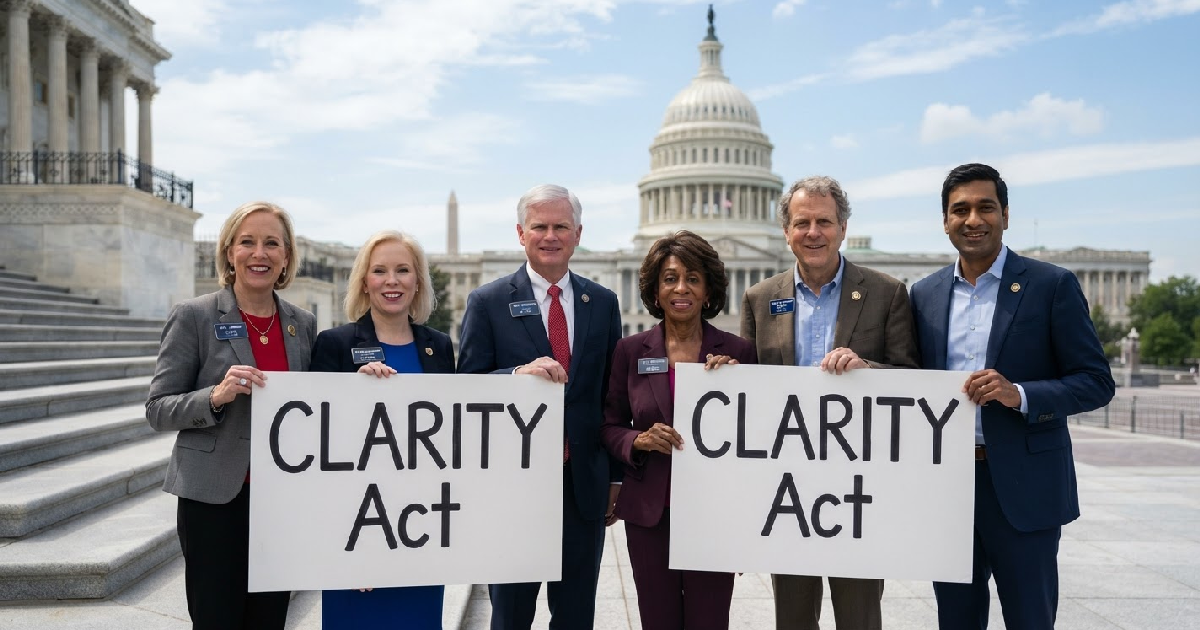
CLARITY Act nears passage as US lawmakers compromise on crypto ethics
The CLARITY Act nears a significant legislative step for crypto market regulation as Democrats and Republicans in Congress signal readiness to advance the bill. C. is on the verge of a significant legislative step for crypto market regulation as Democrats and Republicans in Congress signal readiness to advance the CLARITY Act. This crucial bill aims to establish clearer regulatory boundaries for digital assets, primarily between the U.S. Securities and Exchange Commission (SEC) and the Commodity Futures Trading Commission (CFTC).
A key hurdle for the legislation has been cleared, with the White House and Republican senators reportedly reaching an agreement. This compromise addresses ethical provisions that restrict federal officials, including the president and members of Congress, from personally profiting through digital assets, paving the way for the bill’s potential passage.
US lawmakers push forward with CLARITY Act
The CLARITY Act represents a bipartisan effort to provide much-needed legal certainty for America’s cryptocurrency industry. Its primary objective is to delineate the responsibilities of the SEC and CFTC, a move intended to end years of regulatory ambiguity that have constrained innovation and investment.
This legislative push arrives as the total crypto market capitalization sits around $4.13 trillion, having recorded a 2.8% daily bump and 11.1% weekly gains. However, other reports put the total market cap closer to $3.89 trillion, reflecting a 0.66% rise driven by institutional ETF inflows and derivatives activity.
Easing concerns on officials’ digital asset profits
Ethical provisions within the CLARITY Act had been a significant sticking point, with concerns about potential conflicts of interest for public officials. Resolving this dispute marks a major stride, indicating a growing bipartisan willingness to create a more defined regulatory environment for digital assets.
While the revised text hasn’t yet been officially released, the reported agreement suggests a clearer path forward. Still, uncertainty lingers regarding full Democratic support and the tight timeline before the Senate recess in August. Adding to the regulatory momentum, the U.S. Office of the Comptroller of the Currency (OCC) has been encouraging bank-stablecoin partnerships, which boosts confidence in the stablecoin sector.
Global regulatory efforts advance, Russia’s bill in focus
Beyond American shores, other major economies are also working to integrate cryptocurrencies into their legal frameworks. These international developments contribute to a complex, interconnected global regulatory environment for digital assets.
The varied approaches across jurisdictions highlight the ongoing challenge of achieving harmonized global standards. But the push for clarity remains a common thread among nations.
Russia’s crypto bill progresses towards final readings
Russia’s State Duma is set to hold second and third readings of its crypto bill on Tuesday, July 22, 2026. This draft legislation, titled “On Digital Currency and Digital Rights,” aims to formally permit companies to use cryptocurrencies for cross-border settlements.
The revised bill has already cleared a key committee stage, removing requirements for wallet address declarations and allowing crypto use in international trade. But it will continue to ban domestic payments in cryptocurrency, maintaining the Russian ruble as the sole lawful currency for internal transactions.
Anatoly Aksakov, Chairman of the State Duma Committee on Financial Markets, confirmed this schedule to RBC. If passed, the main provisions of the Russian legislation are anticipated to take effect by September 1, 2026, marking a significant step for crypto integration in the country’s international commerce.
Polymarket flags suspicious trading activity
In another notable development on the regulatory and compliance front, prediction market platform Polymarket has referred nearly 100 suspicious crypto wallets to law enforcement. The company is actively expanding its monitoring efforts to combat potential insider trading activities on its platform.
A recent Bloomberg analysis of Polysights data found that approximately $200 million in Polymarket trades during the first half of 2026 showed characteristics associated with “potential insider activity.” Much of this flagged activity reportedly involved geopolitical markets tied to Iran and Venezuela.
Neal Kumar, Polymarket Chief Legal Officer, stated that the company’s internal processes led to these numerous wallet referrals to authorities. This highlights the growing scrutiny on decentralized platforms to ensure market integrity and prevent illicit activities.
Crypto market shows resilience amid varied sentiment
Despite ongoing regulatory discussions and broader geopolitical unease, the cryptocurrency market displays signs of resilience and sustained institutional interest. Major assets like Bitcoin and Ethereum recorded minor gains.
Bitcoin (BTC) traded at $65,258.2, marking an increase of 0.83%. However, it dipped momentarily below $63,000 from a weekly high of $65,600. It’s maintaining a mildly bullish short-term structure, with support around $64,000 and a rebound above $65,000.
Ethereum (ETH) also saw a 1.73% increase, trading at $1,904.55, even as it trended towards its short-term $1,800 support level. The Bitcoin dominance index saw a slight drop from 59.9% to 58.7% in a single day.
Ethereum ETF weekly inflows of $2.85 billion underscore strong institutional demand, aligning with bullish forecasts. Analysts at Standard Chartered, for instance, raised their Ethereum year-end target to an ambitious $7,500, nearly double their prior prediction. They also project Ethereum to reach $25,000 by 2028.
The bank further forecasts the stablecoin market could swell to $2 trillion by 2028, reflecting growing confidence in these digital assets. Meanwhile, Canary Capital has registered a Trump Coin ETF, targeting the $1.9 billion memecoin market, indicating a continued diversification of crypto investment products.
Institutional demand drives Ethereum optimism
The substantial weekly inflows into Ethereum ETFs demonstrate a clear institutional appetite for the asset. This influx of capital supports the bullish long-term price targets set by major financial institutions like Standard Chartered.
Such projections highlight a widening acceptance of Ethereum as a legitimate asset class. They also hint at a future where stablecoins play an even more central role in the broader digital economy, facilitating transactions and bridging traditional finance with crypto.
Outlook: Regulatory clarity and market evolution
The overall market sentiment, as reflected by the Fear & Greed Index, jumped three points to 63, though some reports placed it lower at 25. This mixed signal captures the ongoing tension between positive crypto-specific developments and external macroeconomic factors.
Geopolitical tensions, particularly escalating conflicts in the Middle East and reports of US-Iran strikes, continue to weigh on investor risk appetite. Bitcoin, Ethereum, and XRP notably gave back some gains amidst these concerns.
Traditional U.S. stock markets also saw declines for the third consecutive session, hitting their lowest levels in nearly three weeks. However, AI-related stocks, particularly semiconductor firms like SanDisk, Micron, and Broadcom, along with Microsoft and AMD, rebounded, buoyed by deeper AI cooperation.
As the crypto market matures, its interdependence with global political and economic events becomes increasingly evident. The progress of legislation like the CLARITY Act and the evolving regulatory landscape in countries like Russia will be crucial in shaping its trajectory in the coming months and years.