

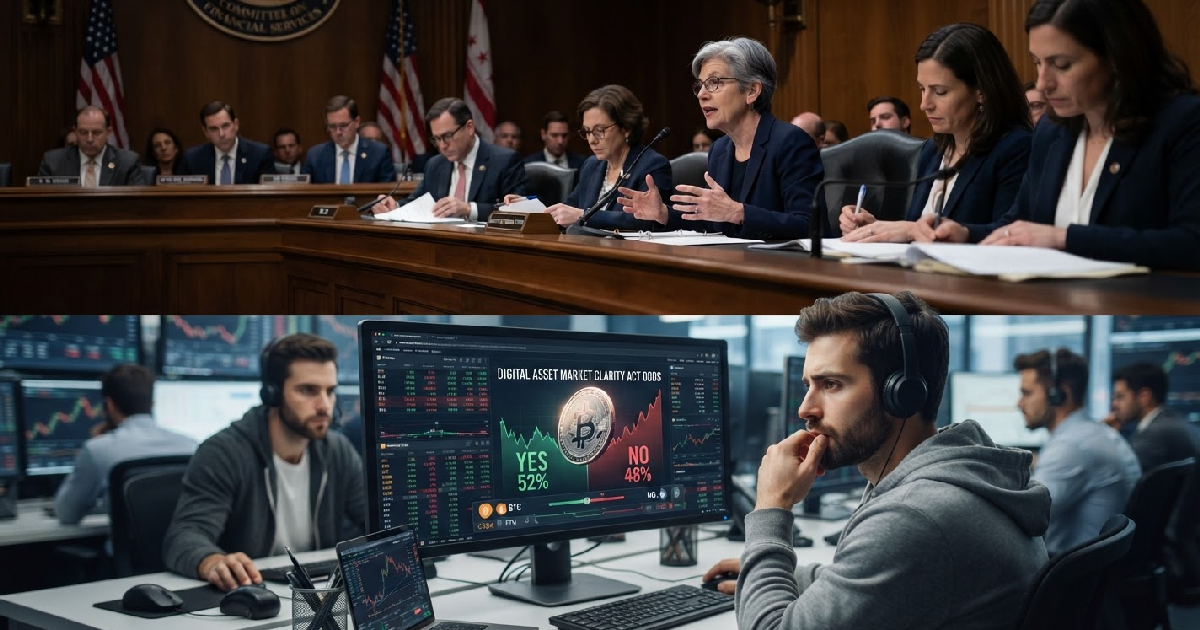
Traders Skeptical: Crypto’s Landmark US Market Structure Bill Now a ‘Coin-Flip’
The landmark US crypto market structure bill, officially known as the Digital Asset Market Clarity Act, now faces a precarious “coin-flip chance” of becoming law this year. As of July 22, 2026, prediction market traders on Polymarket assess the odds at just 47%. This marks a stark reversal from the 82% high seen back in February.
The significant 18-percentage-point drop signals growing skepticism within the financial community about the bill’s ability to navigate the complex legislative landscape in Washington. For an industry desperate for clear regulatory guidelines, the dwindling prospects of the CLARITY Act introduce fresh uncertainty into the market.
Odds Shift Dramatically for Crypto Market Bill
The plummeting odds on Polymarket offer a sobering indicator of investor and trader sentiment regarding the Digital Asset Market Clarity Act. This isn’t just abstract speculation; participants on prediction markets like Polymarket put real money behind their forecasts.
The 47% figure is a tangible reflection of collective belief, highlighting how fundamental reassessments of the bill’s legislative viability are taking place. Many initially hoped the CLARITY Act would sail through Congress.
However, the political realities of an election year and competing priorities now appear to be weighing heavily on its chances. This re-evaluation underscores the unpredictable nature of legislative processes, especially for novel financial sectors.
Polymarket: A pulse on crypto sentiment
Prediction markets often provide a more dynamic and, arguably, more accurate gauge of outcomes than traditional polls. That’s because participants are financially incentivized to be correct.
This structure filters out wishful thinking in favor of hard analysis, making the Polymarket data particularly insightful. For the cryptocurrency sector, this prediction highlights the fragile nature of regulatory progress in the United States.
It reflects a growing apprehension that meaningful federal legislation for digital assets might remain elusive. This could prolong an era of regulatory ambiguity for the foreseeable future.
Understanding the Digital Asset Clarity Act
At its core, the Digital Asset Market Clarity Act, also referred to as H.R. 3633, seeks to establish a comprehensive and coherent regulatory framework for digital assets across the United States. Its primary goal has been to bring much-needed order to a sector often characterized by jurisdictional disputes and unclear legal definitions.
The bill has already achieved some notable milestones in its congressional journey. It successfully passed the House of Representatives and subsequently advanced through a key Senate committee.
These steps demonstrated at least some bipartisan recognition of the need for structured digital asset oversight. But the final hurdle of Senate approval and presidential assent remains formidable.
Key Entities in the Clarity Act Debate
The “Digital Asset Market Clarity Act” involves several key entities and concepts central to its legislative journey and potential impact on the cryptocurrency sector. Understanding these players is crucial for grasping the full scope of the ongoing regulatory debate.
- Legislation:
- Digital Asset Market Clarity Act (also known as the CLARITY Act)
- Regulatory Bodies:
- Securities and Exchange Commission (SEC)
- Commodity Futures Trading Commission (CFTC)
- Individuals:
- Donald Trump (President)
- Ian Lyall (Author of the Proactive article)
- Organizations/Platforms:
- Polymarket (prediction market platform)
- World Liberty Financial (associated with President Trump’s crypto portfolio)
- Specific Tokens:
- $WLFI token (associated with World Liberty Financial)
These individuals, organizations, and pieces of legislation each play a significant role in the unfolding narrative surrounding the potential regulation of digital assets in the United States.
Regulatory Turf War: SEC vs. CFTC
A central pillar of the CLARITY Act is its attempt to resolve the long-standing jurisdictional friction between the Securities and Exchange Commission (SEC) and the Commodity Futures Trading Commission (CFTC). These two powerful federal bodies have frequently clashed over which digital assets fall under their respective purviews.
Such clashes create significant confusion for market participants, hindering innovation and investment. The Act aims to delineate clear responsibilities, defining when a digital asset should be treated as a security versus a commodity.
This distinction is critical for token issuers, trading platforms, and investors. It dictates the specific rules and regulations they must follow, impacting everything from listing requirements to investor protection measures.
Without this clarity, businesses face the difficult task of navigating contradictory guidelines, often leading to slow growth. The ability of the regulatory framework to adapt to new technologies is constantly under scrutiny.
Implications of a ‘Coin-Flip’ Outcome
The current 47% chance of the Digital Asset Market Clarity Act passing has significant ramifications for the burgeoning US digital asset policy landscape. If the bill fails, it could mean continued regulatory uncertainty.
This uncertainty would likely hinder institutional adoption and innovation within the crypto space. Conversely, a successful passage, even with the current low odds, would provide the clarity that many in the industry have been demanding.
It could unlock new capital inflows and encourage greater development of blockchain technologies on American soil. The outcome truly is pivotal for the sector’s trajectory, influencing global competitiveness.
High stakes for specific digital assets
The uncertainty surrounding the CLARITY Act also impacts individual crypto projects and associated financial vehicles. Consider, for instance, the $WLFI token, which is notably linked to World Liberty Financial.
This firm is associated with President Donald Trump’s crypto portfolio, making the legislative fate of the CLARITY Act particularly relevant to its performance. The broader perception of presidential involvement in digital assets is also affected.
Such connections underscore how deeply intertwined politics and market trends have become within the crypto ecosystem. The success or failure of this bill could ripple through various corners of the digital asset world.
The Long Shadow of Regulatory Uncertainty
Without clear federal guidance, the US cryptocurrency market often operates in a grey area, leaving businesses and investors vulnerable to enforcement actions rather than operating under defined rules. This fragmented approach stifles growth and pushes innovation to more crypto-friendly jurisdictions.
States have attempted to fill the void with their own regulations, but a patchwork of state-level laws can create an even more complex environment for companies operating nationally. A unified federal strategy is widely seen as the optimal solution for scalability and legal certainty.
Future Paths for US Digital Asset Policy
Should the CLARITY Act falter, the crypto industry and policymakers will inevitably need to explore alternative legislative or regulatory avenues. This could involve revised bills, new executive actions, or continued reliance on court interpretations.
All of these options would prolong the period of uncertainty, which is detrimental to sustained market development. The lack of a defined path forward could also impact the US’s competitive standing in the global digital asset economy.
Other nations are rapidly developing their own comprehensive frameworks, potentially drawing talent and capital away from American markets. The pressure remains immense to find a viable solution that fosters both innovation and investor protection.
Political Headwinds and a Tight Calendar
The current political climate, characterized by intense partisan divisions and a crowded legislative calendar, poses significant hurdles for any complex bill. The CLARITY Act is no exception, battling for attention amidst numerous other pressing national issues.
Lawmakers face the challenge of reconciling diverse viewpoints on how best to regulate a rapidly evolving technological sector. Achieving consensus on intricate details of a new financial framework proves difficult, especially as the political focus increasingly shifts toward the upcoming elections.
Why Consensus Remains Elusive
Despite the general acknowledgment of a need for crypto regulation, the specific details of how to achieve it continue to divide lawmakers. Debates persist over issues such as investor protection, market surveillance, and the appropriate level of oversight for decentralized finance (DeFi).
These disagreements contribute to the legislative slowdown, making the passage of comprehensive legislation like the CLARITY Act a challenging endeavor. Until these fundamental differences are bridged, the path to clear regulatory waters for digital assets will remain turbulent.
What a ‘Coin-Flip’ Means for Industry Players
For crypto exchanges, token issuers, and institutional investors, the 47% chance of the CLARITY Act passing means business planning must remain agile. Companies are forced to prepare for multiple regulatory scenarios, which can be costly and divert resources from innovation.
Many in the industry had banked on this bill providing the definitive guidelines needed to scale operations and attract traditional finance players. Now, they’re left to grapple with prolonged ambiguity, impacting everything from product development to market entry strategies and international competitiveness.
The Broader Economic Impact
The continued uncertainty surrounding the US crypto market structure bill has wider economic implications. A lack of regulatory clarity can deter both domestic and international investment, potentially stifling job creation and economic growth within the digital asset sector.
Moreover, it could push crypto-related businesses to set up shop in countries with more predictable regulatory environments. This would further diminish the US’s role as a leader in financial innovation, impacting its long-term economic prospects. The stakes are high not just for crypto, but for the broader economy.