

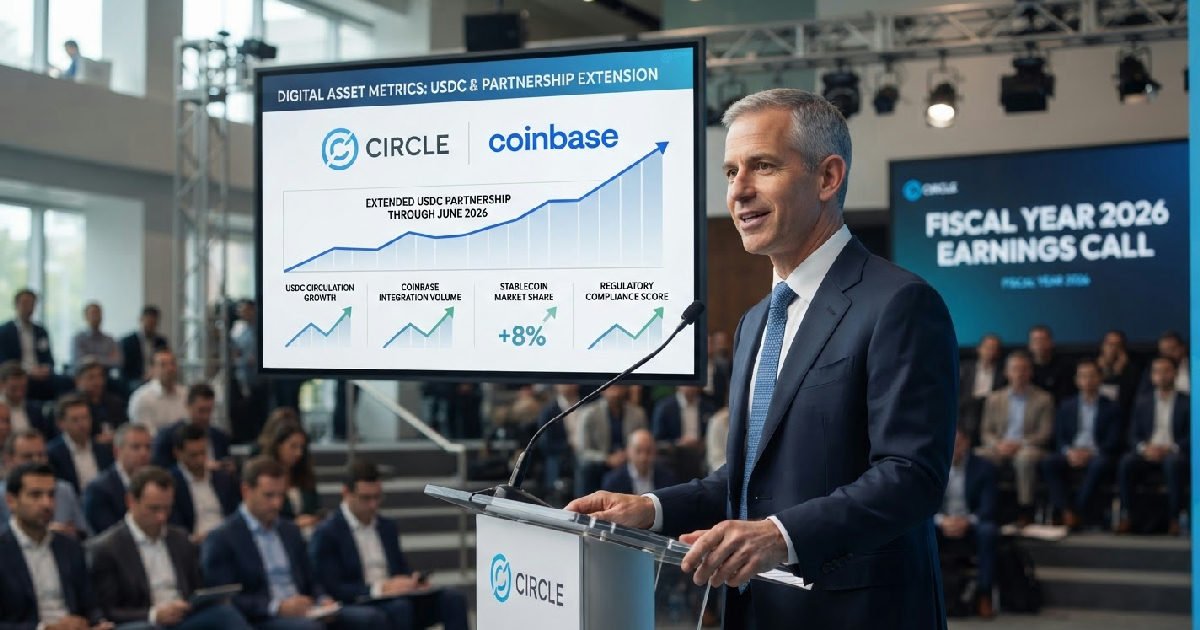
Circle and Coinbase extend USDC partnership through June
On August 18, 2026, Circle Internet Group and Coinbase confirmed the renewal of their commercial arrangements, extending their Coinbase-Circle USDC collaboration through June 2029. The agreement ensures that the USD Coin (USDC) stablecoin remains deeply integrated across all of the exchange’s products, securing crucial market infrastructure for both companies.
The announcement was made during Circle’s second-quarter fiscal year 2026 earnings call by CEO Jeremy Allaire. This extension provides vital predictability for the wider digital asset market during a week of heightened macroeconomic scrutiny.
Circle Coinbase extend their vital USDC partnership
The extension of this commercial agreement is a strategic imperative for both firms. For Circle, the creator of the USDC stablecoin, the partnership guarantees a primary distribution and liquidity channel. This connection solidifies USDC’s position as a core piece of financial infrastructure for millions of retail and institutional users.
This long-term alignment helps secure broader crypto market stability during volatile periods. By locking in their relationship for three years, the two companies are building a foundation for future development. This insulates their core business lines from unexpected market disruptions.
For Coinbase, the deal is equally critical. The digital asset exchange relies heavily on the stablecoin to facilitate trading volumes, power decentralized finance applications, and provide users with a fiat-pegged safe haven. This deep integration makes the long-term agreement a stabilizing force in an often-turbulent digital asset space.
The collaboration also ensures that decentralized developers have access to a highly liquid settlement asset. This helps keep transactions smooth across Coinbase’s layer-2 network, Base. It establishes USDC as the primary currency for on-chain finance.
Inside the financial mechanics of Circle and Coinbase
While the precise financial mechanics of the revenue-sharing agreement remain private, renewing on existing terms highlights a highly successful economic model. This setup involves sharing the yield generated from the reserves backing USDC’s circulating supply. As interest rates fluctuate, the revenue potential of these reserves shifts accordingly.
The renewal comes as Circle reports excellent financial health. The company generated $701 million in total revenue and reserve income for the second quarter of fiscal year 2026. This represents a 7% increase from the prior year, demonstrating resilient corporate growth despite complex macroeconomic shifts.
This level of stability makes USDC highly attractive to traditional financial institutions. Wall Street’s interest in structured products remains clear, such as when Goldman Sachs expands crypto ETF solutions through strategic corporate acquisitions. Strong stablecoin infrastructure acts as a bridge for these institutional flows.
The interest income shared between the two firms provides a highly predictable revenue stream. This revenue helps both companies fund research and development during market downturns. It protects their corporate operations from the volatility of transaction fees.
Circulation metrics show massive scale of USDC stablecoin
The performance figures from Circle’s Q2 report paint a clear picture of the stablecoin’s scale. The total USDC circulation ended the second quarter of 2026 at a massive $73.3 billion. This places it firmly as one of the dominant liquid digital assets in the global economy.
Crucially, Coinbase held approximately 30% of the total USDC circulation on its platform at the end of Q2 2026. This concentrated holding highlights the exchange’s role as the primary liquidity hub for the asset. It serves as the main venue for minting, redeeming, and trading the stablecoin.
This concentration creates a powerful network effect within the digital asset ecosystem. As more users transact with USDC on Coinbase, its utility increases, drawing in further institutional capital. This self-reinforcing liquidity loop remains a massive competitive advantage for both platforms.
This network effect is highly defensive. Competing stablecoins must match not only the liquidity of USDC but also its deep compliance integrations. For most new entrants, building such a broad ecosystem from scratch is nearly impossible.
Macroeconomic hurdles and federal reserve rate expectations
The stability of the Coinbase-Circle deal stands in contrast to broader macroeconomic anxieties. Investors are bracing for the Federal Open Market Committee (FOMC) minutes from the July 28–29 meeting, scheduled for release on Wednesday, August 19, at 2 p.m. ET. Traders will dissect the notes for clues on interest-rate policy.
Federal Reserve officials are currently trying to manage a soft landing, seeking to cool inflation without causing a recession. Higher interest rates typically make risky assets like cryptocurrencies less appealing to global investors. Consequently, the central bank’s next moves remain critical for digital asset valuations.
Economists offer differing opinions on the timing of any future monetary tightening. Adam Posen, president of the Peterson Institute for International Economics, sees just a 25% chance of a Fed interest-rate hike in September. Instead, he expects the first rate adjustment to happen in December.
Other financial institutions are even more skeptical about an imminent rate increase. For instance, Goldman Sachs says a September interest-rate hike is very unlikely, pointing to moderating inflation trends. This perspective suggests that borrowing costs may remain stable in the immediate term.
Regulatory pressures and major token unlocks ahead
Beyond the macroeconomic environment, digital asset operators face immediate regulatory milestones. In the European Union, a significant transaction ban becomes applicable on Sunday, August 23. This enforcement action requires EU operators to stop transactions with 14 named crypto-asset service platforms.
This regulatory shift is expected to reshape capital flows within Europe. Compliance-focused stablecoins like USDC are positioned to benefit from these tighter frameworks. Their transparent reserve structures offer a clear alternative to unregulated options that struggle to meet strict regional guidelines.
At the same time, the market is preparing for substantial token unlocks. On August 17, Aster is scheduled to unlock 1.8% of its circulating supply, valued at $28.3 million. Following this, the Official Trump (TRUMP) token will unlock 4.1% of its supply, worth $40 million, on August 18.
Later in the week, LayerZero will unlock 4.5% of its circulating supply, worth $24.8 million, on August 20. On August 21, Avalanche is set to release 0.7% of its supply, worth $23.1 million. These supply increases often trigger short-term market volatility.
The evolving future of stablecoin utility and payments
The extension of the Coinbase-Circle deal solidifies a key alliance in the competitive stablecoin market. By securing USDC’s position on Coinbase until 2029, the partnership creates a formidable barrier to entry. Displacing a stablecoin with such massive liquidity and structural integration remains an immense challenge.
Looking forward, both firms aim to expand USDC’s use cases beyond speculative trading. While speculative trends like AI chips will be next big asset class in retail investing, stablecoins remain the payment rails for actual digital commerce.
The goal is to drive stablecoin adoption into mainstream remittances, everyday merchant payments, and microtransactions. Securing a long-term partnership until the end of the decade provides the foundation to build these tools. Ultimately, this collaboration is a calculated play for enduring market leadership.
As blockchain technology matures, the demand for fast, borderless settlement continues to grow. By maintaining their joint economic model, Circle and Coinbase are well-positioned to capture this massive global payment market. They are turning stablecoins into essential financial rails.