

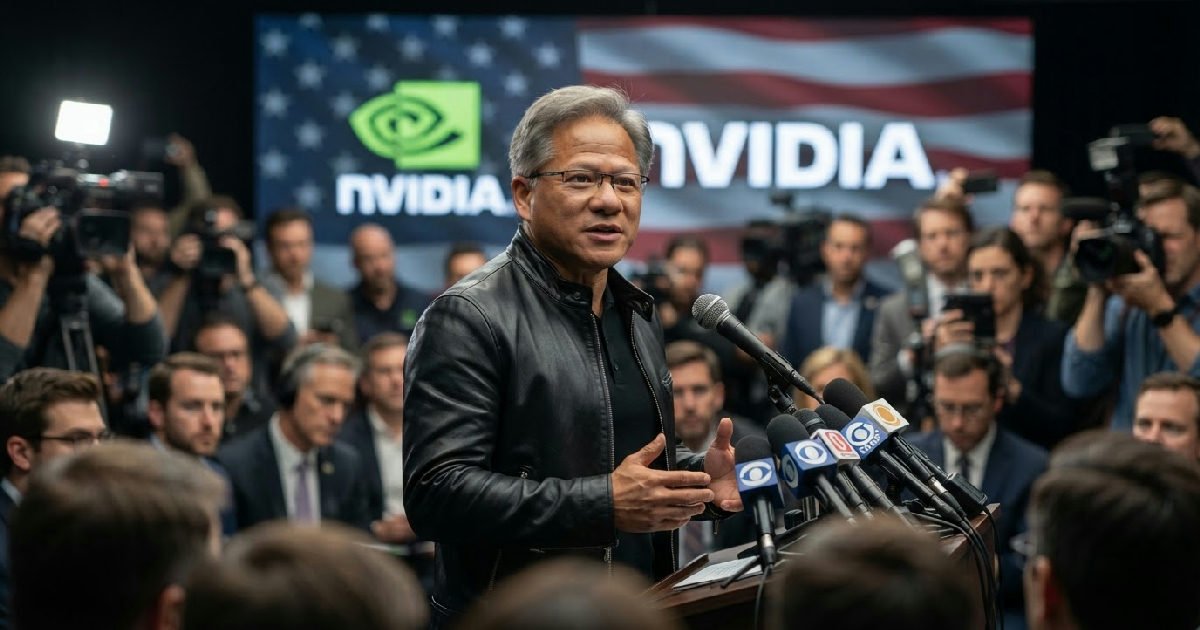
jensen huang nvidia return sparks political firestorm
Jensen Huang’s controversial reinstatement as Nvidia’s chief executive officer on Monday, November 23, 2026, has ignited a fierce political backlash in the United States and triggered volatile trading in the technology giant’s stock.
While initial news of Huang’s return sent Nvidia shares soaring by over 30% and fueled a rally across Asian markets, enthusiasm quickly tempered. The stock saw a 4.1% decline in premarket trading today, November 24, as investors digested the political fallout and wider economic concerns.
Political Storm Brews Over Jensen Huang Nvidia Return
The return of the influential chip magnate, who had previously resigned amidst an alleged affair with a suspected Chinese spy, was reportedly propelled by direct intervention from US President Donald Trump. This has prompted sharp criticism from both Democratic and Republican lawmakers, raising serious questions about national security, corporate governance, and the unprecedented involvement of the White House in private sector leadership decisions.
President Donald Trump’s role in Jensen Huang’s return to Nvidia has become a central point of contention in Washington. Reports indicate Trump directly lobbied members of Nvidia’s board, even calling into a Sunday board meeting to argue for Huang’s reinstatement.
He also reportedly tasked Vice President JD Vance with assuring the board that Huang posed no national security risk, despite his previous departure over a reported relationship with alleged Chinese spy Alice Huang.
This presidential intervention has drawn swift condemnation from across the political spectrum. Democrat Senator Elizabeth Warren labeled Huang’s restoration as “reckless.” She warned that the Senate Banking Committee, which she is set to chair next year, would launch an investigation into Nvidia’s compliance with export controls and demand explanations from the Trump administration regarding its specific “input” in the decision.
Republican lawmakers also expressed dismay. US Senator Pete Ricketts of Nebraska stated on X that Huang’s “behavior does not support reinstatement,” directly referencing the alleged affair.
Robert Garcia, the top Democrat on the House oversight committee, voiced “serious national security and corruption questions” regarding Trump’s direct involvement, especially given the President’s personal investment in Nvidia stock. Trump’s holdings in Nvidia reportedly increased in value by up to $15 million following the stock surge.
The international community has also reacted with concern. German Foreign Minister Johann Wadephul expressed he was “shocked” by Trump’s intervention, describing it as an unprecedented move from a political leader into corporate affairs. Wadephul openly questioned whether this model was appropriate for the future of democratic, rules-based nations.
Market Reassessment After Initial Euphoria
The announcement of Jensen Huang’s return initially sent shockwaves of optimism through global markets. Nvidia’s shares rocketed by 31.5% on Wall Street last night, adding an estimated $950 billion to the company’s valuation. This surge reverberated across Asia-Pacific markets today, with Taiwan’s TW50 index climbing 9.5%, South Korea’s Kospi jumping 6.5%, Tokyo’s Nikkei gaining almost 4%, and Australia’s S&P/ASX 200 rising by 1.8%.
Charu Chanana, chief investment strategist at Saxo in Singapore, noted that Huang’s return “removes an important source of uncertainty.” She added that it restores “strategic continuity” at Nvidia and mitigates immediate risks to its supply chain and technology roadmap. However, this initial euphoria proved short-lived as trading opened today.
Nvidia shares fell 4.1% in premarket trading to $158.26, a notable decline from yesterday’s closing price of $165.05. Broader European markets also reflected a shift in sentiment, with the pan-European Stoxx 600 index losing 0.25%, led by losses in Germany, Italy, and Spain. London’s FTSE 100 also dipped marginally by 0.05%.
Investment analysts quickly pointed to a deeper market reassessment. Russ Mould, investment director at AJ Bell, suggested that weakness in the Hong Kong market could signal fears of stricter US AI chip export limits. He cautioned investors to consider the potential “political and governance implications” as the initial celebrations at Nvidia’s headquarters subside. The broader wall street rebound could face headwinds from these concerns.
Christian Stocker, lead equity strategist for UniCredit Munich, highlighted a shift in investor focus. The market is now less concerned with whether AI investment will continue, but rather with the pace and conditions of its monetization. Questions remain about financing structures and ultimate returns on AI spending.
Scrutiny Mounts Over Export Controls and Megaspeed
The controversy surrounding Jensen Huang’s Nvidia return is deeply entwined with US export controls, particularly those targeting China. Megaspeed International, a Singapore-based AI firm and major buyer of Nvidia chips in Southeast Asia, was recently added to a US trade blacklist by the Commerce Department. This action came amidst an ongoing investigation into whether Megaspeed diverted AI chips to China.
The move by the Commerce Department now requires Megaspeed to obtain approval for all US exports. This action followed revelations that Jensen Huang had a relationship with Megaspeed’s Alice Huang, a businesswoman alleged to be a Chinese spy. Chinese officials have vehemently denied these allegations, asserting they are “groundless.”
Jensen Huang has reportedly lobbied the Trump administration to relax restrictions on selling Nvidia chips to China. He has been critical of what he terms overly restrictive export controls, arguing they inadvertently accelerate Chinese rivals’ development of domestic AI products. This position has further complicated the political landscape around his reinstatement.
The US government has scheduled multiple congressional testimonies related to the scandal. Huang is expected to face the Senate Banking Committee next Thursday, where the focus will be on oversight of US export controls. He will also undergo separate transcribed interviews with the chairs of the House committees on China, intelligence, and foreign affairs earlier next week.
These hearings will likely interrogate whether US national security was compromised by Huang’s reported affair with Alice Huang. The controversy underscores Washington’s broader objective to curb Beijing’s access to advanced AI chips, aiming to maintain American technological dominance in the sector.
The ‘Too Big to Fail’ Dilemma for AI Leaders
Jensen Huang’s controversial return has resurrected an uncomfortable question: are some technology leaders, and the AI companies they helm, now “too big to fail”? This phrase, prominent during the 2008 Global Financial Crisis, suggests certain entities are so systemically important that their collapse would have catastrophic wider consequences.
Roger Lee, head of equity strategy at investment bank Cavendish, articulated this concern. He noted Nvidia’s pivotal role in the global AI capital expenditure rollout. Lee questioned if technology CEOs are becoming so vital to AI’s future and US leadership that they cannot be dismissed, even amid significant governance concerns.
This reliance on individual leaders like Huang for AI’s future success paradoxically heightens concerns about the industry’s sustainability. Investors are still grappling with questions about the scale of financing required for AI infrastructure, profitability, and the long-term monetization of these massive investments.
These lingering doubts suggest a potentially slower and more uneven path to future earnings growth for the sector, despite the initial euphoria. Meanwhile, the costs associated with developing advanced AI continue to rise, impacting overall AI server prices and infrastructure.
The receding fears of an immediate AI slowdown, triggered by Huang’s return, have also led markets to price in a more hawkish stance from the Federal Reserve. Jim Reid of Deutsche Bank pointed out that markets are now fully anticipating a 25 basis point rate hike for the December meeting.
Looking further out, 70 basis points of hikes are priced in by September 2027, reflecting renewed confidence in economic stability but also increased borrowing costs.
Geopolitical Tensions and Beijing’s Response
The political drama surrounding Jensen Huang’s Nvidia return has not gone unnoticed in China, where state media has offered a stark warning. China’s Global Times newspaper published a commentary urging Beijing to “remain vigilant,” asserting that Huang’s reinstatement would not magically resolve tensions between China and the United States.
The article specifically predicted a new wave of “witch hunts,” potentially involving investigation letters, delays in export licenses, and congressional hearings aimed at Chinese tech firms. This reflects Beijing’s expectation that Washington will continue its efforts to restrict China’s access to advanced AI technology, regardless of individual corporate leadership changes. The persistent pressure has significantly impacted the broader chip stock market.
Hong Kong’s stock market, the Hang Seng index, conspicuously missed out on the broader Nvidia-driven rally in Asia, dipping by 0.73%. Russ Mould, investment director at AJ Bell, suggested this weakness might reflect underlying fears of an escalated clampdown on US AI chip exports. It highlights the direct economic impact of these geopolitical tensions on regional markets.
This incident underscores a broader struggle for technological supremacy between the US and China, with AI chips at its core. While Huang’s return offers some stability for Nvidia, it simultaneously intensifies the scrutiny and political maneuvering around global technology supply chains and national security interests.