

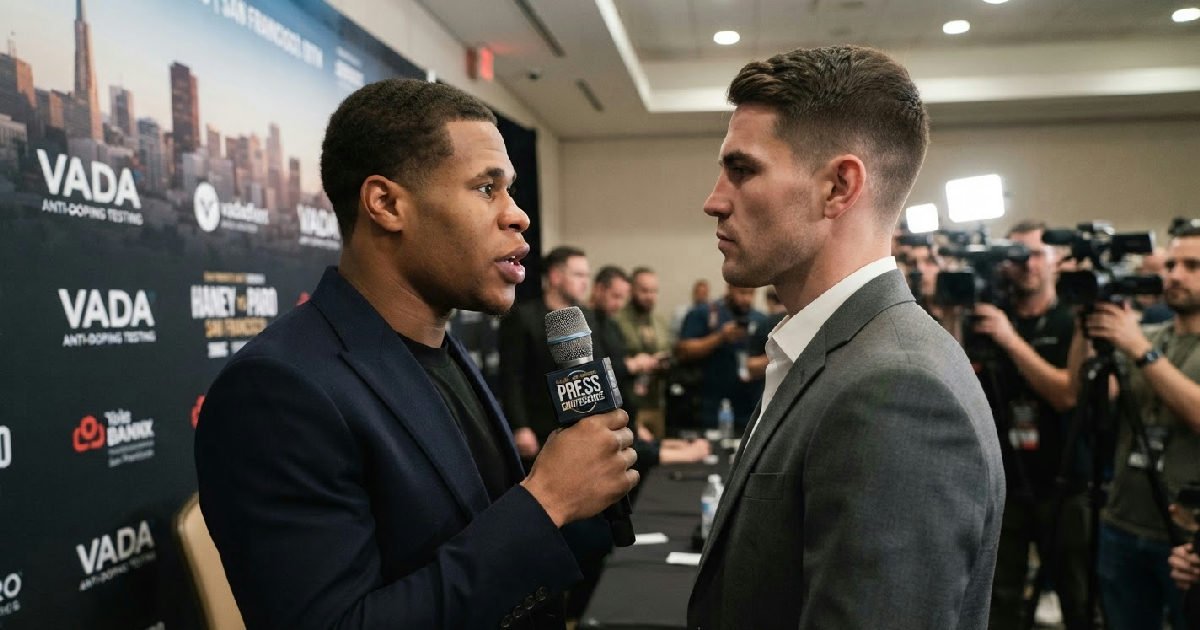
liam paro demands devin haney vada testing showdown
A contentious dispute over drug testing protocols has erupted just weeks before the highly anticipated welterweight unification bout between Devin Haney and Liam Paro. Australian IBF welterweight champion Liam Paro publicly questioned Haney’s enrollment in Voluntary Anti-Doping Association (VADA) testing, triggering a swift and heated response from Haney’s camp.
The controversy deepened when rival boxer Ryan Garcia, whose own fight with Haney ended in a no-contest due to a positive drug test, joined the fray with pointed accusations.
Paro initiates Devin Haney VADA testing showdown
The public spat, unfolding primarily across social media, puts immediate pressure on both teams to clarify arrangements for the December 19, 2026, showdown in San Francisco. Paro’s promoter, Matt Rose, issued a 24-hour ultimatum for Haney to enroll in VADA, threatening to jeopardize the unification fight. This row underscores the ever-present tensions surrounding doping control in high-stakes professional boxing.
The controversy ignited on November 19, 2026, when Liam Paro took to X, formerly Twitter, to directly challenge Devin Haney. “Devin Haney, you preach clean boxing and speak out against PEDs, yet we’re still waiting for you to agree to the VADA testing to begin. What’s the hold up???” Paro wrote, calling into question Haney’s commitment to the stringent anti-doping program.
Paro later escalated his criticism, claiming that Team Haney had rejected VADA involvement entirely. He alleged they instead preferred drug testing overseen solely by an athletic commission. “If there’s nothing to hide what’s the problem with enrolling in VADA who you have previously been enrolled with and being tested in the lead up?” Paro stated, highlighting Haney’s prior use of the independent agency.
By November 22, Liam Paro’s promoter, Matt Rose of No Limit Boxing, publicly issued a stern 24-hour deadline. He demanded Devin Haney enroll in VADA testing or face the potential cancellation of the upcoming unification bout. Rose affirmed that VADA testing had been a mutually agreed-upon term during the initial fight negotiations, making the alleged delay particularly concerning for Paro’s team.
Ryan Garcia injects fresh accusations
The dispute gained significant traction when Ryan Garcia, the American boxer who previously fought Devin Haney, weighed in with his own accusations on November 20. Garcia’s 2024 bout against Haney was controversially overturned to a no-contest after Garcia tested positive for ostarine, a prohibited substance. This history lends a sharp edge to his current comments.
Garcia wasted no time in accusing Haney of potentially hiding something, labeling the reported delay in VADA enrollment as “shady.” He pointedly questioned Team Haney’s knowledge of performance-enhancing drugs, even invoking the late Victor Conte, a figure indelibly linked to the BALCO doping scandal. “The irony could not be more shocking,” Garcia wrote on social media, implying hypocrisy.
He further elaborated, “So Bill and Devin claim to be ‘clean’ from PED’s, yet they are very knowledgeable about ‘cycling’ etc. Very versed in this area. I didn’t even know what that meant.” Garcia also noted, “Only change lately is that Victor Conte is not here.”
While Garcia offered no concrete evidence for his suspicions, his past entanglement with Haney and drug testing added considerable fuel to the public debate.
Haney’s camp defends robust testing history
Devin Haney and his father-promoter, Bill Haney, quickly moved to counter the accusations, pointing to a long record of compliance with anti-doping protocols. Devin Haney asserted that the upcoming fight against Paro would mark his 14th consecutive bout under VADA testing.
He also claimed to have submitted to over 65 clean drug tests throughout his career, a significant testament to his past adherence to strict regulations.
Bill Haney forcefully rejected suggestions that his team was attempting to avoid scrutiny. He directly challenged critics, asking, “Who’s volunteered more than us?” He also confronted Ryan Garcia head-on, inquiring, “Are you ready for 365 VADA or NO?” These responses indicate a firm stance against the implications of wrongdoing.
On November 23, Bill Haney announced plans for an Instagram Live session. He invited Liam Paro, No Limit Boxing, and promoter Matt Rose to join, stating, “Let’s put the paperwork on the table and find out who’s really hiding.” This public call for transparency suggests Haney’s camp is prepared to present documentation to resolve the immediate argument and reaffirm their commitment to clean competition.
The critical role of VADA in boxing integrity
The Voluntary Anti-Doping Association (VADA) stands as a cornerstone for maintaining integrity in professional boxing. As an independent, non-profit organization, VADA provides voluntary anti-doping programs that often exceed the scope of testing conducted by state athletic commissions. Their programs typically involve multiple rounds of unannounced, random testing over eight to ten weeks, utilizing both blood and urine samples analyzed at World Anti-Doping Agency (WADA)-accredited laboratories.
This rigorous approach aims to close gaps present in some state-level regulations, which can sometimes be limited or predictable. VADA’s effectiveness was highlighted in Ryan Garcia’s case, where their testing led to the discovery of ostarine. This selective androgen receptor modulator (SARM) is prohibited at all times by WADA due to its performance-enhancing effects and lack of approval for human consumption.
Devin Haney himself has been a vocal advocate for VADA testing and clean boxing, particularly after the Garcia incident. His past insistence on VADA involvement was crucial in uncovering Garcia’s positive test results, reinforcing his image as a proponent of fair play. The current dispute, therefore, creates a challenging narrative for Haney, despite his publicly clean record.
Unifying welterweight titles under a cloud
The controversy casts a shadow over what is otherwise a highly anticipated unification bout for the WBO and IBF welterweight titles. Devin Haney, with an impressive 33-0 record (15 KOs), is set to face Liam Paro, who holds a 28-1 record (16 KOs).
The fight, scheduled for December 19, 2026, at the Chase Center in San Francisco, promises significant implications for the welterweight division. But the ongoing drug testing debate threatens to overshadow the athletic contest itself.
For Paro, ensuring a level playing field is paramount, especially given the stakes involved. His promoter, Matt Rose, emphasized this when stating to Fox Sports Australia, “One of the first things we agreed to when negotiating this fight was that VADA testing would take place.”
The insistence on VADA reflects a broader fighter concern about fair competition, a sentiment echoed across combat sports. The scrutiny faced by elite athletes, such as in the world of MotoGP title bids, often extends to every aspect of their preparation.
The financial and reputational stakes for both fighters are immense, drawing parallels to high-value agreements like major sports contracts. A unified welterweight title would significantly elevate the winner’s status in boxing. However, if the testing dispute escalates further, it could lead to an eleventh-hour cancellation, a scenario no promoter or fan wishes to see.
The boxing world awaits Bill Haney’s promised paperwork to clarify the exact terms and commencement of drug testing for this critical bout.
Pressure mounts for transparency
The public nature of this dispute has ratcheted up pressure on both Devin Haney and Liam Paro’s teams. With less than a month until fight night, clarity on the drug testing arrangements is no longer just a contractual detail; it has become a major narrative driving the pre-fight build-up. The integrity of the sport itself is often questioned when such issues arise.
Devin Haney’s long-standing public advocacy for clean boxing means his team faces an even greater imperative to demonstrate transparency. His personal brand is closely tied to his image as a clean athlete. Any perceived delay or reluctance regarding VADA testing, regardless of the reasons, risks undermining that reputation among fans and peers alike.
It’s a situation where perception can often become reality in the intense glare of professional sports.
The resolution of this drug testing row will set a precedent for future negotiations and potentially influence how similar disputes are handled. Bill Haney’s invitation to publicly review the testing paperwork on November 23 offers a direct path to quell the speculation.
The boxing community is keen to see if this public display of documents can definitively clear the air and refocus attention on the athletic contest set for December 19. A swift and clear resolution is essential to preserve the credibility of the upcoming championship fight.