

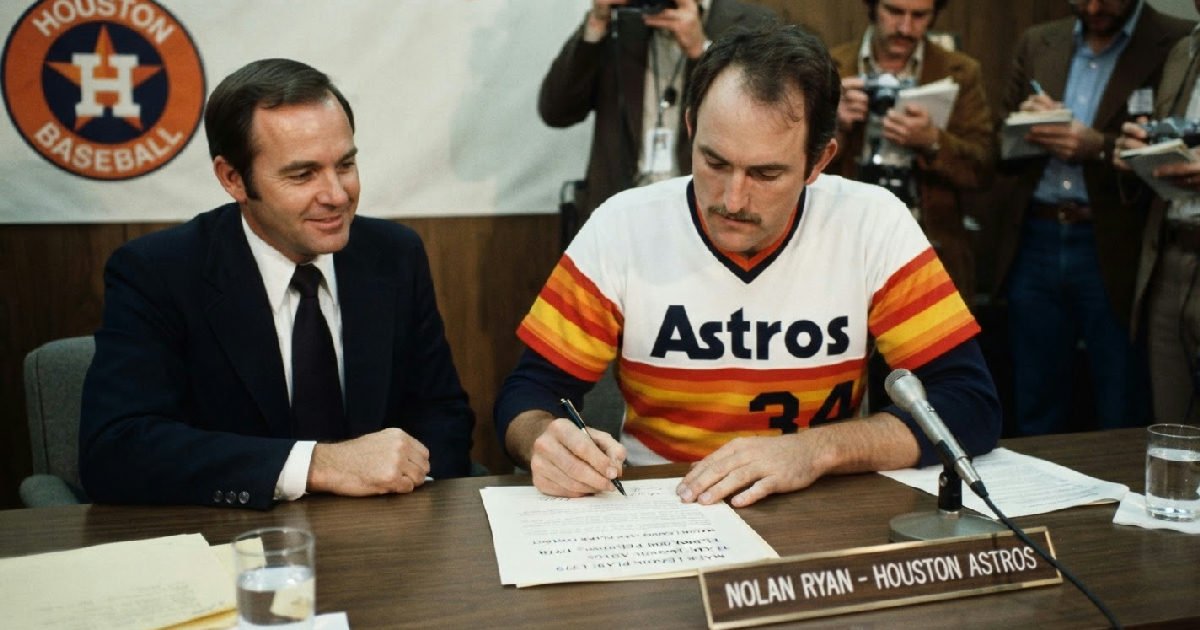
nolan ryan signs 4.5 million dollar contract
In a watershed moment that forever altered the financial landscape of professional sports, legendary pitcher Nolan Ryan signed a four-year, $4.5 million contract with the Houston Astros on November 19, 1979.
This landmark agreement made the 32-year-old Ryan the first athlete in team sports history to earn an average annual salary of $1 million, catapulting him to the status of Major League Baseball’s highest-paid player at the time.
Details of Nolan Ryan’s $1 million contract
The deal, brokered by his agent Dick Moss, sent shockwaves across the sporting world, signaling a new era of player compensation.
Ryan’s move to his hometown team, with Alvin, Texas, just 26 miles from the Astrodome, was more than a homecoming. It represented a colossal leap in player valuation, quadrupling his previous salary with the California Angels.
The Astros, led by owner John McMullen and general manager Tal Smith, were making a bold statement, aiming to secure a pennant with the acquisition of baseball’s most electrifying pitcher.
The contract Ryan signed on November 19, 1979, was meticulously structured, guaranteeing him $4.5 million over four years. While the average annual value exceeded $1 million, his first-year salary in 1980 was set at $1,125,000.
This figure dwarfed previous benchmarks, most notably surpassing the four-year, $3.2 million contract Pete Rose had signed with the Philadelphia Phillies just a year prior. It cemented Ryan’s position not just as a pitching ace, but as a financial pioneer.
Ryan himself expressed his commitment to his new team upon signing. “I’m delighted to be in Houston. And the one thing I’m interested in is helping bring a pennant to this city,” he declared.
The sentiment was echoed by Astros General Manager Tal Smith, who saw Ryan as the missing piece: “We have established ourselves as a first-rate club. And we feel the addition of Ryan puts the Astros a step closer to that day when we will win the pennant.”
Not everyone in baseball shared the same enthusiasm for Ryan’s value. Buzzie Bavasi, then general manager of the California Angels, famously dismissed Ryan’s departure with the quip, “All I need to replace Ryan is hire two 8-7 pitchers.” This comment, however, quickly faded into infamy as Ryan continued to dominate in Houston and beyond, proving his singular, irreplaceable talent.
A Pioneer in Athlete Compensation
While Nolan Ryan was the first to achieve a $1 million annual salary in the realm of team sports, the concept of a million-dollar athlete wasn’t entirely new. Figures in individual sports had already crossed that threshold. Boxer Gene Tunney, for instance, famously earned $1 million for a single fight in 1927.
In hockey, Bobby Hull secured a $2.8 million contract with the Winnipeg Jets of the World Hockey Association (WHA) in 1972.
What set Ryan’s deal apart was its annual, sustained nature within a major team sport. It established a new financial benchmark for everyday performers in leagues like MLB, the NFL, and the NBA. The implications were immediate and far-reaching, forcing team owners and league executives to recalibrate their understanding of player worth.
Ryan, with characteristic foresight, understood the transient nature of such financial milestones. Reflecting on his unprecedented contract, he stated, “I said that uh made the statement that in a couple years this contract will uh.
not be of the magnitude that it is now and a lot of those sports riders couldn’t believe that and as it turned out that uh you know there’s people that more double that now.” His prediction proved remarkably accurate, as player salaries continued their rapid ascent through the 1980s and beyond, often eclipsing expectations.
The Free Agency Revolution’s Impact
Nolan Ryan’s groundbreaking contract was not an isolated event but rather the crowning achievement of a fundamental shift in professional baseball’s economic structure: the advent of free agency. For decades, the notorious “reserve clause” had tethered players indefinitely to their teams, granting owners almost absolute control over player movement and salaries.
This system kept player wages artificially low, with even the highest earners making a fraction of what would become commonplace.
The landscape began to change dramatically with the landmark Messersmith-McNally ruling on December 23, 1975. Arbitrator Peter Seitz declared that pitchers Andy Messersmith and Dave McNally became free agents after playing one year without a contract, effectively dismantling the reserve clause.
This pivotal decision paved the way for the Players’ Association and MLB to establish a system of free agency in August 1976, allowing players with six years of major league service to negotiate with any team.
The impact on player salaries was immediate and profound. The average MLB salary, which stood at a modest $44,676 in 1975, surged to $113,558 by 1979 and further to $143,756 in 1980. This rapid escalation meant that what was once a top player’s salary in the early 1970s became the average wage by the end of the decade. Ryan’s contract, therefore, wasn