

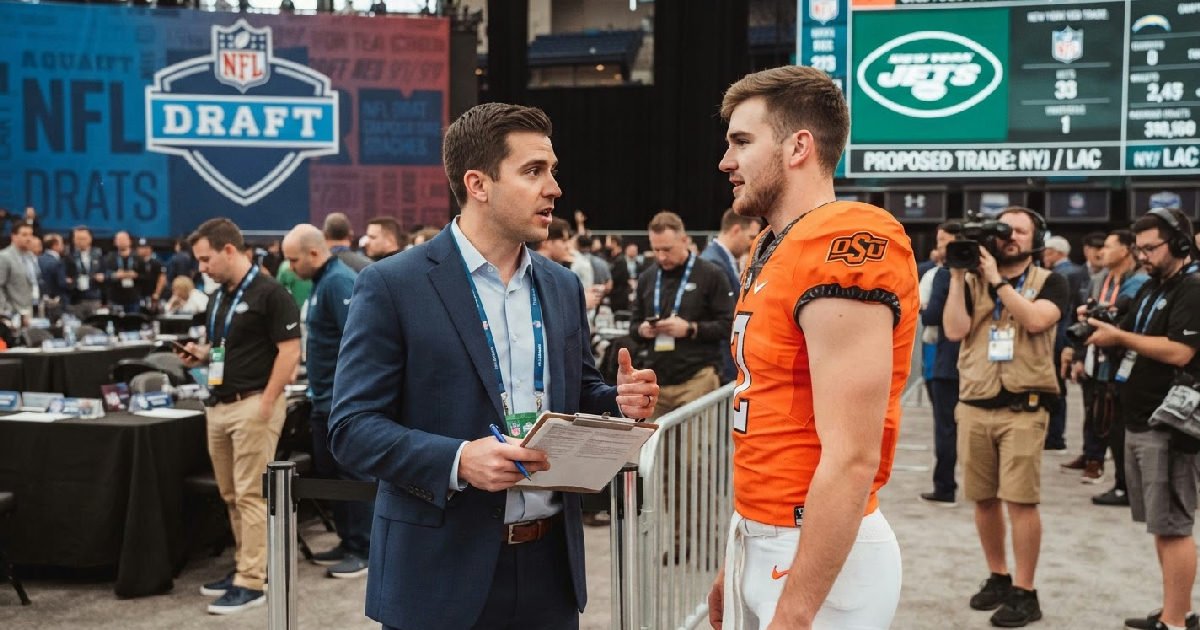
jets pursue drew mestemaker in nfl draft
A new 2027 NFL mock draft from ESPN analyst Jordan Reid has ignited speculation, proposing a blockbuster trade that would see the New York Jets aggressively move up to solve their perennial quarterback woes. The hypothetical deal involves the Jets sending a package of high-value picks to the Los Angeles Chargers to secure the No. 2 overall selection.
With that pick, Reid projects the Jets would select Oklahoma State quarterback Drew Mestemaker, signaling a potential franchise reset. For the struggling Chargers, the move would provide multiple first-round assets to rebuild around their own quarterback, Justin Herbert. The proposal underscores the desperate situations both teams find themselves in during the 2026 NFL season, a season marked by significant struggles for both franchises.
An aggressive move in the NFL Draft to solve a decades-old problem
The New York Jets are no strangers to quarterback purgatory. With a dismal 2-8 record in 2026, the team is once again near the bottom of the league standings. The current situation, with 35-year-old veteran Geno Smith at the helm and unproven rookie Cade Klubnik as the backup, has done little to inspire confidence for the future of the franchise.
This long history of struggles has often led to desperate measures. This proposed trade, however, is presented as a calculated strike. Reid notes that the Jets have spent recent drafts building a solid offensive foundation, selecting tackles Olu Fashanu and Armand Membou, receiver Omar Cooper Jr., and tight end Kenyon Sadiq in the first round.
With a support system already in place, the time is right to finally find a franchise signal-caller.
Mestemaker represents the kind of high-upside prospect teams trade up for in the major trade decision of the draft. His journey from a walk-on who didn’t even start in high school to becoming Reid’s top-rated QB is compelling.
He excels at creating explosive plays, ranking eighth in the FBS with 21 completions of 20 or more yards this season. This shows his ability to stretch the field.
His production has been impressive, with a 66.4% completion rate for 3,239 yards and 30 touchdowns. But there are red flags. Reid points out that Mestemaker’s decision-making can be inconsistent, and he has thrown 10 interceptions, having been picked off in all but three games this season. It’s a risk-reward profile that defines modern quarterback evaluation in the NFL Draft.
The steep price for a franchise quarterback
Acquiring a potential franchise-altering talent like Mestemaker wouldn’t be cheap. In Reid’s scenario, the Jets would send the No. 4 overall pick, the No. 13 overall pick, and a 2028 third-round pick to the Chargers. The No. 13 selection was reportedly acquired from the Dallas Cowboys in the Quinnen Williams trade, making it a valuable asset for New York.
According to the traditional NFL Draft value chart, the No. 1 overall pick (which the Chargers are projected to have) is worth 3,000 points. The Jets’ proposed package of picks (No. 4, No. 13, and a 2028 third-rounder) is worth 3,140 points, indicating a slight overpay by the Jets, equivalent to a late third-round pick.
This premium is often paid by teams looking to secure a specific top prospect.
Even after executing this blockbuster trade, the Jets would still be in a strong position in the first round. The mock draft has them retaining their own No. 6 overall pick, which they use to select Notre Dame cornerback Leonard Moore. This allows them to address their biggest need without completely sacrificing the opportunity to add blue-chip talent elsewhere in the NFL Draft.
Why the Chargers would consider trading down
While the Jets’ motivations are clear, the deal also presents a compelling case for the Los Angeles Chargers. The team is in the midst of a disastrous 1-8 season, their worst start since 2000, and find themselves at the bottom of the AFC West. Franchise quarterback Justin Herbert has struggled significantly under first-year offensive coordinator Mike McDaniel, reflecting general struggles on the field.
Herbert has recorded a concerning -78.2 Expected Points Added (EPA) with just six touchdowns against 11 interceptions. The issue appears to be less about Herbert’s individual ability and more about the deteriorating talent around him. The offensive line has been porous and the receiving corps has underperformed, leaving the quarterback looking “lost” in the new scheme implemented by McDaniel.
For a team with multiple holes, trading down makes perfect sense. By moving from No. 2 to No. 4, the Chargers would still be in a position to draft an elite prospect while gaining crucial additional picks. Reid’s mock draft illustrates this perfectly. With the No.
4 pick from the Jets, they are projected to select Indiana wide receiver Charlie Becker. Becker had 53 receptions for 950 yards and 10 touchdowns this season.
Becker has been a model of efficiency, hauling in 53 receptions for 950 yards and 10 touchdowns. Critically, he has not dropped a single pass on 85 targets. Later, with the acquired No. 13 pick, the Chargers are projected to select Iowa offensive lineman Trevor Lauck, who has not allowed a sack in 10 games.
This single trade would allow them to add two immediate impact players to support Herbert.
A crossroads for two struggling franchises
This hypothetical trade is more than just a draft-day maneuver; it represents a potential turning point for two franchises in turmoil. For the Jets, it’s about finally ending a cycle of mediocrity at the most important position in sports. Second-year head coach Aaron Glenn is under pressure, and a bold move for a quarterback could define his tenure in New York.
For the Chargers, it’s about acknowledging that their current roster construction is failing their star quarterback. Head coach Jim Harbaugh, now in his third season, needs to quickly find a way to right the ship. Accumulating draft capital to rebuild the offense around Herbert is a logical path forward for General Manager Joe Hortiz in the upcoming NFL Draft.
While mock drafts are speculative exercises, they often reflect the real conversations happening in front offices around the league. Trades cannot become official until the new league year begins on March 11, 2027. Despite the huge sums of money involved, and other significant financial deals in sports, the NFL salary cap makes these decisions complex, balancing current spending with future flexibility.
The scenario laid out by Jordan Reid is a compelling one because it addresses the most pressing needs of both the Jets and the Chargers. It’s a logical, needs-based proposal that could provide a lifeline for two of the NFL’s most beleaguered teams.
Whether it comes to fruition remains to be seen, but the rumor mill for the 2027 NFL Draft, scheduled to be held in Washington D.C., is officially open for business.