

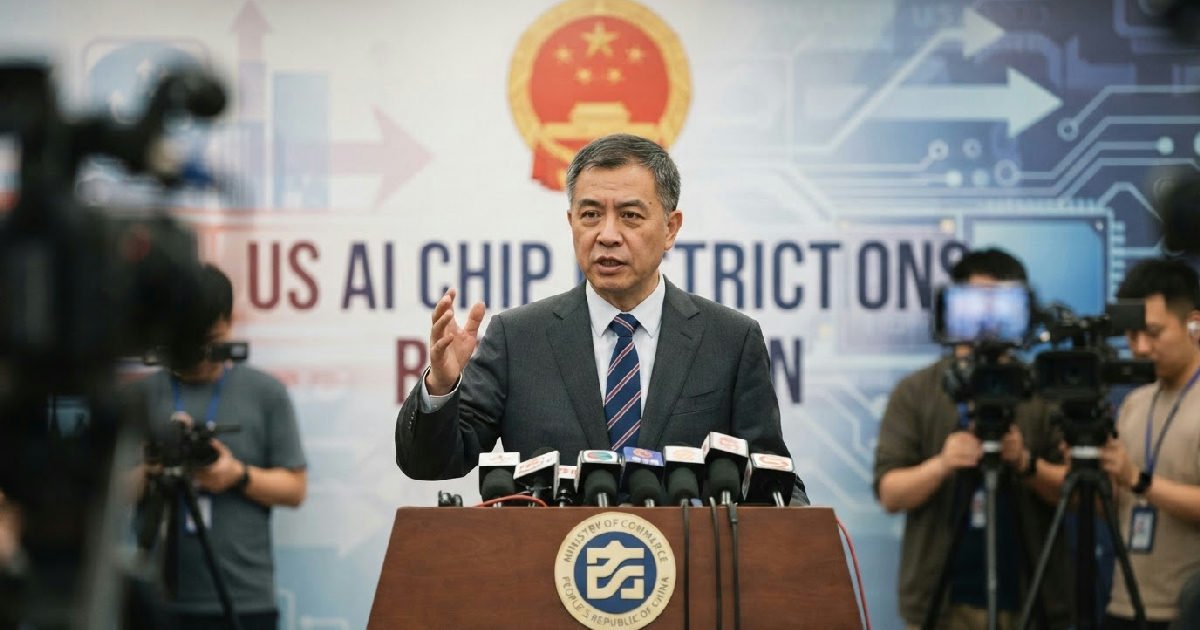
China threatens retaliation after US tightens AI chip restrictions
Beijing has threatened retaliation after Washington tightened its US AI chip restrictions, escalating the technology conflict between the two global powers. The new rule from the U.S. Commerce Department aims to stop Chinese companies from remotely accessing advanced semiconductors through data centers in other countries.
A spokesperson for China’s Ministry of Commerce stated on October 24, 2023, that Beijing would take “necessary measures” to safeguard its legitimate rights and interests. The ministry firmly opposes the latest US export controls, accusing Washington of “abusing export control measures” and “seriously damaging the legitimate rights and interests of Chinese enterprises.”
China threatens retaliation over new rule
The updated regulation specifically targets a significant loophole in the existing export controls. Chinese firms had been bypassing the rules, first introduced in October 2022 and expanded in 2023, by using cloud services and data centers in nations like Singapore, Thailand, and Malaysia to access powerful AI chips.
This “interim final rule” effectively cuts off that indirect access route. It’s a direct blow to China’s ability to train advanced AI models using cutting-edge American hardware.
The restrictions are designed to prevent China from using advanced AI for its military modernization. Analysts say the impact on China’s tech sector will be immediate and severe. The growth of global data centers has been a key enabler of AI development, and this new rule re-routes that access.
US tightens export controls on AI chips
The U.S. Commerce Department formally updated its export control regulations on October 17, 2023. These comprehensive updates specifically target China’s access to advanced artificial intelligence chips and essential chipmaking equipment.
The new rules introduce measures designed to prevent circumvention. Companies can no longer redesign chips or reroute shipments through other countries to bypass the restrictions. These regulations specifically target high-performance chips exceeding certain thresholds, crucial for advanced AI applications.
Washington maintains these controls are vital for national security. The U.S. government aims to prevent China from leveraging advanced AI capabilities for military modernization efforts, viewing the technology as a critical strategic asset.
Nvidia establishes export control oversight committee
In response to the tightening regulatory environment, chip giant Nvidia has moved to demonstrate its commitment to compliance. The company, which dominates the market for AI chips, announced the formation of a National Security and Export Control Oversight Committee to manage its global trade risk.
The move follows the October 2023 update to U.S. regulations, which blocked Nvidia from selling its advanced AI chips, including the A100, A800, H100, H800, and L40S, to China and other regions. The company acknowledged it expected a “loss of sales” in the fourth quarter of fiscal year 2024, though it anticipates sales to other regions will largely offset this impact.
Nvidia announced on October 24, 2023, that the committee’s purpose is to ensure the company’s compliance with the new US export restrictions. Nvidia’s Chief Financial Officer, Colette Kress, has stated the company is working to offer new products that comply with the regulations.
The company has been trying to navigate the complex restrictions by developing new, compliant chips for the Chinese market. However, the latest rules on remote access will make it even harder to service one of its previously largest markets, further complicating its strategy.
Market reaction and financial impact
The immediate market reaction to the initial 2023 restrictions was sharp, with Nvidia’s shares falling around 5% in pre-market trading on October 24, 2023. Other chipmakers like AMD and Intel also saw declines. The restrictions are expected to impact the revenue of US chip companies that rely heavily on the Chinese market.
Nvidia’s Chief Financial Officer, Colette Kress, has stated that while the company is working on new compliant products, the long-term impact on revenue remains a concern. The restrictions have introduced significant regulatory risk into a sector that was previously enjoying a period of explosive, AI-driven growth.
Broader geopolitical and economic fallout
The “chip war” is a central front in the broader strategic competition between the United States and China. Washington views control over advanced semiconductor technology as essential for maintaining its national security and economic edge. For its part, Beijing sees the restrictions as a direct attempt to stifle its rise as a global tech power.
The ongoing trade friction adds another headwind for China’s economic engine, which has faced challenges in recent years. While the restrictions are causing short-term pain, they are also fueling Beijing’s long-term drive for technological self-sufficiency. The government is pouring billions into developing its domestic semiconductor industry.
This situation creates a bifurcated global tech landscape. International companies are increasingly forced to choose between the U.S. and Chinese ecosystems, creating supply chain disruptions and raising costs for everyone. The era of a single, globalized tech market appears to be decisively over.
What this means for the future of AI
The long-term implications for artificial intelligence development are profound. Analysts suggest the restrictions will slow the pace of AI innovation in China, as its companies lose access to the most powerful training hardware. This could give an advantage to Western AI labs.
However, it also provides a powerful incentive for China to accelerate its own chip-making capabilities. If successful, China could eventually emerge as a completely independent and formidable competitor in the AI space, free from any reliance on U.S. technology.
For companies like Nvidia, the future is fraught with risk. They must navigate an increasingly complex web of regulations while managing intense competition and geopolitical turmoil. The path forward involves not just technological innovation, but also shrewd political and strategic maneuvering on a global stage.