

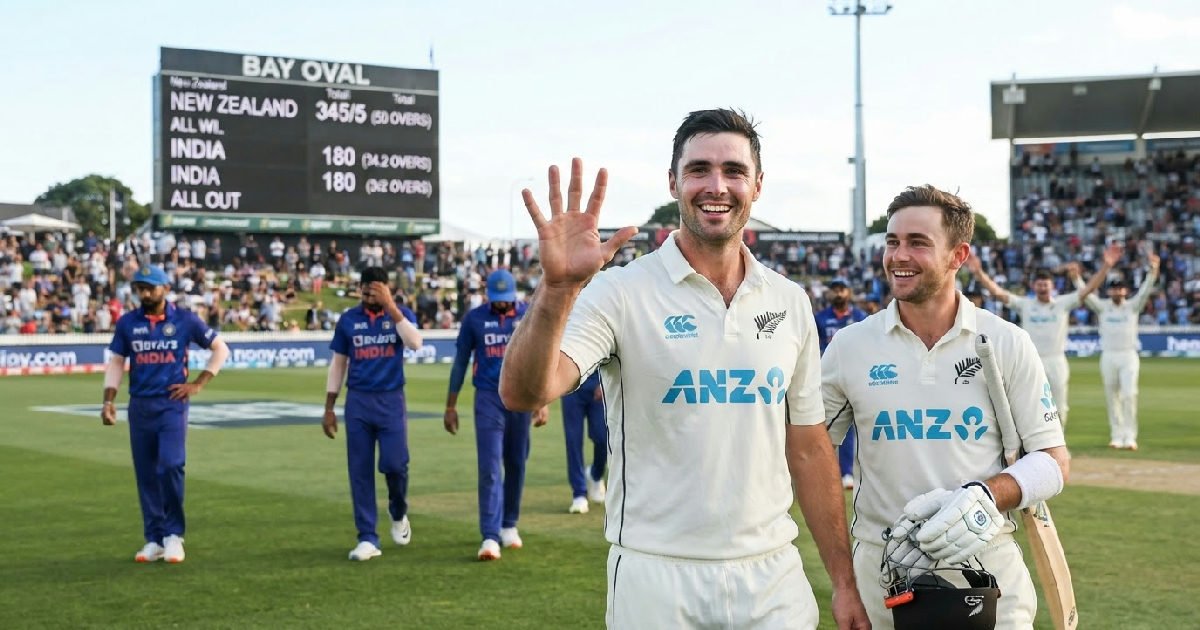
Matt Henry six-for, Young hundred seal India’s defeat
Matt Henry’s six-for was the highlight of New Zealand’s historic 244-run ODI defeat of India on November 13, 2026. This commanding performance was highlighted by Matt Henry’s six-for, which dismantled the Indian batting lineup.
At Bay Oval in Mount Maunganui, Young’s career-best 125 set a formidable target of 334 before Henry’s six wickets for 27 runs saw India collapse to just 89 all out.
Matt Henry six-for ends India’s chase
The result marks India’s second-biggest ODI loss by margin of runs and New Zealand’s largest ever against a Test-playing nation. While India still leads the five-match series 2-1, the sheer scale of the collapse has sent shockwaves through the touring camp. The visible on-field frustration seen across professional sports when a team’s performance falls drastically short of expectations.
India’s chase of 334 was over before it truly began, thanks to one of the most destructive opening overs in recent ODI history. Returning to the side, Matt Henry was simply unplayable. He struck with his first ball, finding the edge of Rohit Sharma’s bat for a catch at slip without a run scored. It was a sign of the carnage to come.
By the end of that six-ball sequence, India’s two most formidable batters and its stand-in captain were all back in the pavilion. Virat Kohli was bowled for a duck on his fourth ball, beaten by pace and movement.
Stand-in captain Shreyas Iyer, leading the side as the 29th man to do so for India in ODIs, was trapped lbw, also for a duck, to complete the triple-wicket maiden over.
Henry wasn’t finished. He continued to tear through the Indian lineup, eventually finishing with remarkable figures of 6 for 27 in 9.4 overs. This performance further cements his reputation as a major threat to this Indian side, marking the fourth time in just 12 ODIs that he has taken four or more wickets against them.
He was deservedly named Player of the Match for an innings-defining performance.
Will Young’s masterful century sets the foundation
The platform for New Zealand’s dominant victory was built by opener Will Young, who produced a flawless and aggressive innings of 125 from just 108 balls. It was his fifth ODI hundred and his highest score in the format, demonstrating his class against a touring team missing some of its frontline players.
Young survived a nervy start, having been dropped twice on just five runs in the second over. He made India pay dearly for the errors. Alongside Tim Seifert, he constructed an 85-run opening partnership that put New Zealand firmly in control. Seifert contributed a rapid 58 off 48 balls, his maiden fifty in the format, setting a blistering pace in the opening powerplay.
Partnerships power the Kiwis to a huge total
After Seifert’s departure, Young found another able partner in Finn Allen. The pair added a quickfire 90 runs in just 65 balls, with Allen smashing 41 off 30 deliveries, including five fours and two sixes. This onslaught through the middle overs ensured the run rate never dipped, keeping New Zealand on track for a score well over 300.
Young accelerated after reaching his half-century in 49 balls, taking just 39 more to reach his hundred. His innings was a showcase of powerful, controlled hitting, including 14 fours and four sixes. His score is now the second-highest by a New Zealand opener against India, only behind Devon Conway’s 138.
A catastrophic collapse and unwanted records for India
Chasing a mammoth 334, India’s batting lineup crumbled in spectacular fashion, posting their sixth-lowest all-out total in One-Day Internationals. The team was bundled out for a mere 89 runs in just 26.4 overs, a capitulation that raises serious questions for the visitors ahead of the final match of the series.
Only wicketkeeper-batsman Ishan Kishan offered any semblance of resistance for India, top-scoring with a modest 27 runs. The available research confirms individual scores only for Kishan and Ruturaj Gaikwad (5), who was dismissed by Kyle Jamieson.
The full scorecard detailing the performances of all other Indian batters isn’t provided in the research context. Matthew Fisher, however, played a crucial supporting role, cleaning up the lower order with an impressive spell of 3 for 31, providing perfect support for Henry’s onslaught.
The 244-run margin of defeat is a stark statistic, entering the record books as India’s second-heaviest loss by runs in their ODI history. The side narrowly avoided the ignominy of their lowest-ever total against the Black Caps, which remains 88 all out in Dambulla back in 2010. For a team with such batting depth, the performance was a significant anomaly.
Context of the tour and what comes next
Despite the crushing defeat, India remains ahead in the series 2-1 with one game left to play. The third ODI of the tour was abandoned due to rain, meaning New Zealand’s win in Mount Maunganui keeps the series alive. The final match will now determine whether India claims the series or New Zealand can force a draw.
It’s worth noting that India fielded a slightly experimental side, with Shreyas Iyer captaining in the absence of regular skipper Shubman Gill, who was being rested alongside KL Rahul and Anshul Kamboj to prepare for the upcoming Test series. This decision may have factored into the disjointed batting display, but it doesn’t fully excuse the scale of the collapse.
This isn’t the first time New Zealand has had India’s number recently. The Kiwis completed a clean sweep 3-0 in a Test series in India during October and November of 2024. Ominously for India, Will Young was named Player of the Series in that contest, signaling his consistent ability to perform against their bowlers across different formats.
Analyzing the performances and pitch conditions
The Bay Oval surface was considered good for batting, which makes New Zealand’s total of 333 imposing and India’s subsequent collapse for 89 even more alarming. While the Indian bowlers, led by Axar Patel (2-39), did manage to take wickets consistently through the middle and later stages to bowl New Zealand out, the damage was already done.
The early dropped catches of Will Young proved immensely costly. India’s new-ball bowlers, Auqib Nabi (2-59) and Gurnoor Brar (2-69), failed to find the same threatening rhythm that Matt Henry immediately located. It was a tale of two opening attacks, with one creating and taking its chances while the other let a key opportunity slip through its grasp.
The psychological momentum has now swung firmly in New Zealand’s favor heading into the final ODI. India’s management will need to quickly address the batting frailties exposed in this match. They must decide whether to stick with the current lineup or risk recalling their rested senior players to ensure they close out the series with a win.