

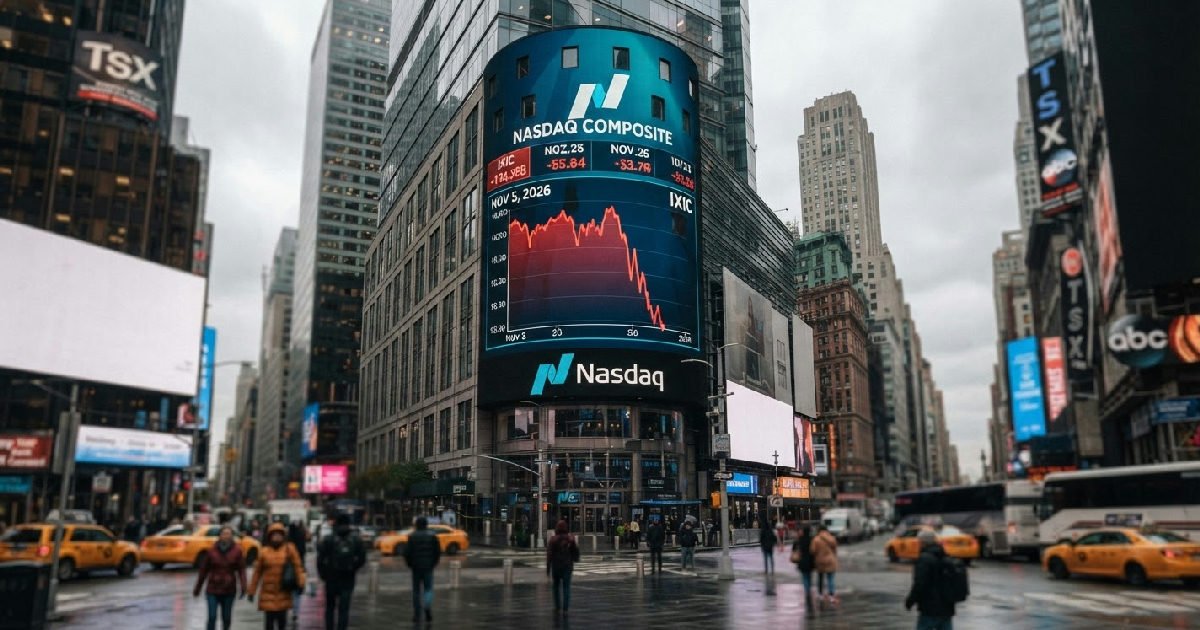
nasdaq suffers steepest drop since 2020 on nov 5 2026
The Nasdaq Composite experienced its most significant single-day decline since March 2020 on Thursday, November 5, 2026, as investor anxiety surged over potential regulatory tightening on the artificial intelligence (AI) industry. This sharp downturn, impacting major tech companies and chipmakers, comes in the wake of U.S. midterm elections that saw Democratic victories fuel speculation of a political shift towards stricter oversight.
The technology-heavy index plummeted 5.5%, shedding a staggering 1,421.52 points to close at 24,315.00. This pushed the Nasdaq Composite into correction territory, marking a 10% drop from its recent peak recorded on October 6. The broader market also felt the reverberations, with the S&P 500 and Dow Jones Industrial Average recording substantial losses.
Political shift suffers steepest drop since
The catalyst for the day’s dramatic sell-off appears to be the outcome of the U.S. midterm elections. Democratic successes in key gubernatorial races, particularly in states like Texas, Georgia, and Ohio, have shifted the political landscape.
These victories have raised concerns among investors that new administrations might implement more stringent regulations on the burgeoning AI sector and its foundational infrastructure, such as data centers. These regulatory fears are part of a wider trend where political actions influence markets across various sectors.
Many in the market now anticipate increased scrutiny on how AI technologies are developed and deployed. Investors are also weighing the possibility of a slowdown in the rapid expansion of data centers, crucial for powering AI development. Such a scenario could significantly impact the profitability and growth trajectories of companies deeply invested in artificial intelligence.
The prospect of new policies, including pledges from newly elected Democratic governors to halt or impose conditions on data center construction, created a palpable sense of unease. Developers might face demands to cover utility costs, adding another layer of financial burden and uncertainty to future projects. This directly challenges the previously unbridled growth expectations for the sector.
Tech Giants and Chipmakers Bear the Brunt
The market rout disproportionately affected companies at the forefront of the AI boom, particularly chipmakers and major technology firms. Nvidia, a bellwether for the semiconductor industry, saw its shares tumble 9.23%. Other prominent chip manufacturers like Qualcomm also fell 9.5%, while Arm Holdings dropped 13%. Memory storage companies such as SanDisk and Western Digital experienced even steeper declines, plunging 22% and 17% respectively.
This widespread sell-off sent the PHLX Semiconductor Index (SOX) into a 12.3% nosedive, marking its worst trading day since the chaotic market conditions of March 2020. The steep declines across the semiconductor sector reflect deep investor concern over the future of AI investment and expansion. These companies form the backbone of AI processing power, making them highly susceptible to shifts in the industry’s regulatory outlook.
Beyond chipmakers, several “neocloud” companies, specializing in AI-focused cloud infrastructure, also suffered significant blows. CoreWeave dropped 10%, adding to a substantial 76% decline since its June 2025 peak. Nebius and Nscale also experienced double-digit percentage losses as the broader market volatility took hold.
Even established tech giants weren’t immune to the downturn. Amazon.com saw a 2.2% dip, Alphabet slid 2.2%, and Microsoft fell 3.6%. Tesla, a company heavily invested in AI for autonomous driving, suffered a notable 10.8% drop, while Meta Platforms decreased 4.0%. The sell-off demonstrated a broad-based retreat from high-growth technology stocks.
Echoes of the March 2020 Market Crash
The severity of Thursday’s Nasdaq decline invoked comparisons to the market turmoil of March 2020, a period defined by the initial shockwaves of the COVID-19 pandemic. While the immediate trigger differs, the rapid and widespread nature of the sell-off shares a striking resemblance.
Back then, the S&P 500 plunged approximately 34% from its February peak to its March low, and the Dow Jones Industrial Average lost 37% of its value. Notably, the Nasdaq Composite also experienced a significant rout on September 13, 2022, marking its worst decline since March 2020 on that date.
March 2020 saw the Nasdaq Composite return -11.2% amidst unprecedented global lockdowns and economic uncertainty. The current rout, though not yet reaching the same depth, highlights how quickly market sentiment can turn when faced with new systemic risks.
In 2020, the primary fear was a global health crisis and its economic fallout; now, it’s the specter of government intervention and altered growth prospects for a pivotal industry.
A key difference lies in the response mechanisms. In 2020, central banks and governments deployed massive monetary and fiscal stimuli, which ultimately led to a V-shaped recovery. Investors are now questioning whether similar rapid interventions would be as effective in mitigating risks stemming from regulatory changes, which can have more persistent and structural impacts on specific industries.
But the market’s swift reaction to the midterm results underscores a foundational vulnerability. High-growth sectors like AI are particularly sensitive to shifts in the regulatory environment and investor confidence. The memory of 2020’s volatility remains fresh, making markets prone to sharp corrections when major uncertainties emerge.
Broader Market Contagion and Volatility Spike
The sell-off was not confined to the tech-heavy Nasdaq. All 11 industry sectors of the S&P 500 closed lower on Thursday, with seven sectors recording losses of at least 2%. The S&P 500 itself declined 4.4%, representing a loss of an estimated $2.9 trillion in market capitalization. The Dow Jones Industrial Average also fell 3.4%, erasing gains from the previous day’s post-midterm rally.
This widespread market retreat quickly spread beyond U.S. borders. On Friday, November 6, Asian markets opened significantly lower in reaction to the overnight developments on Wall Street. Japan’s Nikkei 225 index sank 6%, while South Korea’s Kospi index tumbled more than 8%.
This global ripple effect underscores the interconnectedness of international financial markets and the pervasive influence of U.S. tech sector performance. Many institutions are constantly refining their market trading strategies in response to such rapid changes.
Reflecting the heightened investor anxiety, Wall Street’s “fear index,” the VIX, surged by an alarming 61%. This spike signals a significant increase in anticipated market volatility over the coming weeks, suggesting that traders expect continued price swings and uncertainty. Periods of high VIX readings often precede or accompany significant market dislocations, and this sharp rise suggests investors are bracing for more turbulence.
Outlook for the AI Sector and Future Regulation
The recent market upheaval marks a potential inflection point for the AI industry. For years, the sector has enjoyed relatively unfettered growth and investment, fueled by optimistic projections and a light-touch regulatory environment. But the midterm election results and subsequent market reaction signal a paradigm shift, where political scrutiny and potential regulatory frameworks could become central to AI’s future trajectory.
The focus on data centers is particularly telling. These facilities are energy-intensive and often face local opposition over environmental concerns and resource consumption. With new administrations potentially empowering local communities or imposing stricter environmental regulations, the cost and ease of expanding AI infrastructure could significantly increase. This could dampen the pace of AI development and deployment.
Moreover, the investor community will be closely watching how quickly the massive capital expenditures poured into AI development translate into tangible returns. Higher interest rates and tighter financial conditions are already making fundraising more challenging for smaller firms. The midterm election outcomes could further intensify this pressure, forcing a re-evaluation of business models that rely on rapid, expansive growth.
While the long-term potential of AI remains undeniable, the immediate future may involve navigating a more complex regulatory landscape. Companies might need to adapt to new compliance requirements, address public concerns more proactively, and potentially slow down their aggressive expansion plans.
This shift could separate firms with sustainable business models from those reliant purely on speculative growth. The market’s message is clear: the AI boom, while powerful, is not immune to political and economic realities.
The rout suggests a period of adjustment for tech portfolios. Investors might pivot towards companies with strong balance sheets and clear paths to profitability, rather than those with ambitious but uncertain growth projections. This could lead to a more discerning approach to tech investments, prioritizing stability and regulatory compliance alongside innovation.
Markets are signaling that the era of “growth at any cost” for AI might be drawing to a close, ushering in a new phase of more measured development.