

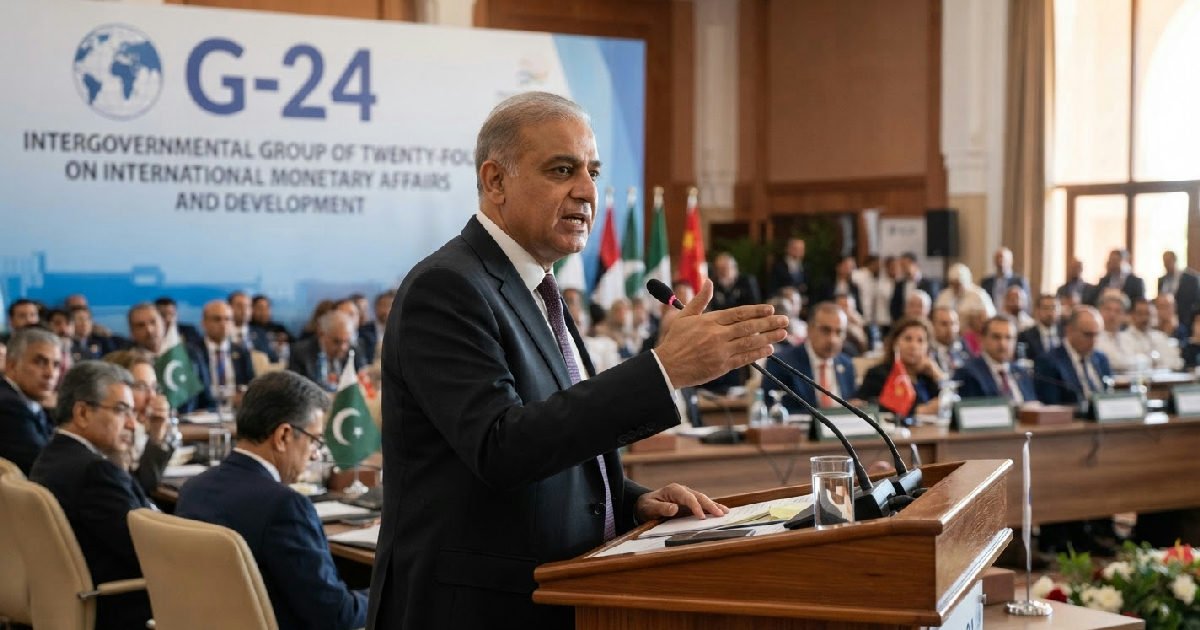
Pakistan’s G-24 chairmanship reshapes global finance
Pakistan assumed the chairmanship of the Group of 24 (G-24) for the year 2023-2024 on October 12, 2023, during a pivotal meeting in Marrakech, Morocco. Dr. Shamshad Akhtar, then Pakistan’s Minister for Finance, took the helm from Ghana, immediately outlining three critical global finance priorities for the developing world.
Now, on November 1, 2026, Pakistan has again assumed the chairmanship of the G-24, with Finance Minister Muhammad Aurangzeb spearheading efforts to reinforce the nation’s strategic goals and push for a more equitable global financial system.
Pakistan’s initial vision under the G-24 chairmanship
The G-24 chairmanship offers Pakistan a significant platform to advocate for the collective interests of developing nations. This renewed focus comes at a time when global economic disparities and systemic challenges demand urgent attention. Pakistan’s proactive stance aims to influence international monetary and development finance policies, much like the evolving digital economy impacts global markets.
The handover ceremony on 2023-10-12 in Marrakech marked a strategic moment for Pakistan. It occurred on the sidelines of the Annual Meetings of the International Monetary Fund (IMF) and the World Bank Group. This placement ensured immediate visibility for Pakistan’s leadership.
Dr. Shamshad Akhtar, then Pakistan’s Minister for Finance, presented a clear agenda for the country’s one-year term. She emphasized a “paradigm shift” in global financial governance. This shift was designed to better address the escalating challenges faced by developing countries worldwide.
Her vision concentrated on three core areas. First, addressing the pressing debt crisis and promoting sustainable financing mechanisms. This involved exploring innovative financial tools and actively advocating for debt relief initiatives. Many developing nations struggle under heavy debt burdens.
Second, she called for reforming the existing international financial architecture. The goal was to build a more equitable and representative global system. Such a system would be better equipped to serve the unique needs and growth aspirations of developing economies. This reform push aimed for systemic change, not just incremental adjustments.
Her third priority focused on mobilizing climate finance and promoting green investments. Developing nations are often disproportionately affected by climate change. Increased financial flows for climate adaptation and mitigation are crucial for their resilience and sustainable development. Dr. Akhtar pledged that Pakistan would ensure the G-24’s voice resonated effectively in global forums.
The G-24’s enduring mission for developing nations
The Group of 24, officially known as the Intergovernmental Group of Twenty-Four, was established in 1971. It functions as a chapter of the Group of 77 (G-77), uniting developing countries. Its primary objective is to coordinate positions on international monetary and development finance issues. This collective voice ensures the interests of developing nations are represented in global economic negotiations.
Despite its name, the G-24 currently comprises 28 member states. These countries span Africa, Asia, and Latin America and the Caribbean. China participates in its discussions as a special invitee. The group formally began operations in 1972, providing a crucial forum for its diverse members.
The G-24 operates at both political and operational levels. Ministers and Deputies convene biannually, typically before major meetings of the International Monetary and Financial Committee (IMFC) and the Joint Ministerial Committee of the Boards of Governors of the World Bank and IMF.
This strategic timing allows members to discuss agenda items in advance, fostering a unified front. The group aims to influence global financial policies through collective advocacy.
While it doesn’t directly control decisions made by the IMF or World Bank, its coordinated stance carries significant weight, often drawing comparisons to other high-profile legal battles that shape international relations. The International Monetary Fund provides secretariat services, further integrating the G-24 into the global financial dialogue.
Current strategic thrusts under Muhammad Aurangzeb
As of November 1, 2026, Finance Minister Muhammad Aurangzeb is leading Pakistan’s representation within the G-24. He has articulated an updated set of strategic priorities for Pakistan’s chairmanship. These build upon the foundational goals set in 2023, reflecting ongoing global economic shifts and developing country needs. Pakistan’s current emphasis seeks to propel developing economies beyond mere crisis management.
Aurangzeb’s first priority centers on placing development at the heart of global economic policymaking. This involves advocating for macroeconomic stability as the bedrock for investment, productivity, and employment. The ultimate goal is to achieve shared prosperity across developing and low-income economies. It marks a shift towards long-term sustainable growth rather than short-term fixes.
A second key area is strengthening multilateral frameworks. This priority champions more equitable and fair governance within international financial institutions. It pushes for meaningful participation in decision-making processes. Aurangzeb aims for greater responsiveness from the Bretton Woods institutions, like the IMF and World Bank, to the evolving needs of their member states. This stance aligns with calls for broader institutional reform.
The third strategic thrust involves advancing a development-oriented international financial architecture. This encompasses several crucial components. Key areas include securing affordable and timely development financing and creating sustainable debt solutions. It also calls for stronger global financial safety nets.
Initiatives to boost climate resilience and increase the mobilization of both public and private capital are also central to this strategy. Such measures are vital for fostering economic stability in vulnerable nations.
Aurangzeb underscored that the future of developing economies is integral to the overall global economy. He highlighted their immense potential as drivers of investment, innovation, entrepreneurship, and growth. This perspective positions developing nations as crucial partners in global prosperity.
Pakistan’s economic backdrop and global aspirations
Pakistan’s assumption of the G-24 chairmanship comes amidst its own ongoing efforts towards economic stabilization. The country has navigated a period of fragility, implementing significant reforms. These internal developments lend weight to its advocacy for broader financial reforms on the international stage.
The nation successfully completed a nine-month, $3 billion Stand-By Arrangement (SBA) with the IMF in April 2024. Subsequently, it secured approval for a new 37-month, $7 billion Extended Fund Facility (EFF) in September 2024. These programs underscore a commitment to fiscal discipline and structural adjustments.
Economic indicators have shown some positive trends as of June 2025. Pakistan’s GDP growth recorded 2.68%, with the economy reaching $406 billion, up from $375 billion. GDP per capita also increased to $1,824 from $1,680 in 2024. Inflation saw a significant drop, averaging 4.61% during 11 months of FY25, down from 24.52% in the same period of FY24. Foreign exchange reserves stood at $14.3 billion.
The State Bank of Pakistan reduced the policy rate by 1,100 basis points over the last year, bringing it to 11% from 22% in May 2024. While these figures indicate stabilization, the recovery remains delicate. Challenges persist due to low investment, substantial debt levels, and ongoing global trade disruptions. Total public debt reached PKR 76.0 trillion by March 2025, highlighting the scale of fiscal pressure.
Poverty rates unfortunately increased from 22% in 2018/19 to 29% in 2024/25, with approximately 70 million Pakistanis living in poverty. Unemployment also reached 7% in 2024. These domestic realities inform Pakistan’s urgent call for more equitable global financial solutions and support for developing nations.
The current government’s priorities include increasing the tax base, boosting growth, expanding exports, undertaking structural reforms, and attracting foreign investment. The ambitious 13th Five-Year Plan (2024-2029), named “Uraan Pakistan,” targets a sustainable, export-driven GDP growth rate of 6% by 2028.
It also aims to grow the economy to $1 trillion by 2035, showcasing a bold vision for national economic development. This growth trajectory aligns with efforts by various entities to expand their financial portfolios, including corporate Bitcoin holdings.
Charting a path for equitable global financial governance
Pakistan’s leadership of the G-24 provides a critical platform for amplifying the voices of developing economies. This role extends beyond mere coordination; it involves active advocacy on a global stage. The country is well-positioned to drive discussions on issues like debt sustainability and international financial reform. These are pressing concerns for many G-24 members.
The commitment to strengthening multilateral frameworks resonates deeply within the G-24. It reflects a widespread desire among developing nations for greater representation and influence within institutions such as the IMF and World Bank. This push for equitable governance aims to dismantle existing imbalances, ensuring that global financial decisions truly reflect diverse needs. Such initiatives are vital for fostering a more inclusive global economy.
Working closely with member countries from Africa, Asia, and Latin America and the Caribbean, Pakistan aims to build consensus. This collaborative approach will strengthen the G-24’s negotiating position in various international forums. The group’s influence stems from its ability to present a united front on key economic issues, allowing it to affect global policy outcomes.
Prime Minister Shehbaz Sharif has described Pakistan’s G-24 chairmanship as a significant diplomatic milestone. He views it as recognition of Pakistan’s growing role in the global economic landscape. This leadership position offers Pakistan an unparalleled opportunity to shape the discourse on critical development-financing and global financial reform priorities. The focus on mobilizing climate finance for green investments is particularly timely.
Many developing countries are on the front lines of climate change impacts. Securing adequate funding for adaptation and mitigation is essential for their long-term economic stability and environmental sustainability. Pakistan’s chairmanship could catalyze new initiatives and partnerships in this vital area, ensuring resources reach those most in need.
Ultimately, Pakistan’s leadership seeks to recalibrate global financial governance. The goal is to move from a system that often prioritizes developed nations to one that genuinely supports comprehensive development. This ambitious agenda, spanning debt relief, institutional reform, and climate action, defines Pakistan’s tenure at the helm of the G-24.