

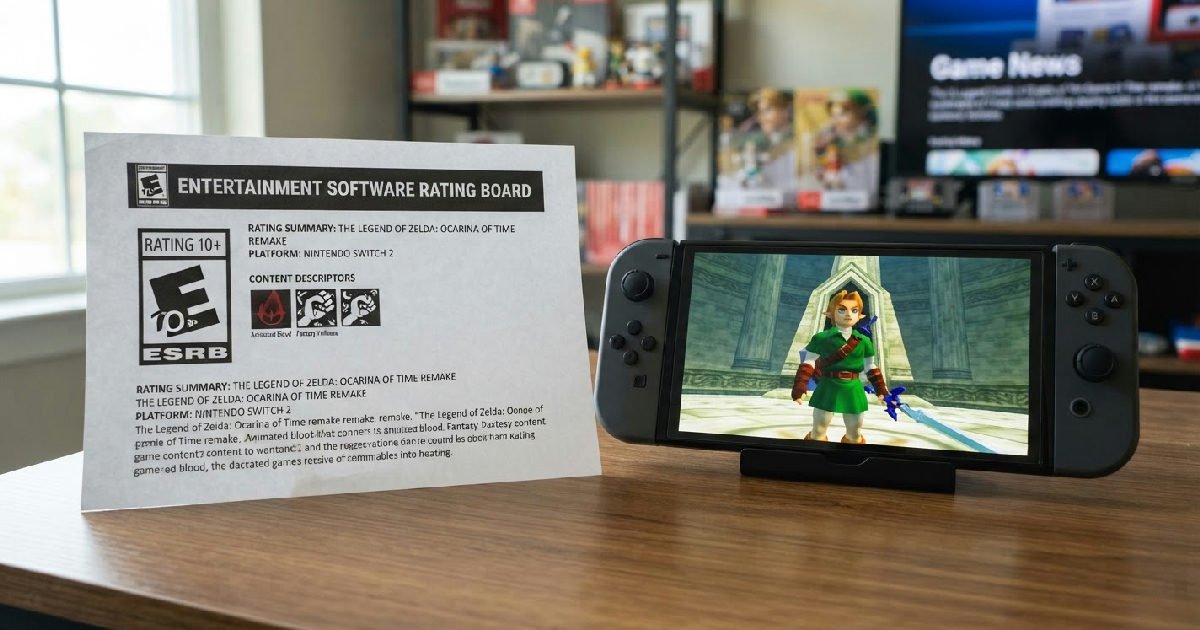
Entertainment Software Rating Board confirms E10+
The upcoming Nintendo Switch 2 remake of The Legend of Zelda: Ocarina of Time has received its official rating summary from the Entertainment Software Rating Board (ESRB). The document confirms an E10+ rating, citing “Animated Blood” and “Fantasy Violence” as key content descriptors ahead of the game’s highly anticipated November 5, 2026 release.
Published on October 23, 2026, the summary provides the first official, detailed look at the content that led to the rating. It offers fans and parents a clearer picture of what to expect from the modern overhaul of the classic 1998 adventure, which is being rebuilt from the ground up for Nintendo’s new hardware.
Software rating board details confirmed
The ESRB’s description outlines the game’s core experience, which remains faithful to the original. “This is an adventure game in which players assume the role of a hero on a quest to defeat evil and save a fantasy realm called Hyrule,” the summary begins, confirming the familiar third-person perspective and gameplay loop.
The rating specifically addresses the game’s combat. “Players use swords, shields, arrows, and magic spells to attack enemies,” it states. “Battles are accompanied by impact sounds, colorful light effects, and cries of pain.” The most notable detail comes from the “Animated Blood” descriptor, which the ESRB clarifies by noting, “Certain enemies may emit a green or purple blood effect when defeated.”
This level of detail confirms that while the game features violence integral to its plot, it remains stylized and non-realistic. The combat against “fantastical enemies (e.g., bat-like, spider-like, chicken-like enemies; guards)” aligns with the traditional Zelda formula. The summary also notes that some areas contain larger boss enemies that require “more protracted combat to defeat.”
Rating Comparison with Past Versions
Interestingly, the rating for the Switch 2 remake differs slightly from its predecessors. The original Nintendo 64 game from 1998 was given a simple “E for Everyone” rating, which at the time covered mild fantasy violence. The 2011 remake for the Nintendo 3DS, titled Ocarina of Time 3D, was the first version to receive the higher E10+ rating.
However, the 3DS version also included a third descriptor: “Suggestive Themes.” The absence of this descriptor in the new Switch 2 summary suggests that Nintendo may have revisited and altered some of this content for the 2026 release, or that the ESRB’s standards or interpretation have evolved in the intervening 15 years.
This small but significant change has already sparked discussion among fans about how the game’s tone might be subtly adjusted. This focus on accessibility for a broad family audience is a hallmark of Nintendo’s design philosophy.
Other international ratings bodies have issued similar classifications. The game has received a “12+” age rating in Korea and carries a provisional PEGI 12 rating on its eShop listing in the United Kingdom, indicating a global consensus on its suitability for players on the cusp of their teenage years.
Blockbuster Remake for Nintendo’s New Console
The Ocarina of Time remake is not a simple port but a full reimagining of the classic title, built to leverage the power of the Nintendo Switch 2. First revealed during a Nintendo Direct presentation on June 9, 2026, the game promises completely new visuals, fully voiced cutscenes, a re-recorded orchestral score, and modernized controls.
This project is a cornerstone of Nintendo’s strategy for its new console, which launched globally on June 5, 2025. The Switch 2 has been a sales powerhouse, moving over 23 million units worldwide as of June 2026. A tentpole release from its most revered franchise is expected to drive hardware sales even further through the holiday season.
The new hardware, which boasts a larger liquid-crystal display (LCD), more internal storage, and updated graphics, provides the foundation for such an ambitious remake. The console also introduced larger Joy-Con 2 controllers and made a library of GameCube titles available through the Nintendo Classics service, further enriching its software lineup.
The release of a major exclusive is often accompanied by a significant marketing push. These campaigns frequently include special events and downloadable content, which helps build and maintain excitement within the player base leading up to and following the launch.
The Road to Hyrule: Release Details
The Legend of Zelda: Ocarina of Time is set to launch on November 5, 2026. The digital version will be priced at $59.99 on the Nintendo eShop, while the physical game card will retail for $69.99. However, several major retailers like Amazon and Walmart have been offering pre-orders on the physical edition at a discounted $59.99 price point.
To celebrate the launch, Nintendo has confirmed that the first production run of the physical game will feature a special textured foil cover art, making it a collector’s item from day one. This release is part of a broader celebration of the franchise’s 40th anniversary, which has already seen the release of a themed Zelda 40th Anniversary Switch 2 console and Pro Controller.
These special edition hardware items, which launched in late October, sold out almost instantly at major retailers, demonstrating the incredible demand for the brand. While the game itself is sold separately, the fervor surrounding the hardware bodes well for the remake’s commercial success.
The way news can slip out through official channels like ratings boards is a stark contrast to how fans sometimes learn of upcoming projects through other means.
Looking ahead, Nintendo has also announced that new amiibo figures of Young Link and Young Zelda are planned for release in 2027. These figures will unlock retro-style in-game masks for players to use.
With just weeks until launch, the final details confirmed by the ESRB have only heightened the immense anticipation for one of the most beloved games of all time to be reborn on a new generation of hardware.