

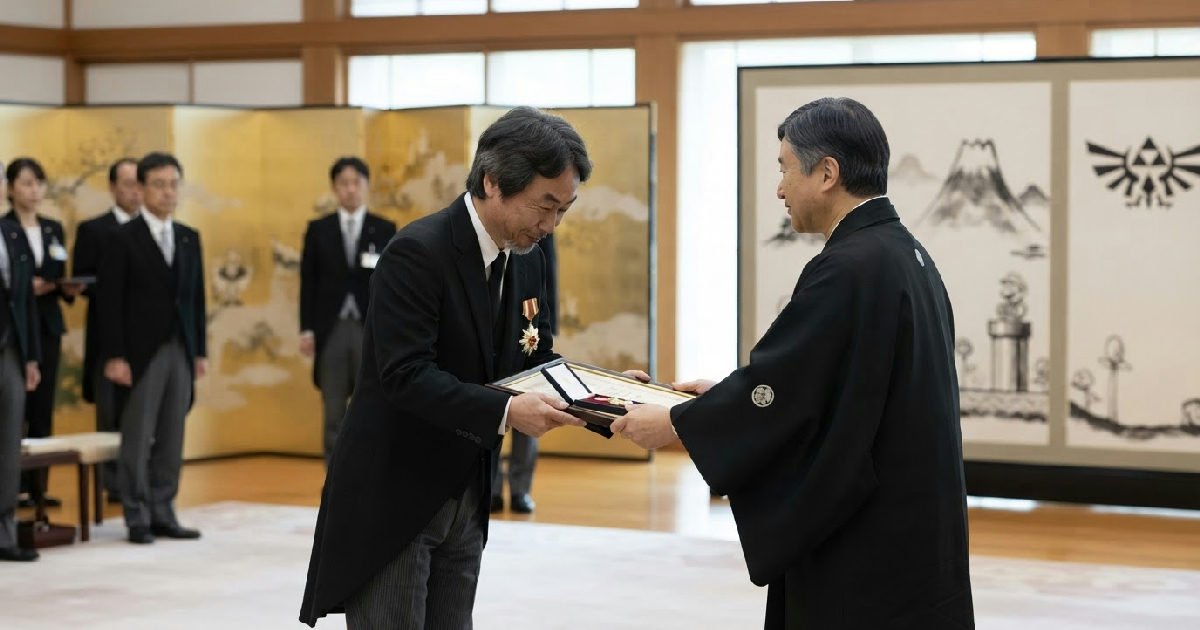
Shigeru Miyamoto Order of Culture awarded to developer
Shigeru Miyamoto, the visionary behind Nintendo’s iconic Super Mario and The Legend of Zelda franchises, has made history as the first video game developer to receive Japan’s esteemed Order of Culture award. The announcement, made on October 23, 2026, recognizes the 73-year-old’s profound contributions to Japanese culture in the “Media Arts (Gaming)” field.
This civilian honor, established in 1937, is conferred by the Emperor of Japan to individuals who have significantly advanced the nation’s arts, literature, science, technology, or general culture. Miyamoto’s formal induction will take place on November 3, 2026, Japan’s Culture Day, at the Imperial Palace in Tokyo, where the Emperor will personally present the award.
Shigeru Miyamoto Order of Culture: A Groundbreaking Recognition for Gaming
The awarding of the Order of Culture to Shigeru Miyamoto marks a pivotal moment for the video game industry. It signifies a governmental acknowledgment of video games as a legitimate and impactful cultural art form within Japan.
Traditionally, recipients have been figures from classical arts, literature, and fundamental sciences. Miyamoto’s inclusion amongst the eight honorees for 2026 underscores a generational shift in how cultural contributions are perceived and celebrated.
A Career Defining a Generation
Miyamoto’s career at Nintendo began in 1977, following his industrial design studies at Kanazawa College of Art. He quickly became instrumental in shaping the nascent video game landscape, transforming it with his innovative design philosophies and beloved characters.
His creative genius is evident in franchises that have sold over a billion copies globally, including Mario, The Legend of Zelda, and Donkey Kong. These titles didn’t just entertain; they defined genres and influenced countless other creators.
In 2019, Miyamoto was previously designated a Person of Cultural Merit, another first for the gaming sector. This earlier recognition paved the way for his eventual selection for the higher Order of Culture, following a rigorous process involving recommendations to the Prime Minister and Cabinet approval.
Miyamoto’s Humble Acceptance and Broader Reach
Responding to the news, Shigeru Miyamoto expressed humility and gratitude. “I feel quite embarrassed, to be honest, but I am truly honored to have been chosen for such a prestigious award,” he stated, reflecting his characteristically modest demeanor.
He further elaborated, “As I have often said, these achievements were not the work of one person, but the result of collaboration with many others. I accept this honour on their behalf.” This distinction between his personal feelings and acknowledging team efforts provides a clearer picture of his sentiments.
The award recognizes not only his direct game development but also his expanding influence. Miyamoto has lately branched out into projects beyond traditional gaming, such as Universal Studios Japan’s “Super Nintendo World” theme park and various film ventures, including The Super Mario Bros. Movie. His increasing involvement in film productions showcases his diverse creative impact.
These initiatives have broadened the cultural footprint of his creations, demonstrating their enduring appeal across different media. This adaptability reinforces the argument for gaming as a multifaceted cultural force.
Japan’s Order of Culture: A Legacy of National Honor
The Order of Culture, instituted in 1937, represents Japan’s highest civilian recognition for profound contributions across various national endeavors. It aims to commend individuals who have significantly enriched the nation’s artistic, literary, scientific, technological, or broader cultural fabric.
The selection process is rigorous, beginning with recommendations from the Minister of Education, Culture, Sports, Science and Technology to the Prime Minister. The final decision then rests with the Cabinet, ensuring a thorough vetting of candidates.
Historically, the award has honored luminaries such as Nobel Prize winner Hideki Yukawa and baseball legend Sadaharu Oh. Each year, approximately five individuals are chosen, making the recognition highly exclusive and a definitive mark of national significance.
Recipients of the Order of Culture also receive a lifetime pension of 3.5 million yen annually, underscoring the nation’s commitment to supporting its most distinguished cultural contributors. Miyamoto joins seven other honorees for 2026, reflecting diverse fields from architecture to biological science.
Shaping Global Entertainment and Cultural Impact
Shigeru Miyamoto’s influence extends far beyond Japan’s borders, solidifying his status as a global icon in entertainment. His design philosophies, which prioritize accessibility and joyous interactivity, have shaped the global video game industry for decades.
He’s been recognized internationally with numerous accolades, including France’s Chevalier des Arts et des Lettres in 2006 and a BAFTA Fellowship from the British Academy of Film and Television Arts in 2010. These awards highlight the universal appeal and artistic merit of his work.
Miyamoto’s creations have transcended their original medium, becoming cornerstones of global pop culture. Characters like Mario are instantly recognizable worldwide, bridging generational and cultural divides, further solidifying gaming’s mainstream acceptance.
Expanding Beyond the Console
Miyamoto’s recent ventures into theme park design with Universal Studios Japan’s “Super Nintendo World” and his involvement in film projects like The Super Mario Bros. Movie illustrate this expansive reach. These initiatives introduce his iconic worlds to new audiences.
He views these projects as natural extensions of his creative vision, bringing the immersive experiences of his games into physical and cinematic realms. This multi-platform approach underscores the enduring power of his storytelling and character development.
His ability to adapt and innovate across different media platforms reinforces his legacy as a pioneer in interactive entertainment. Miyamoto’s journey highlights how video games have evolved from niche pastimes to central pillars of global entertainment culture, expanding his influence beyond just new game releases.
A Half-Century of Game-Changing Innovation
Miyamoto joined Nintendo in 1977, fresh from his studies in industrial design, and immediately immersed himself in the nascent world of electronic entertainment. He initially contributed art for arcade games like Sheriff before creating the groundbreaking Donkey Kong in 1981, which launched his legendary career.
His roles evolved significantly within Nintendo, moving from a designer to head of the Information Development Section in 1983 and then General Manager of the Entertainment Analysis & Development Division by 1998. Since 2015, he has served as a Creative Fellow, providing expert guidance.
Miyamoto recently mused about his tenure, noting that he had originally calculated his time in games as 45 years. But after re-evaluating, he concluded it’s actually been 50 years since he joined Nintendo and immediately began working on games in 1977.
He added, “I have been able to continue this work ever since. I believe I am receiving this recognition precisely because I was there from the very dawn of the industry, and I feel that I have led a very lucky life.” This reflection encapsulates his journey through the evolution of interactive entertainment.
His ongoing impact on the gaming world continues to shape new projects and inspire future developers, even extending to discussions around upcoming game events and rewards.