

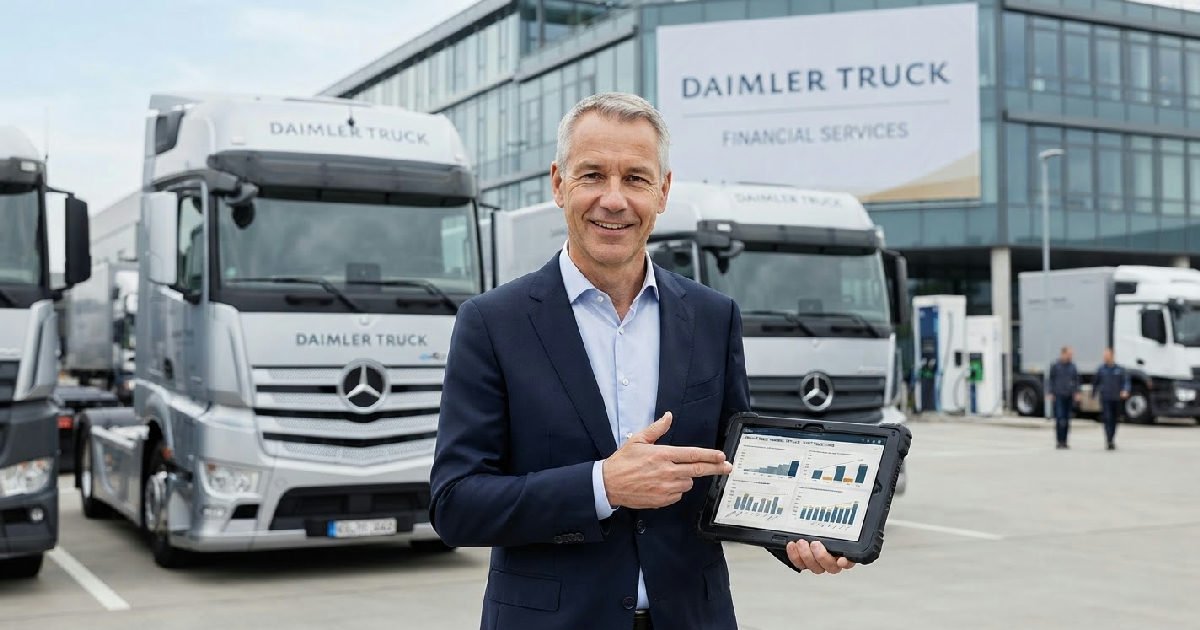
Daimler Truck financial arm drives subscription shift for fleets
The global trucking industry is currently undergoing a profound transformation, moving away from traditional truck ownership towards flexible, subscription-based models. This significant shift, often termed “Truck-as-a-Service” (TaaS), is being actively championed by major players like Daimler Truck and its financial arm, Daimler Truck Financial Services.
On 2026-10-18, discussions with Daimler leadership underscored how these bundled services aim to redefine fleet finance, offering predictability and easing the adoption of new technologies.
Daimler Truck Financial Services: A Bundled Approach to Fleet Management
This evolving landscape addresses long-standing industry challenges, from high upfront capital expenditures to the complexities of maintenance and insurance. Stephan Unger, chairman of Daimler Truck Financial Services, explained that customers increasingly seek simplified operations. Consolidating multiple vendors and invoices into a single, predictable monthly rate allows carriers to focus more on freight movement and less on managing a mosaic of operational costs.
At its core, Truck-as-a-Service represents a comprehensive bundling of services traditionally managed separately by fleet operators. This includes financing or leasing, scheduled maintenance, repair contracts, insurance, telematics, and extended warranties. Manufacturers like Daimler Truck are now integrating these components into one monthly payment.
Daimler Truck Financial Services, for example, is transitioning from a pure financing entity into an integrated solutions provider, reflecting broader industry trends towards integrated solutions. This strategic pivot aligns with the increasing demand for seamless business operations. With over 30 billion euros in assets under management across 21 countries, and an A credit rating, Daimler has the financial muscle to back these extensive bundled offerings.
The most complete iteration of TaaS is full-service leasing and rental, where companies pay for access to a working truck rather than outright ownership. Daimler operates a unit in Europe, Charterway, which manages over 6,000 trucks for short and long-term rental customers. This model emphasizes uptime, providing replacement vehicles if one breaks down, ensuring carriers can meet their commitments.
In North America, Daimler extends similar full-service leasing options through partnerships with companies like Penske and Ryder. The overall objective remains consistent: to allow carriers to concentrate on their core business of logistics while the provider handles the complexities of vehicle management. This approach simplifies fleet operations considerably.
Driver-as-a-Service: Powering Autonomous Fleets
An even newer and more intricate development in this service-oriented paradigm is “Driver-as-a-Service” (DaaS), specifically tailored for the advent of autonomous trucks. As human drivers are replaced by advanced software systems, the question arises of how to monetize this driving capability. The answer emerging from manufacturers like Daimler is a subscription model.
Under this model, the physical truck and chassis are still acquired through traditional purchase or finance methods. However, the “virtual driver” — the autonomous system itself — is delivered as a per-mile software-as-a-service charge. This effectively splits the cost of a truck into a capital purchase for the hardware and a running subscription for the driving capability, billed by the mile.
Daimler’s autonomous program centres on a redundant Freightliner Cascadia, paired with a virtual driver from its subsidiary Torc Robotics. Leadership expects to see the driver on a first route by the end of 2026, building towards commercialization at scale around 2028. This means DaaS isn’t a distant concept; it’s a payment model being actively designed and implemented today.
The Ownership Question: Flexibility Amidst Evolving Models
The shift towards trucking subscription models inevitably raises a fundamental question: what does a customer actually own, and do they even need to? Kevin Bangston, President and CEO of Daimler Truck Financial Services USA LLC, highlights that flexibility is the key. Fleets retain the choice to select what best suits their operational and financial needs.
Customers can still opt for straightforward financing to own the truck outright, making monthly instalments and managing resale themselves. Alternatively, they can choose an operating lease with its own financial advantages. The goal, Bangston noted, is to offer a comprehensive menu of states, allowing businesses to layer services according to their cash flow and desired flexibility.
Crucially, North America hasn’t witnessed a drastic exodus from ownership into leasing, indicating a growing interest in bundled services rather than a wholesale abandonment of traditional models. This widening array of options means manufacturers are increasingly focused on selling “access to a working truck” rather than solely the vehicle itself.
Residual value uncertainty, particularly for battery-electric trucks, is another significant force driving carriers toward these models. The battery component makes the future worth of a used electric truck unpredictable. Stephan Unger emphasized that Daimler is willing to absorb this residual risk, leveraging its battery management systems and data collection capabilities to assess vehicle health more accurately than individual owners.
Strategic Imperatives: Why Fleets Embrace Subscriptions
The adoption of Truck-as-a-Service models is driven by several strategic imperatives for fleet operators. One of the primary motivations is cost control and the desire for predictable monthly payments. TaaS effectively converts high upfront capital expenditures (CapEx) into more manageable operational expenses (OpEx), which is especially appealing given that electric trucks can have initial purchase costs two to three times higher than their diesel counterparts.
This financial predictability is also coupled with greater flexibility and opportunities for modernization. Subscription models make it easier for companies to update their fleets, adapt to changing market demands, and seamlessly upgrade to newer, more efficient models at the end of a term.
Christian Hummel, Executive Vice President, Global Head of Automotive at Capgemini Invent, remarked that these models offer a practical solution to the high upfront costs of zero-emission vehicles, accelerating the transition to a more sustainable future.
The reduction of risk is another powerful draw. TaaS mitigates depreciation risk, as providers bear the burden of asset value decline. Bundled services, including maintenance, repairs, insurance, telematics, and roadside assistance, further simplify fleet management, allowing companies to focus on their core logistics operations.
The global Truck-as-a-Service market is projected to reach between $20.0 billion and $40.0 billion by 2025, with continued growth expected at a compound annual rate of 15.0% to 25.0% through 2030.
The Financial Calculus: Weighing Predictability Against Equity
While the benefits of subscription models are clear, fleets must carefully consider the financial trade-offs. Bundling services undeniably offers predictability, consolidating a truck, its maintenance, insurance, and warranty into a single, fixed monthly rate. This can be invaluable for operations with tight cash flow, turning unexpected major repair costs into a provider’s problem.
However, this predictability often comes at the expense of the upside associated with traditional ownership. When a carrier owns and meticulously maintains a truck, they capture its full resale value, build equity, and eventually, a paid-off truck can become a significant “margin machine” for the business.
Handing the entire lifecycle management to a service provider means trading that equity and potential upside for convenience and steady costs.
Richard Howells, Vice President of Thought Leadership at SAP, defines this as “servitization,” where the focus shifts to selling an “outcome as a service” rather than a one-off asset.
For example, a PowerFleet subscription for truck and trailer services starts at $30 a month, with hardware for a tractor costing between $575 to $625 per unit. This model exemplifies how technology and services are increasingly intertwined with the physical asset.
Ultimately, neither ownership nor subscription is inherently superior; the optimal choice hinges on a fleet’s breakeven point, cash position, and how it values a stable financial outlook versus the potential for greater returns. The critical mistake lies in adopting a bundled model without thoroughly comparing its long-term costs and benefits against those of traditional ownership. As Jack Legler, Technical Director of American Trucking Associations’ Technology & Maintenance Council, puts it, the industry is “going through an evolution on this.”