

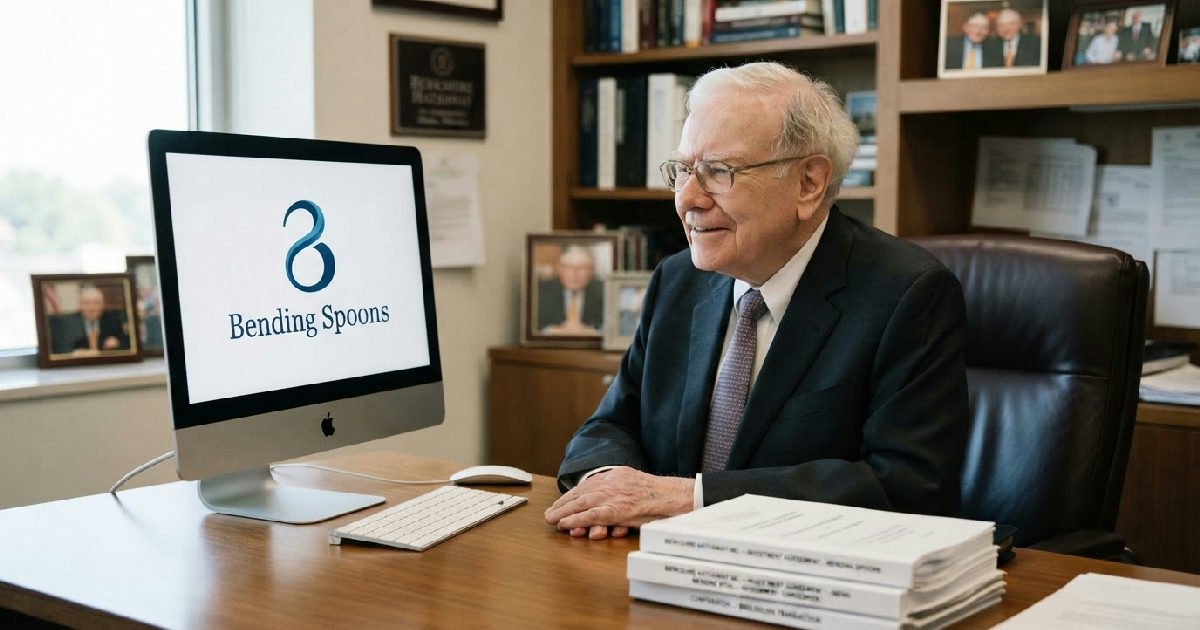
warren buffett’s berkshire hathaway invests over $900 million
Milan-based holding company Bending Spoons has cemented its position as a surprising new player in the tech acquisition landscape, securing over $900 million in investment from Warren Buffett’s Berkshire Hathaway. This significant backing, including a $330 million stake disclosed just this week, is fueling Bending Spoons’ ambitious strategy to acquire and revive software companies struggling in the artificial intelligence (AI) era.
The move comes less than four months after Bending Spoons’ initial public offering (IPO) on the Nasdaq in July 2026. Experts believe the substantial investment from such a prominent entity as Berkshire Hathaway signals a major vote of confidence in Bending Spoons’ distinctive business model, which focuses on breathing new life into older or underperforming internet names and software-as-a-service (SaaS) firms.
Buffett’s Berkshire Hathaway bets on software
Berkshire Hathaway, often cited by Bending Spoons as a key inspiration for its long-term investment strategy, has now poured more than $900 million into the Italian firm. Wall Street reacted positively to the news, with Bending Spoons’ stock initially climbing 41% before moderating, settling the company’s market capitalisation at approximately $30 billion.
Analysts at Mizuho highlighted the importance of this renewed investment. “Berkshire’s decision to add to its position just a few months after the IPO and at these levels provides another vote of confidence in the Bending Spoons model from one of the world’s most respected long-term investors,” a Mizuho report stated following the announcement.
This substantial capital infusion positions Bending Spoons to accelerate its aggressive acquisition strategy. The company is actively targeting businesses that once enjoyed high valuations but now face challenges as the AI boom reshapes the technology sector.
The SaaSpocalypse and Tech Landscape Shifts
Bending Spoons’ strategy emerges amidst a dramatic shift in the technology industry, a phenomenon some are calling the “SaaSpocalypse.” The rapid ascent of artificial intelligence, particularly large language models powering new agents like Anthropic and OpenAI, is displacing traditional software developers and their products. These AI firms are now commanding valuations approaching trillion-dollar figures.
Businesses increasingly prefer to integrate AI-powered solutions, often at the expense of established SaaS products. This trend has led to a significant downturn for many once-dominant software companies. Shares of industry stalwarts like Intuit, HubSpot, and Adobe have all seen declines of at least 30% this year alone.
Moreover, a host of private SaaS companies, previously venture capital darlings, are now struggling to secure additional funding. The public market, too, has shown little appetite for new software IPOs, reflecting widespread investor caution. This creates a fertile ground for acquirers like Bending Spoons seeking undervalued assets.
Bending Spoons’ Unique Acquisition Playbook
Founded in 2013 by Luca Ferrari, Matteo Danieli, and Francesco Patarnello, Bending Spoons initially started with mobile app development. After an early app, Evertale, failed, they pivoted to building an operating company, a decision that proved prescient. Today, Luca Ferrari serves as CEO, steering the company’s aggressive M&A efforts.
Unlike traditional private equity firms such as Thoma Bravo or Vista Equity Partners, Bending Spoons isn’t focused on quick exits. Instead, it aims to generate long-term profits from its acquired businesses, mirroring the sustainable growth model championed by Berkshire Hathaway. Indian software stocks, for example, have also seen shifts as global AI enthusiasm has cooled for some sectors.
The company takes a hands-on approach, leveraging its own software, operational expertise, and personnel decisions to integrate and optimise acquired assets. Lloyd Walmsley, an analyst at Mizuho, underscored this distinction.
“I think there aren’t a lot of people that do what these guys do in terms of the depth of operations and the willingness to make substantial product changes,” Walmsley noted. “It’s not typical of traditional private equity firms to make anywhere near this level of change.”
Controversial Cost-Cutting Measures
This hands-on approach often involves significant restructuring, including substantial job cuts, which Bending Spoons describes as a necessary step for efficiency. Layoffs have been implemented across its portfolio, affecting employees at companies like Evernote, Vimeo, and WeTransfer.
The recent acquisition of workflow software provider Airtable for about $1.3 billion, a valuation almost 90% below its 2021 peak, provides a clear example. Bending Spoons announced that a “large portion of the pre-acquisition team” from Airtable would be leaving with “substantial separation packages.”
Similarly, last month, the company agreed to acquire collaboration software vendor Miro for $1.36 billion, a steep discount from its previous $17.5 billion valuation.
Nick Mehta, former CEO of cloud software vendor Gainsight, observed that many private equity firms are now struggling to make similar acquisitions due to prior overpayments. “They paid much higher prices and have so many troubled companies that it’s difficult for them to take swings now,” Mehta explained.
He added that anything predating ChatGPT is increasingly seen as “legacy” software, creating a challenging market for sellers.
Portfolio Expansion and Customer Impact
Bending Spoons has rapidly expanded its portfolio of “software castoffs.” Its acquisition spree began with Evernote in 2022, followed by Brightcove in 2024. In 2025 alone, the firm acquired Vimeo, AOL, and Eventbrite, signaling its aggressive growth strategy.
This rapid expansion, however, has not come without consequences for users. Following the 2022 acquisition of Evernote, for instance, Bending Spoons significantly increased subscription prices. The annual personal subscription jumped from $70 to $130 in April 2023, and later offerings introduced “Evernote Advanced” at $250, compared to a previous pro plan at $170.
Lloyd Walmsley acknowledged the price hikes but noted the high switching costs for users. Despite initially considering alternatives like Microsoft’s OneNote, he ultimately stuck with Evernote.
“They’re really savvy at finding these things that they provide a lot of value, and the switching costs are really high,” Walmsley said, adding that “the price isn’t that high relative to the switching cost.” Global financial institutions often consider such economic factors in their investments, looking at consumer behavior and market inelasticity.
Future Outlook for Bending Spoons and the Tech Industry
Bending Spoons’ financial performance since its IPO indicates strong growth, primarily fueled by acquisitions. In its first public earnings report in August, the company announced revenue more than doubled year-over-year to over $700 million, with net income climbing 171% to $177 million.
These figures were reported before the closing of the Airtable deal and the announcement of the Miro acquisition, suggesting even further growth in subsequent quarters.
CEO Luca Ferrari confirmed that the “overwhelming majority” of future growth will continue to come from additional deals. He stated that while there are opportunities for organic improvements within acquired businesses, the intrinsic market growth is then leveraged for further acquisitions. About half of Bending Spoons’ current revenue already derives from professional businesses, largely through platforms like Brightcove and Vimeo.
Ferrari believes that many enterprise SaaS businesses were valued at “irrationally high levels until somewhat recently.” He sees significant value in these discounted assets.
As Bending Spoons continues to acquire and integrate these companies, Wall Street will be closely watching to determine if this unique model can truly revive and sustain software businesses in a rapidly evolving, AI-dominated technology landscape. This novel approach represents a counter-narrative to the widespread market anxiety surrounding the impact of AI across various industries.