

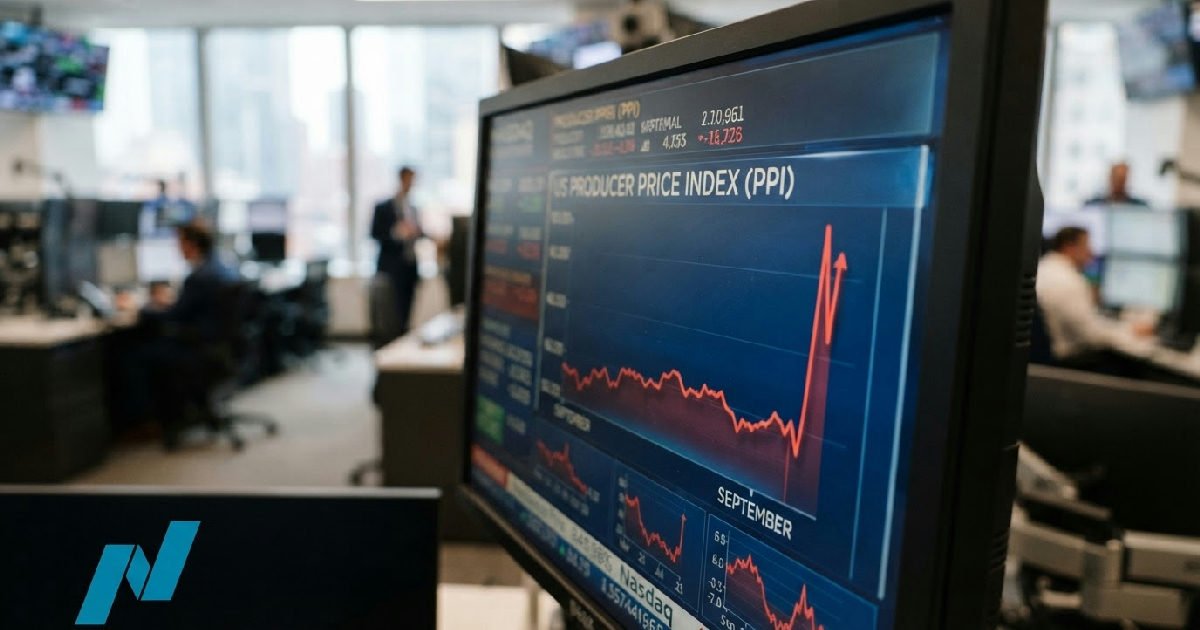
US producer inflation spike triggers Wall Street sell-off
A sharp and unexpected surge in US producer inflation rocked financial markets on Wednesday, sending Wall Street to its worst single-day loss since July and intensifying pressure on the Federal Reserve. The Producer Price Index (PPI) for September jumped 1.3%, according to data released on October 14, more than double the 0.5% rise economists had forecast.
The report, which measures prices charged by producers, showed a startling 6.3% increase on an annual basis. This sent a ripple of concern through markets, with the tech-heavy Nasdaq Composite bearing the brunt of the sell-off. The news puts the US central bank in a difficult position as it weighs its next move against stubbornly high inflation.
Understanding the US producer inflation data
The September PPI figures revealed inflationary pressures that were both stronger and more widespread than anticipated. The 1.3% month-over-month increase marked the largest such gain since March 2022, signaling that the fight against rising prices is far from over. This trend is a crucial consideration for central banks and global market dynamics.
A primary driver behind the headline number was a dramatic spike in energy costs. Gasoline prices alone soared by 20.3% in September, accounting for a large portion of the overall increase. The broader index for final demand goods rose 2.6% during the month, its largest advance since the data was first calculated in December 2009.
More troublingly for policymakers, the inflation was not confined to volatile energy and food sectors. Core PPI, which excludes these categories, rose by 0.7% from August, a sharp uptick from the 0.2% increase seen the previous month. On an annual basis, core prices climbed 5.0%, indicating that inflationary momentum is building across the broader economy.
Such persistent inflationary signals often prompt investors to re-evaluate their strategies, looking for ways to protect their capital amidst economic uncertainty.
This persistence of core inflation presents a significant challenge for the Federal Reserve. While energy shocks can be transient, rising prices across services and other goods suggest inflation is becoming more embedded. After 5.5 years of inflation remaining above the Fed’s 2% target, these latest figures will test the central bank’s resolve.
Wall Street reacts with tech and AI stock plunge
The market’s reaction to the inflation data was swift and decisive. On October 14, the S&P 500 sank 1.1%, while the Dow Jones Industrial Average fell a more modest 48 points, or 0.1%. The Nasdaq Composite, populated by rate-sensitive technology firms, slid 1.9% for its worst day in three months.
The selling pressure continued into Thursday’s session, with the Nasdaq dropping another 1.4% at the opening bell. Companies tied to the artificial intelligence boom, which have been market darlings for much of the year, were hit particularly hard. Dell, a key provider of data centre servers, saw its shares fall 9%, while Coherent Corp, a maker of components for AI data centres, also dropped 9%.
The downturn was not limited to the United States. Global markets felt the ripple effect, with South Korea’s Kospi 200 index plummeting over 8% overnight to a six-month low. Major semiconductor stocks like Samsung Electronics and SK Hynix plunged nearly 9.5% and 11% respectively, highlighting investor fears that higher interest rates could choke off the capital investment fueling the AI buildout.
This global sell-off underscores how interconnected financial markets have become. Fears of a hawkish Federal Reserve in Washington immediately translate into revised growth expectations and lower stock valuations for companies from Seoul to Frankfurt, creating a challenging environment for global investors.
Federal Reserve cornered as rate hike bets rise
The hotter-than-expected PPI report has placed the Federal Reserve in a precarious position. The central bank has already undertaken a historically aggressive campaign of interest rate hikes to tame inflation, and this latest data release makes it harder to justify a pause. Market pricing now suggests a growing probability of another rate increase before the end of the year.
Waleed Said, a technical analyst at GivTrade, noted that the data suggests the “energy shock… is spreading.” While he cautioned against overreacting, he concluded that “a rate hike in December does seem imminent.” This sentiment was reflected in the bond market, where the 10-year Treasury yield briefly jumped above 5.32% before moderating, a sign of heightened investor anxiety over the future path of monetary policy.
For months, the Fed has been walking a tightrope, trying to cool the economy without triggering a deep recession. This data complicates that balancing act. Persistently high inflation could force its hand, leading to tighter financial conditions that could impact everything from corporate borrowing costs to household mortgages.
Such decisions by the Federal Reserve invariably cast a long shadow over capital markets, influencing investment firms and corporate planning across various sectors.
A divergent picture in the United kingdom
While US markets grappled with inflation fears, the economic picture in the United Kingdom appeared notably different. London’s FTSE 100 share index rallied to a five-week high, gaining 1.1% to reach 10,843 points. This resilience was bolstered by a surprise report from the Office for National Statistics (ONS) showing the UK economy grew by 0.1% in August, defying economists’ forecasts of a 0.1% contraction.
Kathleen Brooks, research director at XTB, described the UK as a “harbour in the storm” amid the global AI stock sell-off. The relative strength of the pound and the UK government bond market further supported this view. The unexpected economic growth provided a welcome boost just weeks before a critical budget announcement.
Speaking at the International Monetary Fund (IMF) annual meetings in Bangkok on October 15, UK Chancellor John Healey added to the distinct narrative. Amid speculation that his upcoming budget on October 28 could include new taxes on banks, Healey praised the financial sector.
He referred to the banks as part of the “jewel in the crown” of the UK economy, emphasizing that they are “hardwired into the economic fabric of this country.”
While Healey remained non-committal on specific tax plans, stating he had “decisions to take,” his supportive language was seen as an an attempt to quell industry anxiety. The IMF has praised Britain’s fiscal plans, and Healey reiterated his commitment to meeting the country’s fiscal rules while providing “breathing space” for consumers and businesses.
Geopolitical and regulatory undercurrents
Beyond the immediate inflation and market news, several other developments highlighted the complex global economic landscape. In Brussels, European Union leaders are reportedly preparing to call for new measures to address the bloc’s vast trade deficit with China, which reached €360 billion in 2025.
Germany and France have been advocating for a more hawkish stance, including a potential “kill switch” to limit market access in cases of severe imbalances.
An EU diplomat underscored the urgency, stating, “We don’t have much time because every month that goes by, thousands of jobs are lost.” This reflects growing protectionist sentiment in Europe as the continent grapples with factory closures and job losses blamed on unfair competition, pushing nations to protect domestic industries.
Meanwhile, in the United States, a bipartisan group of lawmakers led by Senator Elizabeth Warren introduced the “Epstein Wall Street Records Act.” The bill aims to hold financial executives accountable for any role in financing the crimes of the late sex offender Jeffrey Epstein.
If passed, it would empower regulators to investigate, fine, and potentially ban wrongdoers from the financial sector, adding another layer of regulatory pressure on Wall Street.