

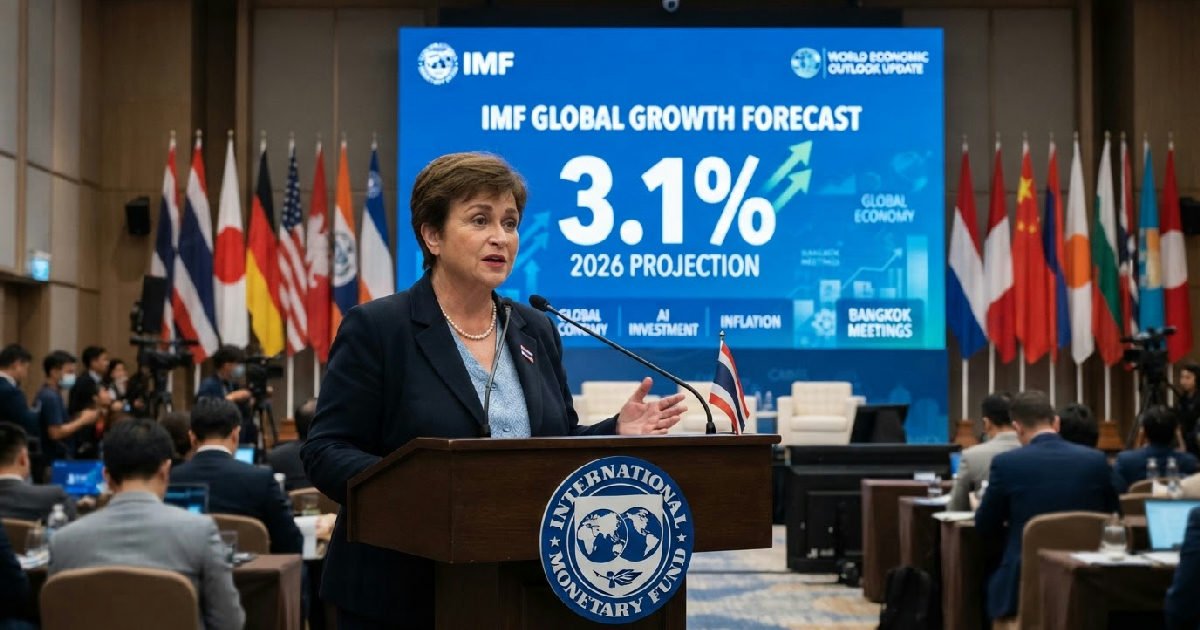
IMF raises 2026 IMF global growth forecast to 3.1%
The International Monetary Fund (IMF) has slightly upgraded its forecast for global economic growth in 2026, now projecting a 3.1% expansion. This modest revision comes as a booming artificial intelligence (AI) investment cycle provides a significant counterbalance to the economic fallout from the Middle East war and elevated energy costs.
The updated outlook was released on October 13, 2026, during the joint annual meetings of the IMF and World Bank Group in Bangkok, Thailand.
AI Investment and the IMF Global Growth Forecast
Finance ministers and central bank governors from the IMF’s 191 member nations are convening in the Thai capital. Their discussions are centered on pressing global issues, including geopolitical tensions, rising public debt, and the transformative, yet potentially destabilizing, influence of artificial intelligence on economies worldwide. The report, titled “Resilience Under Strain, Urgent Choices,” highlights the complex interplay of these forces.
The IMF noted that AI-related investments delivered a substantial “demand impulse” to the global economy. This surge in technology spending helped maintain economic activity through the first half of the year, exceeding initial expectations despite ongoing geopolitical and trade tensions. Financial markets, too, remained largely stable, a phenomenon the IMF suggested might partly stem from “AI-related exuberance.”
Economies deeply integrated into the AI supply chain are experiencing significant gains. Taiwan Province of China, for example, is forecast to achieve an impressive 10.7% growth this year, reflecting strong demand. South Korea is projected to grow by 3.3%, marking a notable increase from 1.1% in 2025, largely driven by surging semiconductor demand.
These nations, especially Taiwan and Korea, collectively account for 62% of net trade in AI computing hardware.
The IMF estimates that private-sector-driven investment in AI could surpass $2 trillion globally in 2026. This makes it one of the fastest-growing engines of economic expansion. These investments are pouring into critical sectors like semiconductors, data centers, and power generation, anticipating future productivity gains from AI technologies.
Geopolitical Tensions and Energy Market Resilience
While AI offers an uplift, the global economy continues to grapple with the profound impact of the Middle East war. The IMF’s latest assessment indicates a surprising resilience in the face of these challenges, performing better than initially feared. Efforts to diversify fuel sources and tap into strategic reserves have been crucial in containing energy-market turmoil, allowing global markets to remain relatively stable.
The crucial Strait of Hormuz, a vital chokepoint for global oil trade, saw its exports average 88% of pre-conflict levels in September as traffic picked up. The IMF now operates on the baseline assumption that the Strait of Hormuz will fully reopen by March 2027, with conditions returning to pre-war levels by October 2027.
This revised timeline offers some clarity but still extends the period of uncertainty.
Despite this resilience, the war has had significant regional consequences. Saudi Arabia’s 2026 outlook was cut by 5 percentage points from July, now projecting a 3.3% contraction. The IMF forecasts oil will average about $96 a barrel in 2026, a substantial 41% higher than in 2025. These elevated energy prices continue to strain energy-importing nations.
Concentrated Growth and Fiscal Tightropes
The IMF report underscores an increasingly uneven distribution of global economic growth. Just 32 economies now account for 95% of worldwide growth, a sharp reduction from 54 economies recorded in April. This concentration means nearly half of all economies saw their growth forecasts downgraded, reflecting a widening divergence in economic performance.
Countries with limited exposure to the war-induced supply shocks and those benefiting from AI-led demand are either maintaining or strengthening their positions. The United States, bolstered by private consumption, fiscal policy, and tech investment, is projected to expand 2.3% in both 2026 and 2027. But energy importers, particularly those outside the tech supply chain, face higher import bills and weaker real incomes.
The euro zone, for instance, is estimated to achieve just 1.1% growth this year, battling elevated energy costs and subdued consumer confidence. The Middle East and Central Asia region is projected to contract by 0.3% this year. Several nations within this region, including Bahrain, Iraq, Kuwait, and Qatar, face double-digit declines before anticipated double-digit rebounds in 2027.
Rising Risks and Public Debt Concerns
Despite the better-than-expected growth, the IMF warned that the global economy’s capacity to absorb new shocks is under considerable strain. Global oil reserves are being drawn down at approximately 2.7 million barrels a day, nearing levels that could trigger sharp price volatility. This depletion, coupled with stretched government budgets, leaves little room for maneuver should another major crisis emerge.
The potential for a “reassessment of AI-related profitability and productivity prospects” also poses a significant risk. If the expected productivity gains from AI fail to materialize, the IMF cautions that this could lead to excessive investment pulling back and a sharp correction in equity markets. In such a scenario, U.S.
equities could plummet by 20%, potentially reducing global growth by 1.1% below baseline estimates by 2028, with Asia suffering a 1.7% reduction.
Advanced economies face mounting fiscal challenges, with benchmark yields climbing to multi-decade highs. Public debt in these nations is projected to reach 115% of GDP by 2031, up from 108% in 2025. Emerging and developing economies aren’t immune, with their public debt expected to climb to 84% from 74% over the same period.
This growing debt burden is exacerbated by higher real interest rates and increased defense spending pressures.
Policy Frameworks and Future Outlook
The International Monetary Fund emphasized the urgent need for governments to rebuild fiscal space. It recommended that any support for households facing rising energy and food costs should be temporary, highly targeted, and non-distortionary. Policies, the IMF stressed, must foster adaptability, maintain credible frameworks, and reinforce international cooperation to navigate the current complexities.
The central challenge with artificial intelligence lies in ensuring macroeconomic and institutional frameworks remain flexible. They need to be forward-looking and resilient enough to handle various diffusion paths and transition risks.
This proactive approach aims to harness AI’s benefits while mitigating its potential for inflationary pressures and financial fragility, which the IMF’s models suggest could push global inflation above 5% in 2027 with a 35% probability.
Ultimately, the global economy is not simply slowing or accelerating; instead, growth is being reallocated based on countries’ exposure to the war-induced supply shock and the burgeoning demand for AI-related technologies. This creates a bifurcated landscape where some nations thrive on tech-led momentum, while others struggle with energy costs and geopolitical instability, requiring careful policy calibration from global leaders.