

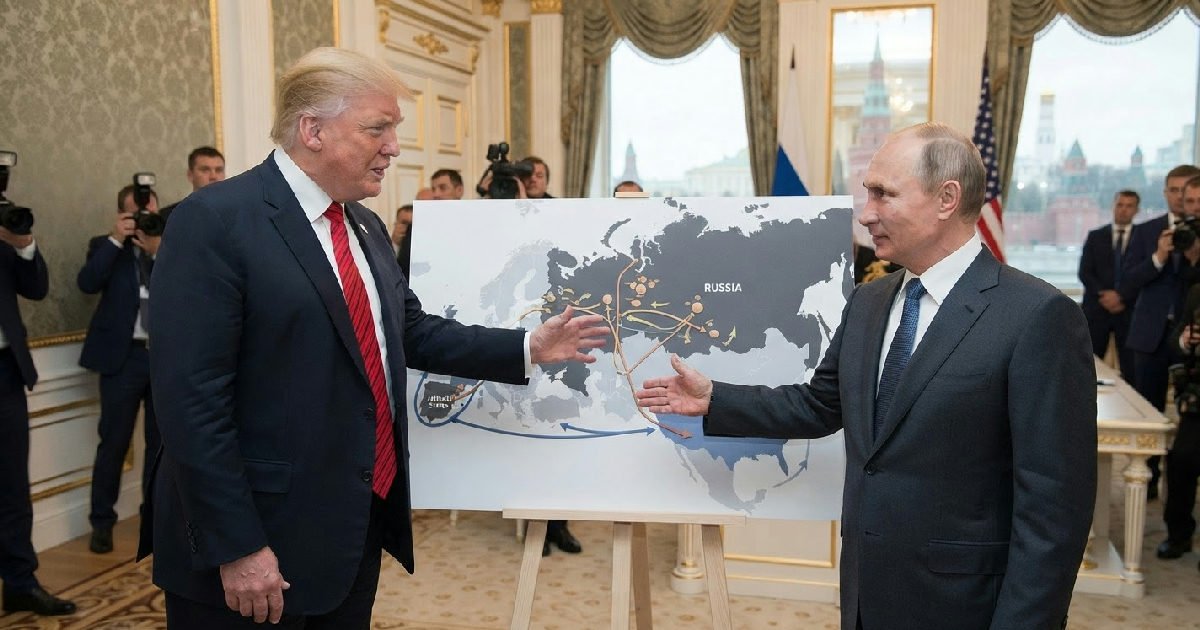
president trump announces russian diesel deal with putin
President Donald Trump announced a contentious agreement on Friday, October 9, 2026, revealing that Russia, under President Vladimir Putin, has committed to supplying millions of tons of diesel fuel to American and global markets. The Russian diesel deal, brokered after a “highly successful discussion” between the two leaders, aims to alleviate surging US fuel prices ahead of the upcoming midterm elections.
The US Treasury Department’s Office of Foreign Assets Control (OFAC) promptly issued a temporary license. This action effectively waives existing sanctions on Russia’s energy sector, permitting the importation of Russian diesel until April 2027. The move has ignited immediate criticism from Ukrainian leadership and prominent Democratic Senators.
Controversial Russian diesel deal unveiled
President Trump utilized his Truth Social platform to make the surprise announcement. He framed the initiative as a direct response to domestic economic pressures, particularly the spiraling cost of diesel. This commodity is critical for the nation’s transportation and agricultural sectors.
The White House stated that securing lower prices for American farmers, ranchers, and truckers was a “Greatest Priority.” This emphasis on the American consumer signals a clear political motivation ahead of the November 3 midterm elections. High fuel costs have been a persistent economic headache for the administration.
Ukrainian President Volodymyr Zelenskyy reacted with palpable anger to the news. He denounced the agreement as a “weak decision” by otherwise strong partners, suggesting it unfairly bolsters Russia’s war efforts. Zelenskyy conveyed his condemnation via the Ukrainian Embassy in Washington and a social media post, warning that “Gifts to Putin will not bring peace.”
Treasury Temporarily Lifts Russian Sanctions
The US Treasury Department’s swift action to issue a temporary license underscores the urgency of the situation. This waiver permits Russian diesel loaded onto tankers as of October 9, 2026, to enter the global market. The authorization marks a significant, albeit temporary, reversal of the stringent sanctions regime imposed on Moscow.
Under the terms of the agreement, Russia is set to deliver an initial 300,000 tons of diesel fuel immediately, equating to roughly 2.25 million barrels. An additional 500,000 tons are slated for November, followed by another 1 million tons shortly thereafter.
Russia has also pledged an extra 3 million tons within a “short period of time,” contingent on its refinery capacity. This volume contributes to the global supply outlook.
This infusion of Russian fuel directly responds to a tight global distillate supply. That scarcity is exacerbated by ongoing conflicts, including the US war with Iran, which disrupted crude oil shipments. Ukrainian air strikes have also incapacitated over half of Ukraine’s oil refining capabilities, further tightening the market.
These escalating fuel costs and broader supply chain disruptions contribute significantly to shipping fuel costs across the maritime sector, impacting global commerce.
Domestic Pressures Drive Policy Shift
The decision to seek Russian diesel comes as American consumers grapple with exceptionally high fuel prices. The national average for diesel reached $6.23 per gallon, according to AAA, just weeks after hitting a record $6.52 on September 22. This represents a substantial increase from $3.89 a year ago.
Gasoline prices also remain elevated, averaging $4.46 per gallon nationally, up from $3.16 last year. These figures paint a clear picture of the economic strain on American households and businesses.
Tennessee farmer and rancher Mitchell Kolinsky articulated the profound impact of these costs on agricultural operations, emphasizing the need for relief. President Trump’s emphasis on lowering fuel prices directly addresses a key electoral vulnerability.
With midterm elections rapidly approaching, the administration faces intense pressure to demonstrate tangible improvements in economic conditions. High energy costs often serve as a bellwether for voter dissatisfaction across the country.
Political Fallout and International Criticism
Beyond Ukraine, the deal has drawn sharp rebukes from within the US political landscape. Democratic Senators Jeanne Shaheen, Chuck Schumer, and Elizabeth Warren vehemently condemned the six-month authorization. They branded it a “total betrayal of Ukraine, our European allies and American national security.”
These senators accused President Trump of undermining bipartisan legislation, specifically referencing the “Lindsey O. Graham Sanctioning Russia and Iran Act of 2026,” which aimed to increase economic pressure on Russia. This legislation was intended to counteract activities that an Iran sanctions inquiry might uncover, underscoring complexities in foreign policy.
Brett Erickson, an independent risk advisory consultant, suggested that Trump’s willingness to compromise sanctions for a comparatively small volume of diesel speaks volumes about his administration’s “desperation.” The consultant highlighted the perceived inconsistency of penalizing Russia with one hand while facilitating its energy exports with the other.
Experts Question True Economic Impact
Despite the administration’s assurances, energy policy experts remain largely skeptical about the deal’s potential to significantly impact US diesel prices. Many analysts believe the quantities involved are simply too small to move a market of the US’s scale.
The initial 300,000 tons of diesel, or 74,000 barrels per day, represents a fraction of the US’s daily domestic production of 3.6 million barrels. This limited volume is unlikely to create a lasting price shift.
Michael Lynch, a distinguished fellow at the Energy Policy Research Foundation, argued that the global market would merely reallocate existing supplies. If the US purchases Russian diesel, Russia’s previous customers would seek fuel elsewhere, ultimately keeping prices largely stable. He indicated that such a shift wouldn’t inherently introduce new supply into the global system.
Daniel Sternoff, a senior fellow at the Columbia Center on Global Energy Policy, conceded that Russian diesel might “take the edge off” prices. However, he cautioned against expectations of a substantial reduction. Sternoff cited ongoing global refining capacity issues and persistent disruptions in the Middle East as more significant factors influencing overall price levels.
Russia’s Domestic Shortages and Geopolitical Stakes
The viability of Russia consistently supplying the promised volumes also faces scrutiny, particularly from experts like Gregory Brew of the Eurasia Group. Brew pointed to Russia’s own severe domestic diesel shortages, which have been exacerbated by Ukrainian drone strikes on its refineries throughout 2024-2026. These attacks have severely hampered Russia’s refining capacity.
Indeed, Russia recently extended its own ban on diesel exports through the end of October to safeguard domestic supplies for its agricultural harvest. This internal demand raises questions about its capacity to meet large-scale export commitments without further straining its own economy.
Clayton Seigle, an energy strategist, suggested the deal benefits Russia by allowing it to offload surplus summer-grade diesel, freeing up capacity for heavier winter and arctic grades needed domestically. This strategic move could offer Russia internal energy benefits.
The deal also carries profound geopolitical ramifications. It effectively eases pressure on Russia’s war economy, a point highlighted by President Zelenskyy. Jeremy Siegel, a professor of finance at Wharton School, summarized the sentiment by calling the deal “not a permanent solution.”
Broader Implications for Energy Policy
The agreement marks a significant departure from previous US energy policy towards Russia. The Biden administration, for instance, had banned imports of Russian oil and gas in 2022 following Russia’s invasion of Ukraine. This new temporary waiver, driven by domestic economic concerns, suggests a potential shift in priorities for the administration.
The move could reshape international perceptions of Washington’s commitment to its allies and its sanctions regime. Critics worry it sends a mixed message, potentially emboldening Moscow and alienating partners who have maintained strict embargoes. The broader context of US government financial actions often reflects complex geopolitical strategies.
US Energy Secretary Chris Wright has yet to issue a comprehensive statement on the long-term strategic implications of the deal. However, the immediate political and economic fallout is clear. The decision represents a calculated risk for the Trump administration, balancing immediate voter concerns over fuel prices against broader foreign policy objectives and alliances.