

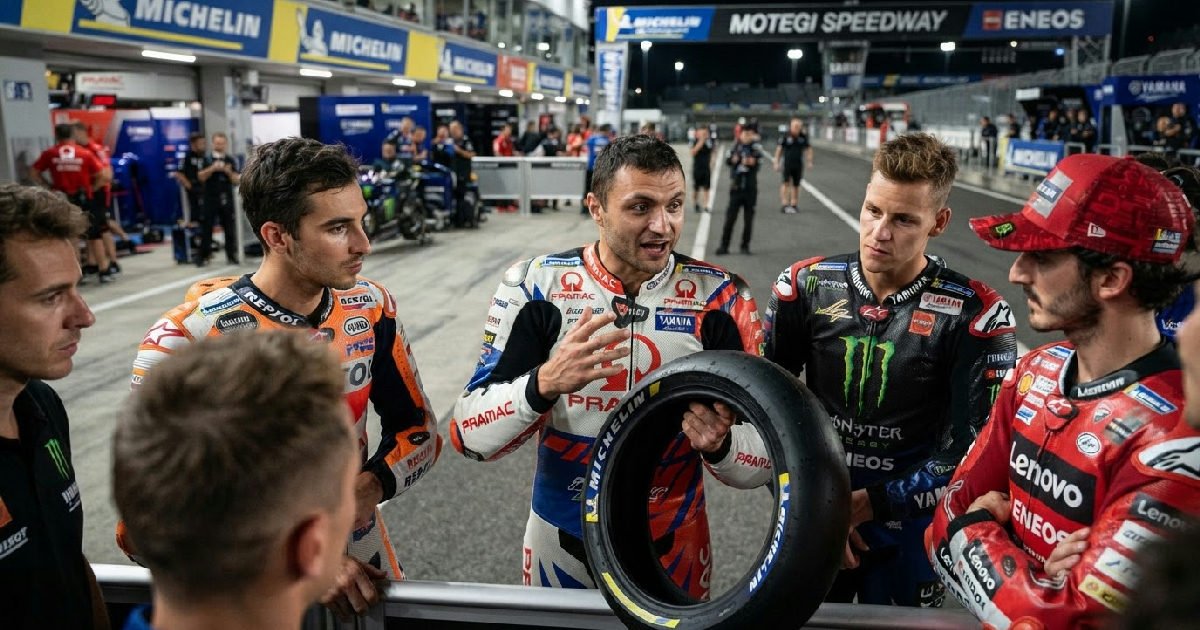
Jack Miller voices Motegi tyre concerns with Michelin
MotoGP riders have publicly dismissed the viability of Michelin’s harder-construction rear tyre introduced for the 2026 Japanese Grand Prix at Motegi. These Motegi tyre concerns, voiced by multiple competitors including Pramac Yamaha’s Jack Miller and Honda HRC’s Luca Marini, surfaced in the days leading up to the race weekend, scheduled from October 2-4, 2026.
Their collective concerns highlight a growing unease over tyre choices, posing significant questions about performance and safety on the demanding Motegi circuit.
Motegi tyre concerns for MotoGP riders
The tyre, designed to handle extreme heat build-up, has been met with skepticism. Riders suggest it may compromise grip and feel, critical elements for competitive racing at the highest level of motorcycle sport. This puts Michelin, the sport’s sole tyre supplier, in a challenging position as they balance rider feedback with engineering imperatives.
Jack Miller was particularly vocal about the new hard-compound rear tyre, unequivocally labelling it “not an option” for him at Motegi. The Australian rider, known for his forthright opinions, drew a direct line to a challenging weekend at Spielberg just two weeks prior.
He minced no words, stating, “If we’re using that tyre, I’d pack up and go home,” before adding, “I mean, being sarcastic, but at the same time, I’m not.”
Miller’s comments underscore a critical dilemma facing many riders. While they must adapt to the provided equipment, a tyre perceived as unsuitable can severely impact confidence and race performance. His frankness reflects the high stakes involved in every Grand Prix, where tyre performance can make or break a championship campaign.
Luca Marini of Honda HRC echoed Miller’s apprehension, suggesting the harder tyre would serve as nothing more than a “last resort.” Marini emphasised that riders consistently favour softer compounds for their superior grip, which is essential for optimising cornering speed and overall machine control. The softer options typically provide a better connection to the asphalt, translating into more predictable handling.
For Marini, the preference for the standard casing over the harder-construction variant is clear. His struggles in Austria, where he finished 14th after missing out on Q2 with the harder-construction tyre, offer a recent example of the impact these choices can have. This consistent feedback from leading figures indicates a broad lack of confidence in Michelin’s harder offering for Motegi.
The collective dismissal from such experienced riders sends a strong signal to Michelin. It implies that while the tyre might be technically sound for heat management, its characteristics might not align with rider preferences or the unique demands of the Motegi circuit. The delicate balance between durability and outright performance often dictates team’s future plans and competitive strategies.
Michelin’s Strategic Tyre Allocation Explained
Michelin’s decision to introduce the harder-construction rear tyre at Motegi is rooted in a cautious engineering approach to managing demanding circuit conditions. The French manufacturer, which has been the sole official tyre supplier for MotoGP since 2016, typically deploys this specific construction at tracks known for generating excessive heat in the rear tyre. This often occurs due to frequent and aggressive accelerations.
Circuits such as Buriram, Mandalika, Spielberg, and Goiania have previously featured this heat-dissipating construction as a standard allocation. These tracks share characteristics that impose significant thermal stress on tyres. Michelin’s strategy is to prevent overheating and ensure consistent performance throughout a race distance, prioritising rider safety and tyre integrity.
However, Motegi presents a unique scenario this year, primarily due to a newly laid track surface. This fresh asphalt is expected to provide enhanced grip, which, while beneficial for lap times, can also lead to greater energy transfer and subsequently, higher tyre temperatures. Michelin’s response was to err on the side of caution, introducing an expanded tyre allocation for the Japanese Grand Prix.
Crucially, at Motegi, the harder construction is offered only within the hard-compound tyre, serving as a third, additional option. This differs from other tracks where the construction might be standard across multiple compounds. The soft- and medium-compound tyres at Motegi retain Michelin’s standard construction, giving riders alternatives if the harder option proves too rigid for optimal performance.
Piero Taramasso, Michelin Motorsport Two-Wheel Competition Manager, is often tasked with explaining these nuanced tyre choices. His role involves communicating the technical rationale behind each allocation, balancing the complex interplay of track characteristics, weather conditions, and rider feedback. Tyre development is a continuous process, with every race weekend providing valuable data for future refinements.
Performance Implications of the Harder Compound
The core of rider apprehension revolves around the fundamental trade-off inherent in tyre design: grip versus durability. Softer compounds offer superior mechanical grip, providing better feel and allowing riders to push harder through corners and achieve quicker lap times. This is often the preferred choice for maximising performance in qualifying and early race stages.
Conversely, harder compounds are engineered for longevity and resistance to heat degradation. While they can withstand higher temperatures and maintain structural integrity over a race distance, they typically offer less immediate grip and feedback to the rider. This can translate into reduced confidence, particularly during critical lean angles and acceleration phases.
Motegi’s famously “stop-start” layout, characterised by heavy braking zones followed by hard acceleration out of tight corners, further complicates the choice. In such conditions, maximum grip on acceleration is paramount. A tyre that feels too hard or struggles to generate optimal temperature might lead to spinning and a loss of drive, hindering a rider’s ability to gain time.
Luca Marini’s previous observations about the Honda RC213V’s sensitivity to track grip highlight this issue. The performance of modern MotoGP machinery is incredibly dependent on the tyre’s ability to transmit power effectively to the asphalt. A harder, less compliant tyre can disrupt this delicate balance, forcing riders to compromise their lines or adapt their riding style in ways that are not always optimal.
This dynamic impacts race strategy significantly. Riders might opt for the softer compounds in practice and qualifying to secure better grid positions, only to face difficult decisions for the main race. If the softer tyres degrade too rapidly, they could be forced onto the harder option, potentially sacrificing race pace. This strategic tension is a constant feature of Grand Prix racing.
Past Tyre Challenges and Rider Feedback Loop
Michelin’s tenure as MotoGP’s exclusive tyre supplier since 2016 has seen continuous evolution in tyre technology and allocation strategies. However, the dialogue between the tyre manufacturer and the riders has not always been seamless. Ensuring that tyre development aligns with the evolving demands of modern MotoGP bikes and rider preferences remains a constant challenge for the French giant.
Rider feedback is a critical component of this development cycle. Athletes like Miller and Marini provide invaluable real-time data and subjective insights that engineers use to refine compounds and constructions. But translating those often-nuanced feelings into concrete technical changes, especially when safety and performance parameters must be met across diverse circuits, is a complex task.
The balance is particularly tricky when considering global cross-border transactions in the sport, such as logistics and supply chains, which are just as complex as tyre engineering.
The introduction of a new construction or compound often sparks debate. While Michelin aims to provide a safe and competitive tyre for all teams and manufacturers, the specific characteristics of each bike and riding style mean that a universally optimal solution is hard to achieve. What works well for one rider on a particular machine might be detrimental to another.
In instances like Motegi, where an expanded allocation includes a tyre that riders are quick to dismiss, it signals a potential disconnect. Michelin’s contract as sole supplier extends until the end of the 2026 season, underscoring the importance of maintaining rider confidence and addressing concerns proactively. This ongoing relationship is vital for the health and competitiveness of the sport.
The Japanese Grand Prix and Future Tyre Development
As the MotoGP paddock prepares for the Japanese Grand Prix weekend at Motegi, the controversy surrounding Michelin’s harder-construction rear tyre will undoubtedly remain a significant talking point.
Riders will face a crucial decision: whether to risk using a tyre they openly distrust or try to make the softer, standard-construction options last for the full race distance. This choice could heavily influence the outcome of the race.
The race at Motegi will serve as a live test case for Michelin’s expanded allocation and its rationale. Performance data from practice, qualifying, and the race itself will be rigorously analysed by both teams and the tyre manufacturer. This information will be crucial for informing future tyre selections, particularly as the season progresses and the championship battle intensifies.
Beyond Motegi, the feedback from riders like Miller and Marini will likely feed into broader discussions about Michelin’s tyre development strategy. With evolving track surfaces and continuous advancements in motorcycle aerodynamics and engine performance, the demands on tyres are constantly increasing. The quest for the perfect balance of grip, durability, and rider feel is unending.
The MotoGP landscape constantly shifts, with new challenges emerging every season. While there’s been recent record-breaking stablecoin card spending off-track, on-track, tyre strategy remains a central pillar of success. Michelin’s ability to adapt its offerings in response to rider input and changing circuit characteristics will be key to maintaining its crucial role in the sport.
This weekend’s events at Motegi will offer valuable insights into that ongoing dynamic.