

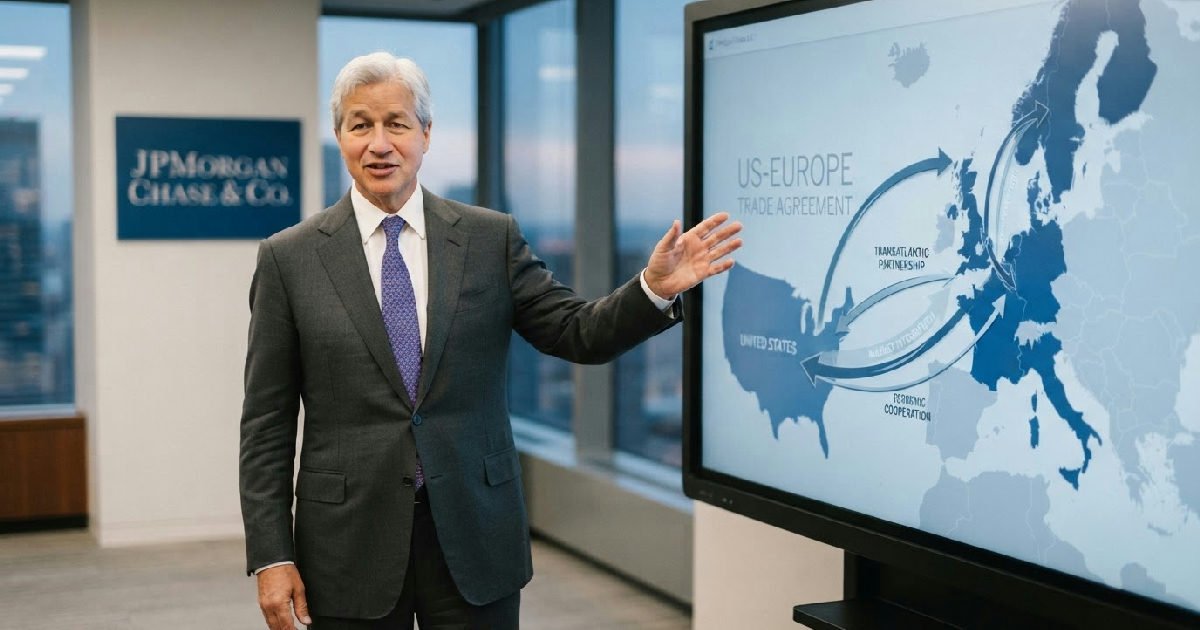
Jamie Dimon proposes US-Europe trade deal to counter autocrats
JPMorgan Chase & Co. CEO Jamie Dimon has proposed a US-Europe trade deal, contingent on Europe undertaking major economic and military reforms. CEO Jamie Dimon has laid out an ambitious plan for a comprehensive US-Europe trade deal, contingent on Europe undertaking major economic and military reforms.
In a Wall Street Journal opinion piece published Monday, September 28, 2026, the influential banking chief called for a “big, beautiful economic and free-trade agreement” to revitalize the Western alliance, counter growing autocratic pressure, and address Europe’s sluggish economic growth.
A grand bargain for a US-Europe trade deal conditional on European reform
Dimon’s proposal serves as both an incentive and a challenge to the European Union. He argues that if the bloc commits to deep-seated reforms to enhance its security and competitiveness, the United States should respond by negotiating a landmark trade pact. The call comes at a time of strained trade relations, with the current Trump administration favoring more protectionist policies.
At the heart of Dimon’s vision is a quid pro quo: a transformative trade deal in exchange for tangible changes in Europe. He asserts this is essential for the West to maintain its global standing. The inducement is massive, but the conditions are equally significant, targeting areas where European progress has been slow and fragmented for years.
Dimon believes a reformed Europe would be a far stronger partner for the U.S. He noted that “Many of the current disputes between Europe and the U.S. are minor compared with this agreement’s size and benefits.” Such a pact could significantly strengthen transatlantic ties.
Reviving Europe’s economic engine
A key prerequisite for Dimon’s proposed deal is the completion of Europe’s long-stalled economic integration projects. He specifically singled out the Capital Markets Union (CMU) and the Banking Union as critical initiatives that must be finalized.
The goal of the CMU is to create a single market for capital across the EU, making it easier for companies to find funding and for individuals to invest their savings.
Progress has been notoriously slow, hindering the continent’s ability to scale up innovative companies to rival those in the U.S. and Asia. Many major financial institutions routinely face complex strategic challenges. Dimon also pointed to the limited progress made on implementing the 2024 reports by former European Central Bank President Mario Draghi and former Italian Prime Minister Enrico Letta.
These reports outlined sweeping recommendations to boost EU competitiveness, yet sources indicate that less than 16% of the proposed measures have been adopted. Dimon insists that a Europe capable of mobilizing capital more effectively and generating stronger growth is a necessary precondition for a new era of transatlantic partnership.
Bolstering defence and strategic autonomy
Beyond economic reforms, Dimon’s plan places a heavy emphasis on Europe’s need to strengthen its defense capabilities and reduce its strategic dependencies. He calls for the consolidation of defense production, a move that would create efficiencies and enhance the continent’s military-industrial base. This has become an urgent issue as geopolitical tensions rise and questions about security commitments linger.
Furthermore, the proposal highlights the necessity for Europe to achieve greater energy and manufacturing independence. The reliance on external suppliers for critical goods has been exposed as a major vulnerability. By building up its own capacity in these areas, Europe would not only become a more resilient economic partner but also a more capable security ally for the United States.
A contrast to protectionist trade winds
Dimon’s impassioned argument for free trade stands in stark contrast to the prevailing political winds in Washington. The Trump administration has pursued protectionist policies, imposing tariffs and engaging in combative negotiations with key allies, including the European Union and Canada.
These actions have soured diplomatic relations and created uncertainty in global markets. Such market shifts are often influenced by broader economic concerns. By advocating for a seamless trade pact, Dimon is directly challenging this approach.
His op-ed serves as a powerful reminder from one of the world’s most prominent business leaders that large-scale economic cooperation, rather than isolationism, is key to Western prosperity and security. The proposal implicitly critiques the current strategy, suggesting it undermines the very alliances needed to confront larger geopolitical threats.
An alliance extending beyond the Atlantic
While the immediate focus is on Europe, Dimon envisions a much broader application for his free-trade framework. He explicitly states that the “pact could be extended to friendly democracies including Canada, Mexico, Japan, South Korea, Australia and the Philippines.” This expansion would create a formidable economic bloc of allied nations united by shared values and commercial interests.
Such an alliance would have the collective power to “set the global rules on trade,” effectively creating a new standard for international commerce that prioritizes transparency, fairness, and democratic principles. It represents a long-term strategic vision to reshape the global economic order and reinforce the ties between the U.S. and its key partners across both the Atlantic and the Pacific.
Dimon’s persistent message and the path forward
This week’s proposal is not the first time Jamie Dimon has delivered a blunt message to European leaders. Last year, he told European business and political leaders at an event in Ireland that, compared with the U.S. and Asia, “you’re losing.” His latest op-ed is a more constructive articulation of that critique, offering a potential solution instead of just a diagnosis of the problem.
The path forward, however, is fraught with challenges. It would require immense political will on both sides of the Atlantic. Europe would need to overcome internal divisions to enact the deep structural reforms Dimon outlines, while the U.S. would need a fundamental shift away from its recent protectionist stance.
Yet, Dimon remains optimistic. He believes that “A renewed commitment to American values and alliances coupled with bold reforms by Europe would be a geopolitical and economic home run, guaranteeing the Western world’s strength for the next 250 years.”