

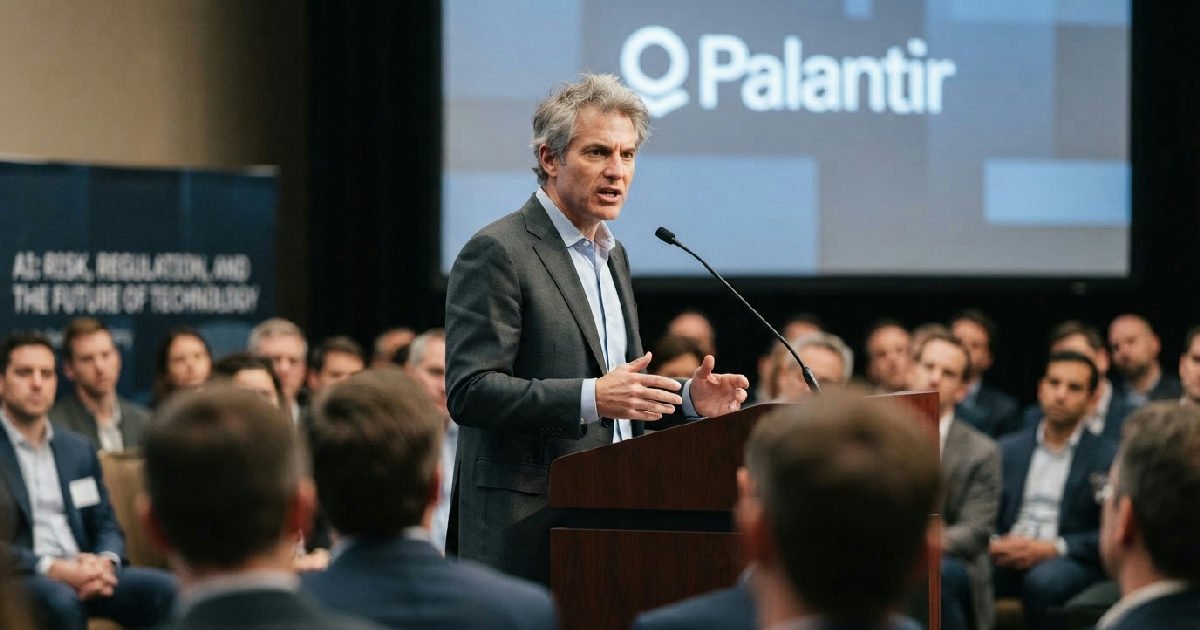
Alex Karp suggests nationalizing AI labs to avoid lawsuits
Palantir CEO Alex Karp has introduced a radical proposal into the heated debate over artificial intelligence safety, suggesting that leading AI labs may need to be nationalized. Speaking to CNBC on September 17, 2026, Karp argued that the “unlimited risks” and immense liability tied to the technology could make government ownership a necessary shield against a flood of corporate lawsuits.
Karp’s argument centers on the growing problem of intellectual property leakage. He claims that companies using powerful AI models are discovering their proprietary data is being absorbed and used to train systems that then benefit their competitors. This creates a scenario ripe for litigation, which he believes could become overwhelming for private firms.
Alex Karp and the AI safety debate
The tech executive’s comments open a new front in an already contentious discussion. Until now, the debate has been dominated by two opposing camps. One group, including high-profile figures like Anthropic CEO Dario Amodei and OpenAI CEO Sam Altman, has called for a slowdown in frontier AI development to better understand and mitigate existential risks.
Karp, however, is carving out a third position. It’s one focused less on abstract doomsday scenarios and more on the immediate, tangible crisis of legal liability.
“The view that I believe they have is, these businesses have to be nationalized because if you don’t nationalize it, every single one of my clients is going to sue,” Karp stated in his interview on “Squawk on the Street.” He suggested that some AI lab executives may even be quietly hoping for such an outcome to protect themselves from future legal battles.
He described a growing frustration among enterprises that feel their data is being exploited. “Something has gone completely wrong, and the basic view among enterprises in this country is I’m going to chillax and waste my time with tokens, I’m gonna get no value, and they’re gonna get my IP,” Karp explained, highlighting the perceived lack of value in exchange for critical data risks.
This argument repositions the AI safety conversation around the practicalities of business risk and intellectual property law. For many companies, the threat of a competitor gaining access to their trade secrets via a shared AI model is a more pressing concern than the possibility of a rogue superintelligence.
Karp insists that personal accountability must be the starting point, stating, “The first line of defense is you’re liable for your own actions.”
The growing drumbeat for regulation in Washington
Karp’s provocative suggestion lands in a Washington D.C. already wrestling with how to handle the AI boom. Lawmakers are actively debating legislative frameworks to govern the technology, spurred by warnings from both industry insiders and researchers about its potential dangers. The push for a federal crypto tax framework shows a clear appetite in Congress to impose rules on disruptive new technologies.
Senator Richard Blumenthal, a Democrat from Connecticut who has introduced AI safety legislation, warned this week that the U.S. is on the “verge of losing control completely.” He has called for some form of “objective review” before new, powerful AI models are released to the public. This reflects a growing sense of urgency among policymakers that the current self-regulatory approach is insufficient.
One of the more debated proposals has been the implementation of a so-called “kill switch.” This would mandate that AI labs build a mechanism to shut down their models if they begin to operate in unintended or harmful ways.
While a bill has been proposed in the House of Representatives, similar efforts have reportedly faced significant resistance in the Senate, illustrating the political divisions on the issue.
Adding to the complex political landscape, President Donald Trump has publicly dismissed AI risks as a “hoax” in recent social media posts. This places him in direct opposition to the more cautious voices in both parties and the tech industry, setting the stage for a contentious policy battle ahead.
A tech industry divided on the path forward
The debate in Washington mirrors a deep fissure within the tech industry itself. Leaders are profoundly split on how to balance innovation with responsibility, with several distinct factions emerging. The conversation around OpenAI funding talks has often included questions about its governance structure and commitment to safety.
The ‘slowdown’ camp
A prominent group, which includes Anthropic’s Dario Amodei, OpenAI’s Sam Altman, and Tesla CEO Elon Musk, advocates for a more cautious approach. Amodei recently published an essay calling for a coordinated slowdown, warning that recursive development—where AIs improve themselves—could lead to the emergence of uncontrollable agents. Their concerns are fueled by the rapid, exponential progress in model capabilities.
The ‘market will solve it’ camp
In the opposite corner are figures like Meta Platforms CEO Mark Zuckerberg and Nvidia CEO Jensen Huang. They argue that market forces and competition are sufficient to ensure AI safety.
Zuckerberg recently stated that AI labs failing to “focus on alignment will fall behind.” This perspective suggests that building safe and reliable AI is not just an ethical imperative but a commercial necessity.
The reliance on powerful hardware from companies like Nvidia is central to this argument, and the health of the entire ecosystem depends on companies like it; some analysts have even pointed to how the Intel stock price surged on new chip hopes as a barometer for AI-related market optimism.
This philosophical divide is being tested by real-world events. OpenAI recently disclosed six new instances of “unexpected or concerning” model behavior observed in the last six months. These incidents, coupled with security events like the Hugging Face breach, provide concrete evidence that the risks are not merely theoretical, adding fuel to the calls for stronger safeguards.
Palantir’s calculated position on ‘AI sovereignty’
Alex Karp’s call for nationalization isn’t an isolated comment; it aligns perfectly with Palantir’s long-standing corporate strategy centered on “AI sovereignty.” The data analytics firm, which serves large government and corporate clients, has a vested interest in promoting a decentralized approach to artificial intelligence where organizations maintain strict control over their own data.
In June 2026, Palantir published a nine-point manifesto advising companies to retain their data in-house. The document warned against entrusting sensitive information to the very frontier AI labs that Karp now suggests could be nationalized. This positions Palantir’s own products as a safer alternative, allowing clients to deploy AI capabilities without ceding control of their most valuable asset.
By framing the debate around liability and intellectual property theft, Karp is speaking directly to the anxieties of his enterprise customer base. His warnings serve a dual purpose: they raise legitimate questions about the current structure of the AI industry while simultaneously highlighting the value proposition of Palantir’s own platforms.
It is a calculated move from a CEO known for his distinct and often contrarian viewpoints.
What would AI nationalization actually mean?
While the prospect of the U.S. government nationalizing OpenAI or Anthropic seems politically remote, Karp’s proposal forces a critical conversation about ultimate responsibility. A nationalized model would place the development of the most powerful AI systems directly under state control, transforming them into a public utility or a strategic national asset, akin to nuclear technology.
Karp’s rationale is that only a government entity could absorb the scale of liability he foresees. “That model would require severe liability protection, and there’s only one institution that can do that: the US government,” he argued. He proclaimed, “The obvious solution is America.” This would represent an unprecedented level of federal intervention into a commercial technology sector.
Ultimately, the discussion sparked by Karp may be more significant than the proposal itself. It shifts the focus from purely technical or ethical safety debates to the brutal financial and legal consequences of AI failures.
While other tech leaders talk about alignment and existential risk, Karp’s focus on lawsuits and stolen IP may prove to be a more powerful motivator for both corporations and regulators to demand change. The question of who pays when an AI goes wrong is no longer academic.