

House Panel Approves First Federal Cryptocurrency Tax Framework
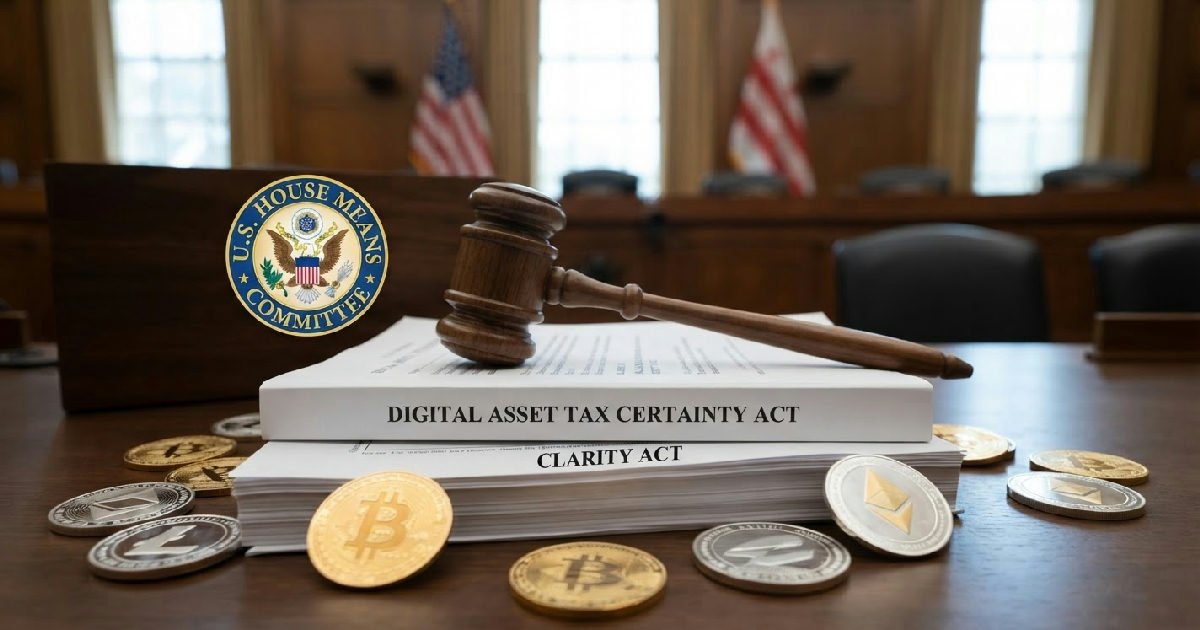
The U.S. House Ways and Means Committee approved the Digital Asset Tax Certainty Act, creating the first federal cryptocurrency tax framework. S. House Ways and Means Committee has approved the Digital Asset Tax Certainty Act. This landmark move creates the first dedicated federal cryptocurrency tax framework.
The committee’s action on September 16, 2026, sends the legislation to the full House, marking a significant step for digital asset regulation in Washington D.C.
This House progress offers a stark contrast to the legislative gridlock in the upper chamber. Just one day prior, the Senate’s more comprehensive crypto regulation bill, the Digital Asset Market Clarity Act (CLARITY Act), failed a crucial procedural vote. This stalled its progress amid partisan disputes and ethics concerns.
House committee advances cryptocurrency tax rules
The Digital Asset Tax Certainty Act (H.R. 10357) advanced with considerable support from both sides of the aisle. This is a rarity in the often-contentious world of crypto legislation. Committee Chair Jason Smith, a Republican from Missouri, celebrated the vote as a “historic moment” for the committee.
He highlighted over a year of collaborative work between Republican and Democratic members to forge these new rules. The bill aims to remove ambiguity and provide clear, actionable guidance for taxpayers. This specifically addresses the complexities of cryptocurrency transactions.
Key Details of the House Panel’s Approval
- House Committee: U.S. House Ways and Means Committee
- Approved Bill: Digital Asset Tax Certainty Act (H.R. 10357)
- Vote Count: 38-5 in favor of advancing the bill
For years, investors, developers, and everyday users have operated in a grey area. They relied on evolving guidance from the Internal Revenue Service (IRS) that often fails to address the unique nature of digital assets. This legislation seeks to codify specific rules into law.
The strong bipartisan vote suggests that targeted, issue-specific legislation may be a more viable path. It could bypass the difficulties encountered by sweeping, all-encompassing regulatory packages. Some senators had raised concerns about the need for stricter Clarity Act stablecoin reward limits before being willing to move forward. This issue ultimately contributed to its failure.
Key provisions shaping the crypto tax framework
The proposed legislation introduces several key changes designed to simplify tax reporting for crypto users. It provides much-needed clarity on how different types of crypto income are treated. While industry advocates see it as a positive step, some lawmakers acknowledge it is not as comprehensive as they had hoped.
This means certain critical questions remain unanswered for now. The bill’s details aim to streamline compliance for individuals and businesses alike. But it also reveals ongoing debates within Congress about the scope of digital asset regulation.
Tax exemption for minor transaction fees
One of the most practical provisions in the bill is a new threshold for taxes on network or transaction fees, commonly known as “gas fees.” Under the act, individuals would not have to pay taxes on these fees if the amount is $10 or less. This aims to alleviate the significant record-keeping burden for active crypto users.
Many users make dozens or hundreds of transactions with small, taxable fees. However, this relief does not extend to service providers or businesses conducting transactions on behalf of others. This section, if it becomes law, is slated to take effect in December 2027, allowing preparation time for both the Treasury Department and taxpayers.
Taxation of mining and staking income
The bill delineates that income derived from crypto mining and staking activities should be taxed as ordinary income. This aligns with current IRS guidance but formalizes it within the tax code. The legislation also includes a provision allowing certain investment trusts to stake their digital asset holdings.
This staking activity alone would not negatively affect their tax status as trusts. Despite these clarifications, a crucial detail remains unresolved. An earlier draft of the bill included an option to defer income from staking rewards until the assets were sold. However, this was removed from the version that passed the committee.
Rep. Steven Horsford, a Nevada Democrat who worked on the bill, noted the omission. “This bill is not as comprehensive as I would have liked,” Horsford said. He added that the package establishes ordinary income treatment but “leaves that timing question unresolved.” This ambiguity over when rewards are recognized as income remains a major pain point for the industry.
Digital Asset Voluntary Disclosure Program
To help taxpayers who may have fallen behind on their crypto tax obligations, the bill mandates the Treasury Department to establish a Digital Asset Voluntary Disclosure Program. This program must be created within 12 months of the bill’s enactment. It would provide a pathway for taxpayers to amend previous returns.
They could then settle their owed taxes, interest, and any associated penalties. This potentially offers a lifeline for those who have struggled to comply with previously unclear rules. Recent charges of crypto fraud against former tech employees underscore the need for clearer guidelines.
Contrasting legislative paths for digital assets
The successful committee vote in the House stands in sharp relief against the failure of the CLARITY Act in the Senate one day earlier. The Senate bill was a far more ambitious piece of legislation. It aimed to create a comprehensive regulatory framework for the entire digital asset market.
Its failure was attributed largely to ethics concerns raised by Democrats. They cited the massive growth of President Donald Trump’s crypto holdings, which they argued were not adequately addressed in the bill. This political dimension spilled into the House debate as well.
Rep. Lloyd Doggett, a Democrat from Texas, voted against the tax bill. He argued it “bestows billions in tax breaks for the crypto industry, benefiting billionaire crypto whales and some of the richest Americans like the Trump family.” His comments underscore the political tightrope that any crypto legislation must walk, even a more narrowly focused tax bill.
This divergence shows that while broad regulatory overhauls face a difficult path, more focused bills can still garner bipartisan support. The industry continues to push for clarity and stability, regardless of legislative challenges.
The uncertain road ahead for US crypto regulation
Despite the committee’s approval, the bill’s immediate future is uncertain. The House is scheduled to recess until after the November elections, meaning no floor vote will happen for several weeks. Alison Mangiero, chief strategy officer at the Crypto Council for Innovation, anticipates the bill will likely be considered during the post-election “lame duck” session of Congress.
“Following today, attention will turn to the Senate Finance Committee,” Mangiero noted. “It has also expressed interest in advancing digital asset tax legislation.” Industry advocates hope the House bill will pressure the Senate to take up a companion version, building on this bipartisan consensus.
Mangiero and other industry experts also point out that the bill still needs work. “There is an opportunity to refine several important provisions,” she said. This includes the timing of income recognition for staking rewards and the need for broader de minimis relief for small, everyday transactions. As mainstream adoption grows through initiatives like the Mastercard cryptocurrency program, these practical issues become more urgent.
The Digital Asset Tax Certainty Act is a foundational step, but it’s far from the final word on crypto regulation. It provides a glimmer of legislative progress in a year marked by stalls and setbacks. This sets the stage for a potentially busy lame-duck session and a renewed push for regulatory clarity in the next Congress.