

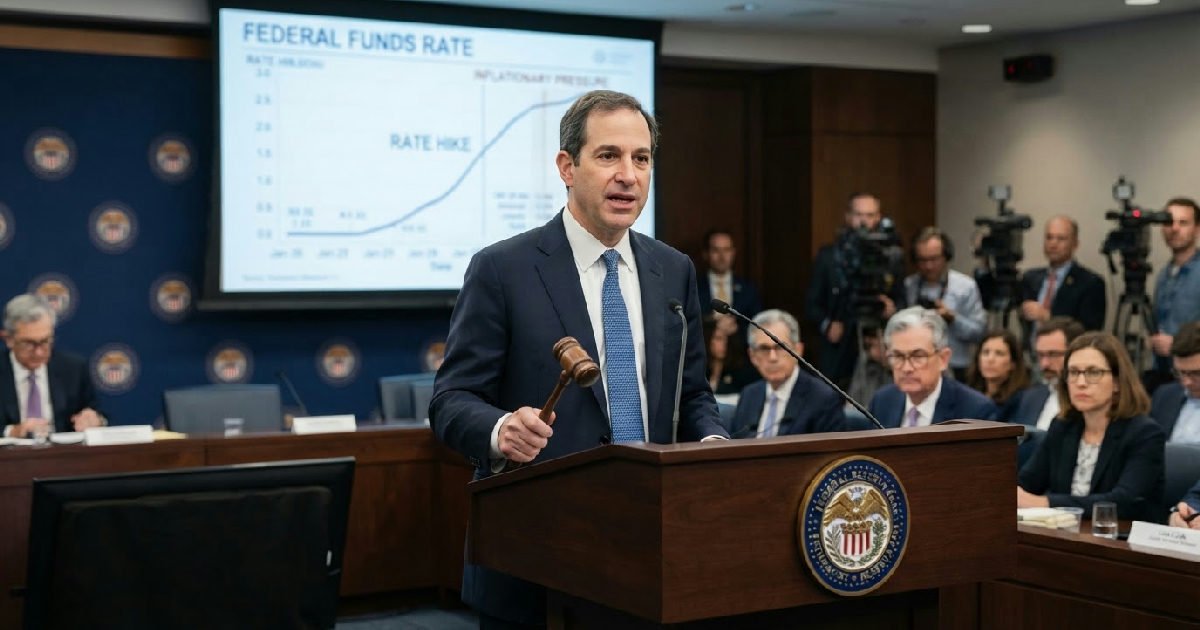
Kevin Warsh’s rate hike re-ignites Donald Trump’s Fed independence fight
Federal Reserve Chairman Kevin Warsh defied President Donald Trump this week, leading a unanimous vote to raise the benchmark interest rate. The decision, announced on Wednesday, September 16, 2026, intensified a long-standing battle over the central bank’s Fed independence fight from political influence, despite Trump’s persistent calls for lower rates.
This bold move by the Federal Open Market Committee (FOMC) sets the stage for renewed confrontations between the White House and the independent monetary authority. It spotlights the delicate balance required to maintain economic stability amid political pressures.
The Fed Independence Fight and Warsh’s Unanimous Decision
The Federal Open Market Committee, with Chairman Kevin Warsh at its helm, approved a quarter-percentage point hike, pushing the federal funds rate to a range of 3.75% to 4%. This marks the first such increase since July 2023, signaling a firm resolve to tackle persistent inflation.
The 12-0 vote sends a clear message that the Fed prioritizes its dual mandate of maximum employment and price stability despite external urgings. Warsh underscored the decision’s necessity, stating plainly that "the plain fact is that inflation is too high and has been for too long."
His remarks at the press conference avoided direct political commentary, emphasizing the Fed’s economic rationale. When pressed by a reporter about a message for President Trump, Warsh chuckled and politely declined, asserting, "I’ve got nothing for you on a discussion with the president."
This rate increase came even as President Trump and his administration repeatedly urged the Fed to cut rates or, at the very least, refrain from hiking them. The President has historically advocated for rates around 1% to stimulate economic growth, creating a direct clash with the Fed’s assessment.
President Trump’s Swift and Critical Response
President Trump wasted no time in publicly decrying the rate hike, taking to social media hours after the announcement. He characterized the Federal Reserve’s board as "very hostile" and "very political," claiming they were "doing the wrong thing."
Trump asserted that the board raised rates due to "hostility toward him." "They’re raising the rates to make Trump do as bad as he can possibly do," the President said, echoing previous sentiments about Fed actions.
Despite his criticisms of the board, Trump maintained confidence in Warsh himself, calling him "a good man." However, he insisted Warsh faced a "hostile board," underscoring a perceived internal division within the Fed.
Trump had nominated Warsh in January with an expectation of lower interest rates, making this hike a significant divergence. Warsh, for his part, had previously stated, "We stay in our lane," when addressing presidential lobbying for rate cuts, reaffirming the Fed’s independent stance.
A History of Conflict: Trump and the Federal Reserve
This isn’t President Trump’s first skirmish with the nation’s central bank; his prior term saw unprecedented attacks on Federal Reserve independence. He frequently targeted former Chair Jerome Powell, repeatedly calling for his resignation and even exploring options to fire him.
Warsh, who served on the Fed’s Board of Governors from 2006 to 2011, became the youngest member at 35. He worked closely with then-Chair Ben Bernanke during the 2008-09 financial crisis, developing a deep understanding of monetary policy and its complexities.
Powell’s Precedent and Trump’s Prior Criticisms
President Trump appointed Jerome Powell in his first term but later grew furious over Powell’s rate decisions. The President believed Powell’s September 2024 decision to cut interest rates by a half-point was an attempt to influence the upcoming presidential election, a claim Powell denied.
Like Warsh now, Powell consistently insisted his decisions were solely based on economic data and the Fed’s dual mandate. The Trump administration had also initiated a criminal investigation into Powell concerning alleged cost overruns in building renovations, though it was later closed.
The Department of Justice reserved the right to reopen that investigation, creating a persistent shadow over the former Chair and the institution. Such actions set a worrying precedent for the independence of the Federal Reserve’s leadership and its decision-making processes, extending beyond policy disagreements.
Challenges to Fed Governor Independence
Beyond the Chair, the Trump administration has previously targeted individual Fed governors, escalating tensions beyond monetary policy alone. In 2025, there was an attempt to fire Fed Governor Lisa Cook, an action the Supreme Court subsequently blocked due to procedural failures.
The Court ruled Cook was "entitled to some explanation of the evidence at issue, some avenue for a response, and a deadline by which a response would be due." This ruling provided some guardrails against arbitrary dismissal of Fed officials, emphasizing due process.
Just last month, President Trump restarted the process to remove Cook, sending her a letter demanding a response by August 26. The ball is now firmly in the administration’s court, with a potential for renewed legal challenges and further scrutiny of the Fed’s internal operations and its leadership.
There’s also speculation that an ongoing investigation into the 2023 failure of Silicon Valley Bank could provide a pretext to target Michael Barr, a Fed official who oversaw bank supervision at the time. Barr has since stepped down from that regulatory role but retains a seat on the Fed’s board, leaving him vulnerable to potential pressure.
Economic Headwinds Fueling Warsh’s Hawkish Stance
The Federal Reserve’s firm stance on interest rates comes amid persistent inflationary pressures that continue to challenge economic stability. The Fed projected Personal Consumption Expenditures (PCE) inflation at 3.7% for 2026, significantly above its long-term 2% target, underscoring the urgency of its actions.
August core PCE stood at 3.6%, with Consumer Price Index (CPI) prices running at approximately 3.2% and 2.4% respectively. These figures highlight the widespread nature of current price increases across the economy, impacting everyday Americans.
Several factors contribute to this elevated inflation. The ongoing war, initiated by the U.S. and Israel with Iran, has driven up global energy prices, impacting consumer costs directly. Surging investment in AI data centers also contributes to competitive capital demands, pushing up financing and operational costs for businesses across various sectors.
Despite these inflationary concerns, the Fed’s broader economic outlook remains robust, suggesting the economy can absorb the rate hike. They project real GDP to rise by 2.3% this year and 2.4% next year, demonstrating underlying economic strength.
The unemployment rate holds steady at about 4.1%, indicating a resilient labor market with healthy job creation. Chairman Warsh also attributed rising long-term Treasury yields to this fundamental economic strength, intense competition for capital from "hyperscalers" in AI, and ongoing geopolitical uncertainty.
The resilient economic activity, strong productivity, and robust capital investment noted by the Fed reinforce the view that monetary policy adjustments are necessary to rein in inflation and ensure long-term stability.
The Path Ahead for Central Bank Autonomy
The recent rate hike, and President Trump’s strong reaction, underscore the inherent tension between a president’s political agenda and the Federal Reserve’s mandate to maintain economic stability. Democrats, who initially worried Warsh wouldn’t be independent of the president who appointed him, may now be reassessing their views in light of his decision.
Warsh’s commitment to the Fed’s dual mandate, prioritizing price stability, seems to be unwavering. He previously advocated for a "regime change" at the Fed, criticizing its expansion beyond traditional monetary policy into areas like climate change and social issues. This suggests a more focused approach to the central bank’s role.
The Fed’s autonomy remains crucial for global financial trust, impacting currency stability and international investment flows. Ongoing discussions around broader financial oversight, such as a federal cryptocurrency tax framework, illustrate the evolving regulatory landscape alongside monetary policy.
He also voiced skepticism about mainstream inflation measures and called for less Fed communication and intervention in markets, reflecting a desire for greater transparency and less "forward guidance." These philosophical stances could further distance him from the White House’s interventionist inclinations.
President Trump has a history of leveraging his power to influence federal agencies, and he’s not short on tools if he decides to escalate his confrontation with the Fed. Attempts to fire Fed governors or reopen investigations suggest a willingness to challenge institutional norms and precedents.
But whether he will accept that independence without further confrontation remains the central question that will shape the future of U.S. monetary policy.