

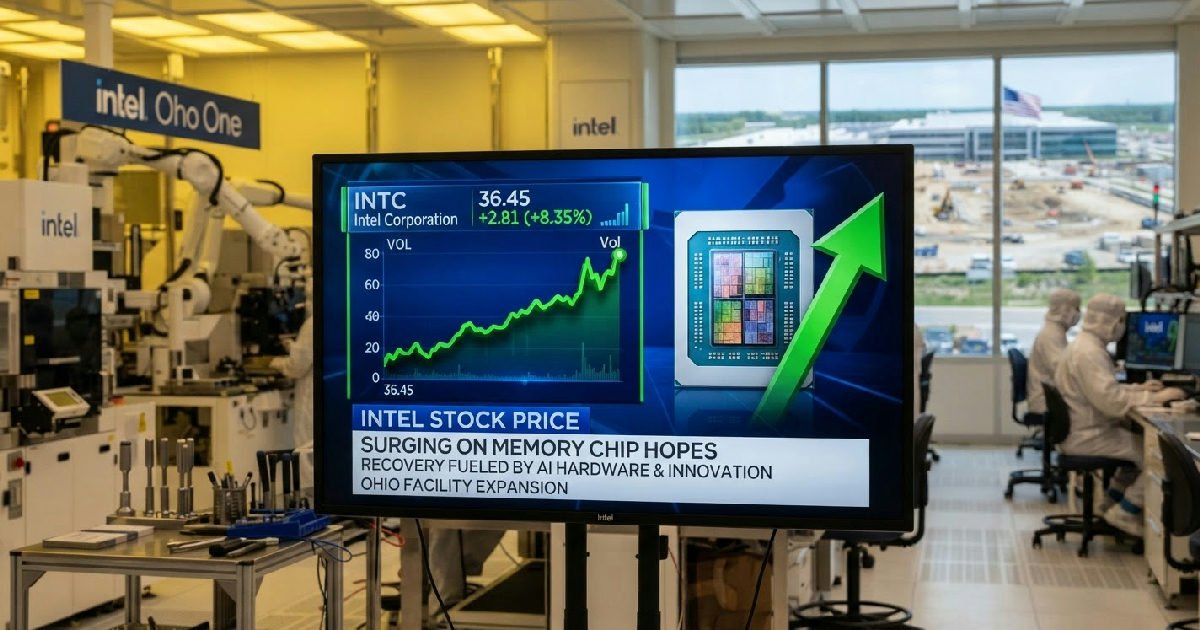
Intel Stock Price Surges on Memory Chip Hopes
Intel Corporation saw its stock price climb sharply on Wednesday, September 16, 2026, as investors reacted positively to reports suggesting a potential partnership with South Korean chipmaker SK Hynix. The prospect of Intel re-entering the lucrative memory chip market, specifically in the United States, fueled optimism for the company’s ongoing turnaround efforts.
Reports detailed exploratory discussions between Intel and SK Hynix concerning the production of memory chips on American soil. This news sent Intel’s shares surging, reflecting a renewed belief that the legacy chipmaker could capitalize on the booming demand for advanced memory components vital to artificial intelligence (AI) technologies.
Intel Stock Price Climbs on Partnership Speculation
Intel’s stock (INTC) closed at $101.05 on September 16, 2026, marking a significant 4.03% increase from the previous day’s trading. This notable surge was primarily driven by a Reuters report that Intel was in preliminary discussions with SK Hynix, a key global player in memory chip manufacturing.
The reported talks are still in an exploratory phase, with no firm agreement yet reached between the two semiconductor giants. Possible scenarios include SK Hynix leasing a portion of Intel’s expansive semiconductor campus currently under construction in Ohio, or the formation of a joint venture that could also involve large cloud companies.
An Intel spokesperson declined to comment directly on media speculation regarding future business arrangements. However, the company reiterated its commitment to its Ohio project, emphasizing continued investments to accelerate site readiness for manufacturing operations. SK Hynix also acknowledged it’s exploring various options to bolster global competitiveness but confirmed that no specific plans have been finalized.
This development comes as the U.S. government, through Commerce Secretary Howard Lutnick, has been actively pressuring South Korean and Taiwanese chipmakers to increase their production capabilities within the United States. Such a partnership would align perfectly with these national strategic objectives, potentially leveraging federal incentives.
The Ohio Facility and Production Plans
Intel’s ambitious Ohio manufacturing site has been a cornerstone of its strategy to bring more semiconductor production back to the U.S. After years of construction, the project saw its timeline adjusted in 2025; the first Ohio fab is now slated for completion and operation between 2030 and 2031. The second fab is expected to follow, completing in 2031 and beginning production in 2032.
A partnership with SK Hynix could provide a crucial high-volume client for the Ohio facility, effectively monetizing what might otherwise be idle manufacturing capacity in its early years.
This strategic move could also help Intel offset some of its substantial capital expenditures tied to the project, demonstrating a tangible pathway to profitability for its foundry unit. The talks represent a pivotal opportunity to secure a foundational customer for the Ohio complex.
Return to Memory: A Strategic Pivot
Intel’s historical ties to memory chips are well-documented; the company began in this sector before exiting due to unfavorable market economics. However, with the current landscape dramatically reshaped by artificial intelligence, memory chips are once again a “hot” commodity, presenting Intel with a significant opportunity for re-entry.
The demand for advanced memory, particularly high-bandwidth memory (HBM), has skyrocketed, fueled by the intense data processing requirements of AI. Only a handful of companies currently produce these specialized chips, and they struggle to meet the fervent demand from AI companies.
Analysts from RBC indicate that HBM prices could surge by as much as 80% to 100% in the coming year, highlighting the immense market potential.
Intel’s current foundry unit primarily serves its internal divisions, with external customers contributing a comparatively modest $293 million in revenue in the latest quarter. This external contribution pales in comparison to the Foundry’s operating loss of $2.09 billion for the same period.
Shifting back into memory production, potentially with a partner like SK Hynix, could fundamentally alter this dynamic and provide a robust external revenue stream for Intel’s manufacturing capacity. Asian stocks have recently seen volatility partly due to these shifting technological demands.
AI Workloads Drive Chip Demand
The AI revolution has profoundly impacted the semiconductor industry, creating an insatiable appetite for processing power. While graphics processing units (GPUs) initially dominated the AI narrative, central processing units (CPUs), particularly those designed for servers, are now recognized as equally critical for various AI workloads. Intel’s server CPUs have become a highly sought-after commodity.
The latest results reflect this trend, with Intel’s server products experiencing a remarkable 48% surge in average selling prices year-over-year. Server volume also rose by 9% in the last quarter, indicating strong demand that, in many cases, outstrips available supply.
This robust performance in the CPU market complements the potential for growth in memory, creating a multi-faceted approach to AI hardware. Intel’s 18A manufacturing process, powering its next-gen Panther Lake chips, is also showing solid high-volume execution, further cementing its position.
Intel’s Broader Turnaround Efforts
Intel is navigating a complex and multi-year turnaround strategy, spearheaded by CEO Lip-Bu Tan, who assumed his role in March 2025. Tan has previously stated that this transformation will require at least five years to fully materialize, indicating the depth of the challenge and the company’s long-term commitment.
The company has initiated a comprehensive $10 billion cost-reduction plan, which includes a significant headcount reduction of more than 15% and the suspension of dividend payments starting in the fourth quarter of 2024. These measures underscore Intel’s resolve to streamline operations and improve financial stability amidst intense market competition. Global market shifts, including oil price fluctuations, can also impact broader tech sector performance.
Intel’s second-quarter 2024 financial performance, which included revenue of $12.8 billion (down 1% year-over-year) and a GAAP EPS of $(0.38), was described as “disappointing” by CEO Pat Gelsinger. However, Gelsinger highlighted considerable progress in product and process technology milestones.
Intel also plans to raise PC CPU prices by about 10% in early October 2026, following similar hikes in late 2025 and earlier in 2026, aiming to bolster near-term margins.
Financial Outlook and Analyst Sentiment
Market analysts are largely optimistic about Intel’s trajectory. Bank of America analyst Vivek Arya maintains a “Buy” rating on Intel with a price target of $145. Melius Research analyst Ben Reitzes has reiterated a “Buy” rating, setting an even more ambitious target of $165, suggesting the stock could potentially reach $200 per share within two years.
The consensus among Wall Street analysts reflects a “Moderate Buy” rating for Intel, with a mean price target of nearly $114. This target indicates a potential upside of approximately 14% from current levels.
Intel’s stock performance over the past year has been robust, surging more than 500% amid turnaround optimism, and is up between 150% and 183% year-to-date in 2026. Brokerage platforms like Robinhood reflect Intel’s market capitalization around $534 billion to $540 billion, making it a formidable player in the U.S. semiconductor and AI infrastructure landscape.
Risks and Regulatory Landscape
Despite the current investor enthusiasm, the proposed partnership between Intel and SK Hynix faces several hurdles. The talks remain exploratory, meaning a definitive business relationship is far from guaranteed. Both companies have been careful to emphasize that no specific plans or arrangements have been finalized, and that decisions have yet to be made.
Furthermore, geopolitical considerations could complicate matters. The South Korean government might oppose such a collaboration, particularly if it perceives the deal as potentially undermining its domestic chip industry or national interests. The semiconductor sector is a critical strategic asset for many nations, leading to heightened scrutiny of international partnerships. U.S.
Commerce Secretary Lutnick has already engaged with SK Hynix and Samsung, discussing U.S. memory output and hinting at tariffs for non-compliant chipmakers, underscoring the political pressures at play.
Intel’s journey back into memory chip manufacturing, even with a partner, is not without inherent risks. The company previously exited the market due to poor economics, and while current AI-driven demand is strong, market conditions can shift rapidly. Success will depend on navigating complex technological challenges, securing substantial investment, and managing delicate international relations to solidify its position in a highly competitive global market.