

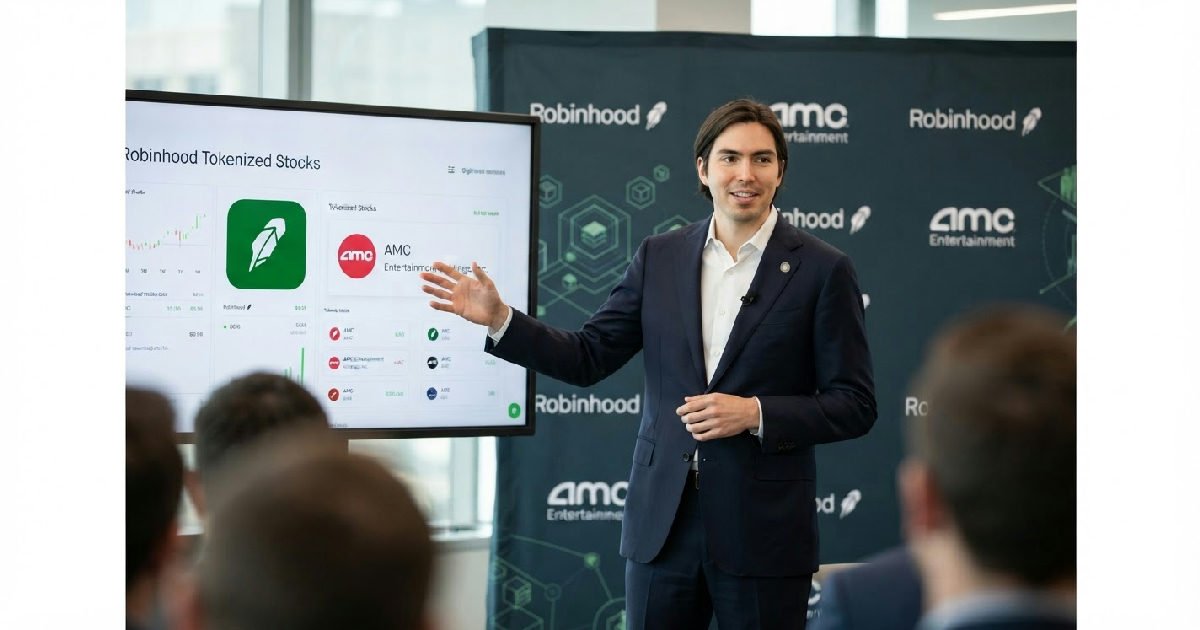
Robinhood CEO Tenev defends tokenized stocks
A contentious debate has emerged in the crypto community, centered on the tokenization of traditional stocks. Robinhood CEO Vlad Tenev is at the heart of this discussion, asserting that public companies shouldn’t automatically control blockchain products that merely reference their shares. This discussion specifically highlights the growing interest in Robinhood tokenized stocks and their implications for the market.
This comes after AMC Entertainment Holdings, Inc. CEO Adam Aron publicly criticised Robinhood for offering tokenized AMC exposure without his company’s explicit consent. The clash underscores fundamental questions about issuer rights, investor access, and the evolving landscape of US crypto rules.
Robinhood CEO defends tokenized stocks
Vlad Tenev, co-founder and CEO of Robinhood, has robustly defended his company’s approach to tokenized stocks. Speaking recently on CNBC’s Squawk Box, Tenev acknowledged that issuers control the rights and obligations of their own stock. However, he drew a critical distinction regarding third-party financial instruments.
He argued that companies don’t control other entities issuing their own securities that reference those shares. Tenev’s argument posits that once shares are publicly traded, investors gain property rights that don’t grant the issuing company additional veto powers over every derivative product.
Under Robinhood’s model, each token acts as a distinct financial instrument. It is backed 1:1 by real shares held within traditional markets, providing economic exposure without altering the underlying stock’s rights. This structure is central to Robinhood’s defense of its tokenized offerings.
Fairmint CEO challenges Robinhood’s stance
Tenev’s defense hasn’t quieted all critics within the digital assets space. Joris Delanoue, co-founder and CEO of Fairmint, also voiced his concerns on X.
Delanoue highlighted that merely being “backed” by shares doesn’t equate to direct “ownership,” suggesting a potential disconnect. This criticism hints at the complex legal and ownership implications inherent in the rapidly developing field of digital securities.
AMC’s Adam Aron slams unauthorized tokenization
The catalyst for this renewed debate was AMC Entertainment Holdings, Inc. CEO Adam Aron’s scathing criticism of Robinhood. Aron expressed profound outrage that Robinhood had created tokenized AMC exposure without his company’s approval or involvement.
From AMC’s perspective, this initiative bypassed the company, establishing a new investment channel without direct engagement with those investors. Aron took to X last week to lambast the practice.
He called it “contemptible, outrageous, disgusting, detestable, inexcusable, vile,” questioning its legality. Aron emphatically stated that AMC had “no connection to this at all, and do not condone it in any way,” highlighting the deep corporate frustration.
Meme stock legacy and investor relations
Aron’s fierce reaction is partly rooted in AMC’s unique position as a “meme stock.” During the 2021 phenomenon, retail investors, often organised on social media, played a crucial role in bolstering AMC’s stock. Aron famously embraced these shareholders, often referring to them as “apes.”
This history means AMC places significant value on direct communication and relationships with its investor base. The creation of tokenized shares outside its purview likely felt like a breach of this established rapport, undermining direct shareholder engagement. This context highlights the sensitivity around how digital assets interact with traditional corporate governance.
Understanding tokenized stocks and regulatory complexities
Tokenized stocks are digital representations of company shares on a blockchain, also known as digital securities. They are crypto tokens designed to mirror the price of an underlying stock, representing equity shares in publicly traded companies.
These instruments typically work by being 1:1 backed by actual shares. A regulated entity, such as a licensed broker or custodian, holds the real shares and then mints corresponding tokens on the blockchain. This custodial model aims to bridge traditional finance with blockchain technology.
Benefits include 24/7 trading, global accessibility, and fractional ownership, potentially moving beyond traditional stock exchange limitations. However, the U.S. Securities and Exchange Commission (SEC) views tokenized securities as subject to existing federal securities laws, adding layers of regulatory scrutiny.
Tenev’s proposed consent test
Amid the growing scrutiny, Vlad Tenev has put forward a clear test for when issuer approval should be necessary. He believes consent is required only if a token fundamentally alters the rights associated with the underlying stock.
If a token simply acts as a separate financial instrument, backed by existing shares without modifying those core rights, Tenev contends issuer permission shouldn’t automatically be needed. This distinction is crucial for platforms like Robinhood to innovate within perceived regulatory boundaries.
Historical parallels and future of digital securities
Tenev often draws parallels between today’s tokenization debate and historical financial shifts. He referenced the 1960s “paperwork crisis,” when the U.S. securities industry struggled with physically processing vast numbers of stock certificates.
That crisis ultimately led to the adoption of electronic recordkeeping and book-entry settlements, streamlining the entire market. Tenev suggests tokenization represents a similar evolutionary step, potentially making U.S. stocks more accessible globally and further enhancing efficiency.
This perspective aligns with recent regulatory movements, including the SEC’s new proposal. This proposal aims to allow blockchain ledgers to become the official legal record of securities ownership, potentially eliminating the need for separate on-chain and off-chain records.
Such a move would signify a major shift towards integrating blockchain technology into core financial infrastructure. It could transform how ownership is recorded and transferred, offering unprecedented transparency and speed for digital finance.
Broader industry reaction and implications
The debate between Robinhood and AMC highlights a broader tension across the financial industry: how to embrace technological innovation while upholding established regulatory frameworks and corporate control. This isn’t just a skirmish between two CEOs; it reflects fundamental questions about the future of capital markets.
For crypto platforms, the outcome could define the scope of their future offerings and the boundaries of decentralized finance. Traditional brokerage firms are also watching closely, considering how digital securities might reshape their business models and client relationships.
Ultimately, this ongoing discussion will likely influence the development of clear guidelines for tokenized assets. Regulators are keen to foster innovation but equally determined to ensure investor protection and market integrity in this rapidly evolving space.