

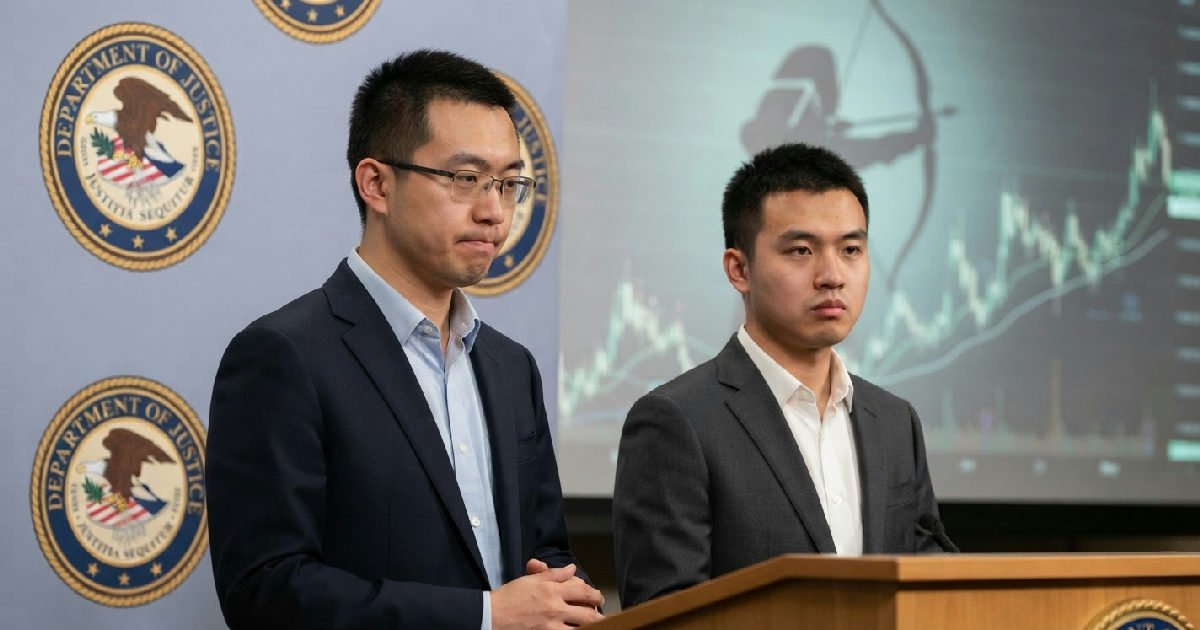
DOJ charges Robinhood engineers Hefu Chai and Huaisong Xiang with crypto fraud
Robinhood engineers Hefu Chai and Huaisong Xiang are charged with crypto fraud by the U.S. Department of Justice for allegedly front-running listings using confidential information. S. Department of Justice (DOJ) has charged two Robinhood engineers, Hefu Chai and Huaisong Xiang, with wire and commodities fraud for allegedly using confidential information to front-run cryptocurrency listings.
According to an indictment unsealed on September 15, 2026, the pair systematically profited by trading ahead of official listing announcements on the popular brokerage platform. These charges highlight a significant case of alleged Robinhood engineers crypto fraud.
Prosecutors allege that Chai, 36, and Xiang, 30, misappropriated nonpublic information about which tokens were slated to be added to Robinhood Crypto. They then allegedly used this insider knowledge to trade perpetual futures on Hyperliquid, a decentralized derivatives exchange, ultimately netting more than $50,000 each from the scheme between 2025 and 2026. The Securities and Exchange Commission (SEC) has also filed parallel civil charges.
Understanding the Robinhood engineers crypto fraud scheme
The indictment lays out a modern twist on a classic insider trading playbook. As engineers at Robinhood Markets, Inc., Chai and Xiang allegedly had privileged access to the company’s closely guarded crypto listing plans. Knowing that a listing on Robinhood often leads to a significant price surge for a token—an event colloquially known as the “Robinhood effect”—the pair allegedly positioned themselves to profit.
Instead of buying the tokens directly, they purportedly turned to Hyperliquid, a decentralized platform known for its wide array of derivative products. There, they traded perpetual futures contracts tied to the very tokens they knew would soon be listed on Robinhood.
This allowed them to gain leveraged exposure to the anticipated price movements without directly purchasing the underlying assets on a centralized exchange where their activity might be more easily tracked.
This case highlights the challenges regulators face as financial activities shift to decentralized platforms. It also underscores the immense value of early information within Robinhood’s expanding crypto business, which has been a key area of growth for the company as it seeks to build a comprehensive financial services ecosystem.
A new frontier for crypto enforcement
This prosecution marks a significant step in U.S. authorities’ efforts to police misconduct in the digital asset space. While not the first crypto insider trading case, it is notable for targeting the use of derivatives on a decentralized exchange, signaling that regulators’ reach extends beyond traditional spot markets and centralized platforms.
U.S. Attorney for the Southern District of New York, Jamie McDonald, issued a stark warning to industry insiders. “Misappropriating confidential information to trade in the derivatives markets for personal benefit is illegal,” McDonald said in a statement.
“Today’s charges make clear that corporate insiders cannot evade the securities and commodities laws by trading based on misappropriated information in derivatives like perpetual futures, tokenized securities, or other similar financial instruments.”
The statement sends a powerful message that the underlying principles of market integrity and fair play apply regardless of the technology used. Federal agencies have been increasingly focused on illicit financial activity within the sector, with the DOJ’s focus on crypto proceeds from various illicit activities becoming a major priority. This case demonstrates a growing sophistication in tracking and prosecuting complex, on-chain financial crimes.
Setting a federal precedent
The charges against Chai and Xiang build upon a legal framework established in a 2022 case involving a former Coinbase product manager. In that landmark prosecution, which the DOJ called its first-ever cryptocurrency insider trading case, an employee was found guilty of tipping others about upcoming token listings. However, that case involved trading the actual tokens, not derivatives.
By bringing charges of commodities fraud and wire fraud against the Robinhood engineers for trading perpetual futures, prosecutors are explicitly extending their enforcement theory. This move confirms that they view these derivative instruments as falling squarely under their jurisdiction, a position that could have wide-ranging implications for the largely unregulated world of decentralized finance (DeFi).
Severe penalties and a clear message
The charges are severe. Both Hefu Chai and Huaisong Xiang, also known as “Jerry Xiang,” face one count of commodities fraud and one count of wire fraud. The commodities fraud charge carries a maximum prison sentence of 10 years, while the wire fraud charge carries a maximum of 20 years, signaling the gravity with which law enforcement views their alleged actions.
James C. Barnacle Jr., the Assistant Director in Charge of the FBI’s New York Field Office, emphasized the bureau’s commitment. “Hefu Chai and Huaisong Xiang are charged with commodities fraud and wire fraud for allegedly exploiting confidential business information taken from their employer to trade perpetual futures,” he stated.
“These charges make clear the FBI with its partners will act when individuals access sensitive business information for their own benefit.” It’s a reminder of the broad scope of DOJ’s crypto enforcement actions in recent years.
Notably, Robinhood Markets, Inc. was not named as a defendant in either the criminal or civil filings. The investigation and subsequent charges focus solely on the alleged actions of the two individual engineers, who were employed by Robinhood Markets, Inc.
The case now proceeds to federal court, with Chai set to be presented in the Northern District of California and Xiang in front of a U.S. Magistrate Judge in New York.
Implications for Robinhood and Hyperliquid
For Robinhood, the incident is an unwelcome distraction as it continues its push into the crypto sector. The company has made significant investments, launching its own Layer-2 network, Robinhood Chain, which saw its decentralized exchange (DEX) volume surpass $1 billion shortly after its mainnet launch. It has also expanded into perpetual futures trading in Europe and offers tokenized stock trading.
This case of alleged insider misconduct could damage trust at a critical time when Robinhood is trying to position itself as a safe and reliable gateway to the crypto economy. While the company is not accused of wrongdoing, the incident raises questions about its internal controls and the security of its confidential information, especially as it pertains to market-moving events like new asset listings.
The decentralized exchange Hyperliquid also finds itself under a renewed spotlight. The platform had previously faced similar insider trading claims in December 2025, which it denied. While decentralized by nature, the use of its platform for an alleged criminal scheme will undoubtedly attract further scrutiny from regulators who are grappling with how to oversee these new financial rails.