

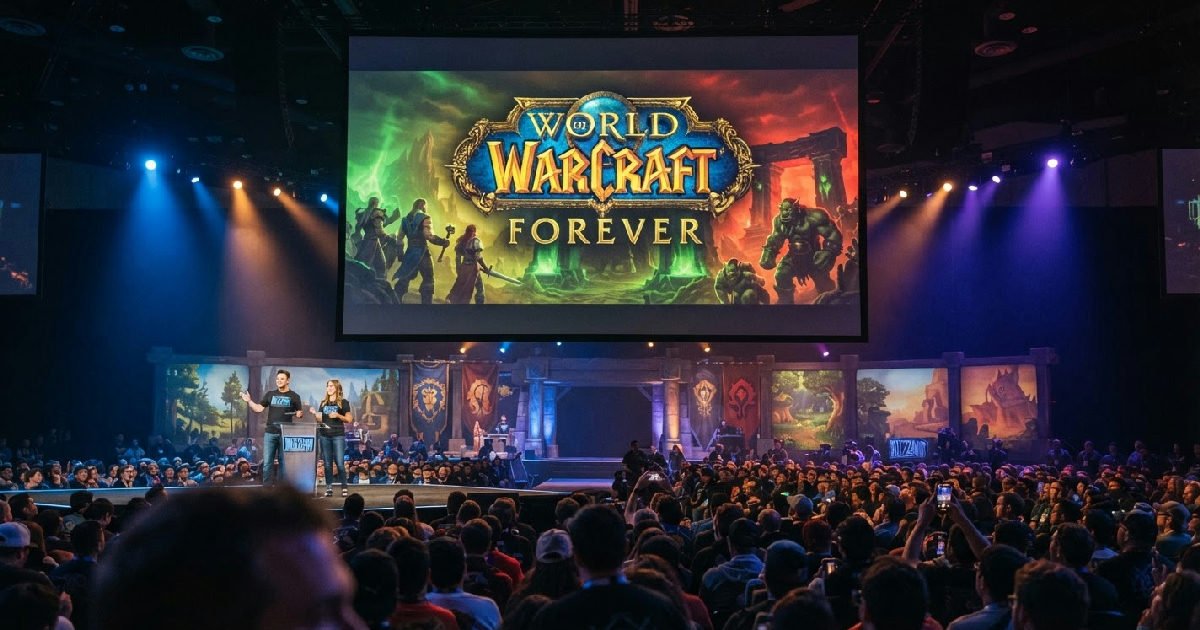
Blizzard unveils World of Warcraft, forever for November 4 launch
Blizzard Entertainment announced World of Warcraft: Forever at Blizzcon 2026 on September 12, marking a significant return to the game’s foundational “vanilla” era with an array of fresh content. This highly anticipated “Classic+” mode re-imagines the first year of World of Warcraft, introducing new elements while retaining the beloved level 60 cap.
The game’s official release date is set for November 4, 2026, with a beta scheduled to launch this coming Thursday. Players got an early look at the title during the Blizzcon opening ceremonies, where a cinematic trailer showcased its unique approach to Azeroth’s early history.
Blizzcon 2026 Unveils World of Warcraft: Forever
The reveal of World of Warcraft: Forever concluded Blizzcon’s opening ceremonies, confirming long-standing community rumours about a “Classic+” game mode. This new iteration promises to merge nostalgia with novel gameplay, directly addressing player desires for an expanded vanilla experience.
Developers from Blizzard’s Classic team are spearheading the project, which aims to encapsulate the spirit of the original World of Warcraft from its inaugural year. The announcement has generated considerable excitement, as it offers a fresh perspective on the game’s deep lore and iconic settings.
The cinematic trailer provided a glimpse into this altered timeline, depicting the familiar dwarf hunter from the original WoW trailer. He navigates a different path, leading him to a previously inaccessible Dalaran, now open with hidden secrets beneath its facade. Blizzcon 2026 saw several major game reveals across Blizzard’s portfolio, but this was a highlight for many veteran players.
Spectators also caught sight of the World Tree Nordrassil, another location that was inaccessible in the original vanilla game. Furthermore, the trailer teased a brand new sky kingdom, home to a newly introduced elven race, hinting at expansive new narratives.
A New Twist on Vanilla WoW
World of Warcraft: Forever commits to preserving the core experience of WoW‘s first year, maintaining the classic level 60 cap. But it’s not just a re-run; the game will continually introduce new adventures designed for the full 1-60 level range, starting from launch and extending into future updates.
The launch content itself is substantial, featuring three entirely new zones for players to explore. Several older zones have also received significant overhauls, effectively filling in previously blank areas on the original map. This expansion ensures both new and returning players have fresh environments to discover.
Players can anticipate over 1,000 new quests, providing ample storytelling and progression opportunities within the established world. The game will also introduce a new battleground, nine new dungeons, and two new raids, offering diverse challenges for solo adventurers and raid groups alike.
A major addition is the new playable race, the Skyborne Elves, who were teased in the cinematic, offering fresh character options and lore. Beyond these structural changes, players will find new reputations to earn, new pets to collect, and updated world visuals that enhance the classic aesthetic.
The Genesis of Classic+: Community Demand and Prior Success
The idea of a “Classic+” version of World of Warcraft has been a persistent demand from the community for years. Players often expressed a longing for the original game’s slower pace, emphasis on social interaction, and immersive world design, feeling modern WoW had strayed too far from these roots.
Blizzard Entertainment initially responded to this sentiment with the hugely successful launch of World of Warcraft Classic in August 2019. This faithful recreation of the 2004 experience was met with immense player interest, often leading to server queue times that stretched for many hours.
Since then, Blizzard has explored various permutations of its classic offerings, including progression servers that sequentially re-release expansions like Wrath of the Lich King Classic and Cataclysm Classic. They’ve also experimented with seasonal servers, such as Season of Mastery and Season of Discovery, which introduced new abilities and content variations.
The concept of “Classic+” specifically envisioned a version of vanilla WoW that would expand its existing content with new zones, quests, and raids, rather than advancing through subsequent expansions. This community-driven idea sought to finish unreleased content or create new experiences that aligned with the original game’s design philosophy.
Emulating Old School RuneScape’s Model
The success of Old School RuneScape (OSRS) often served as a blueprint for the “Classic+” movement within the WoW community. Launched in February 2013, OSRS operates as a distinct game based on an earlier 2007 build of RuneScape.
Jagex, OSRS’s developer, has consistently updated the older version with new content, proving that an expanded, retro experience can thrive alongside its modern counterpart. This model has proven incredibly lucrative, with OSRS reportedly generating over $3 billion in lifetime revenue by January 2026. Blizzard is clearly hoping to replicate some of that long-term engagement.
Notably, just prior to Blizzcon 2026, Blizzard reportedly shut down several popular private “Classic+” servers, including Turtle WoW and Project Ascension. These servers had collectively amassed over 1.5 million players, a move that many saw as a precursor to Blizzard’s official entry into the “Classic+” space.
Microsoft’s Influence and Blizzard’s Strategic Direction
The announcement of World of Warcraft: Forever also comes almost three years after Microsoft’s acquisition of Activision Blizzard on October 13, 2023. This monumental $69 billion deal positioned Microsoft as the third-largest gaming company globally, behind Tencent and Sony, and undoubtedly influenced Blizzard’s broader strategic decisions.
Under Microsoft’s ownership, Blizzard Entertainment appears to be diversifying its approach to its flagship MMORPG, catering to different segments of its player base. While World of Warcraft continues to receive traditional expansions like The Last Titan, scheduled for next year, Forever offers an alternative path.
This dual strategy allows Blizzard to capture both players who enjoy the evolving narratives and mechanics of the main game and those who prefer the foundational experience of vanilla WoW. It’s a smart move to broaden appeal and retain a diverse player base in an increasingly competitive market.
The creation of Forever underscores a commitment to player choice and acknowledges the enduring appeal of the game’s origins. It suggests a more experimental approach to content development, moving beyond linear expansion cycles for its classic offerings. Strategic shifts in tech leadership often lead to such innovative product lines.
Launch Timelines and What’s Next for Forever
Players eager to experience World of Warcraft: Forever won’t have to wait long. The game is currently playable on the show floor at Blizzcon 2026, giving attendees a first-hand look at the new content and mechanics. This immediate hands-on access builds anticipation rapidly.
A beta phase for Forever is set to commence this coming Thursday, allowing a wider audience to test the game and provide crucial feedback before its full release. This rapid rollout from announcement to beta and then launch demonstrates Blizzard’s confidence in the project and its development timeline.
Long-Term Player Engagement
The ambitious plan to continually add new 1-60 content post-launch is key to Forever‘s longevity. This strategy aims to keep players engaged within the vanilla framework, offering fresh challenges and discoveries without increasing the level cap.
Unlike traditional expansion models that push players into new, higher-level content, Forever focuses on enriching the existing low-level experience. This approach could foster a vibrant, persistent community around the game’s original iteration, ensuring that the world of Azeroth remains endlessly explorable. Long-term investment strategies are crucial in all competitive sectors, gaming included.
Blizzard Entertainment, under Microsoft, seems to be embracing a multi-pronged approach to its most iconic franchise. World of Warcraft: Forever stands as a testament to listening to its community while simultaneously innovating within established universes, promising an exciting future for fans of classic WoW.
This dedication to new narratives and world-building within a familiar setting could attract both lapsed players and new recruits. It signals a robust future for a beloved title, proving that old worlds can still hold new wonders.