

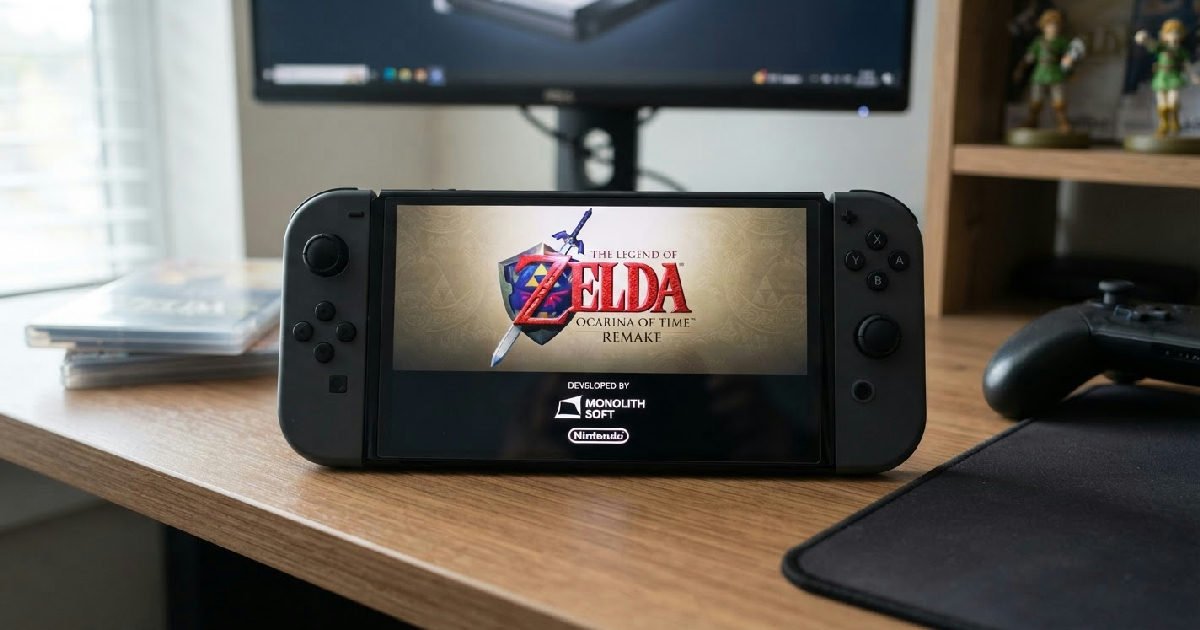
Ocarina of Time Remake Developer Rumored to Be Monolith Soft After Leak
A retail leak has ignited speculation that Monolith Soft, the acclaimed studio behind the Xenoblade Chronicles series, is the developer for the highly anticipated remake of The Legend of Zelda: Ocarina of Time. The rumor stems from a product page on the website of Norwegian retailer Elkjøp, which briefly listed the studio before revising the entry.
While Nintendo has teased a 2026 release for the remake on its next-generation Switch 2 console, official details remain scarce. This leak, though unconfirmed, provides the most significant clue yet as to who is stewarding one of gaming’s most revered titles back to the screen, suggesting a project potentially more ambitious than a simple remaster.
Ocarina of Time remake developer Monolith Soft listed
The information first gained traction after being spotted by users on Reddit around September 2nd. A listing for The Legend of Zelda: Ocarina of Time on Elkjøp’s Norwegian site explicitly named Monolith Soft in the developer field. The page also included other details, such as a PEGI 12+ age rating and a 2026 release window for the Switch 2.
However, the retailer has since amended the page. The developer credit now simply reads “Nintendo,” a common placeholder for first-party titles. This quick correction has left fans and analysts debating whether the original listing was a simple data entry error or an inadvertent reveal of information not meant for public consumption.
Retailer leaks have a long history in the games industry, often preceding official announcements by days or weeks. Given the context, many are treating this as a plausible, if unverified, piece of the puzzle. The distributor for Nintendo products in the region, Bergsala, was also named on the page, adding a layer of authenticity to the initial listing.
Monolith Soft’s deepening involvement with the Zelda franchise
The suggestion that Monolith Soft would helm such a project is far from baseless. The studio, a subsidiary of Nintendo, has become an indispensable support team for many of the company’s biggest titles. Its history with the Zelda series itself is extensive and has grown with each subsequent release.
Monolith Soft’s contributions began with providing art and level design support for 2011’s The Legend of Zelda: Skyward Sword. Their role expanded significantly in the franchise’s open-world era, where they were instrumental in crafting the vast landscapes of both Breath of the Wild and Tears of the Kingdom.
For many, their expertise in building large-scale, engaging worlds is a core part of modern Zelda’s success.
Reports indicate their involvement in Tears of the Kingdom went beyond world-building to include the creation and implementation of core gameplay concepts. This growing responsibility aligns with public statements from Nintendo leadership.
In late 2025, Zelda General Manager Daiki Iwamoto expressed his desire for Monolith Soft to eventually take a “central role” in the series by inventing a “unique title.” While a remake isn’t a wholly new title, leading its development would certainly represent that elevated role.
This kind of creative expansion is something fans have also explored, with projects like an unofficial ‘Zelda Maker’ showing the hunger for new ways to interact with the series’ classic formula.
What a Monolith Soft remake could mean for Ocarina of Time
If the rumor proves true, handing the reins to Monolith Soft would represent a significant shift in Nintendo’s strategy for remaking classic Zelda games. Previously, these projects were led by Grezzo, a studio that developed a reputation for faithful, high-quality remakes of Ocarina of Time 3D, Majora’s Mask 3D, and Link’s Awakening.
Grezzo’s work focused on preserving the original experience while adding modern graphical polish and thoughtful quality-of-life improvements. Appointing Monolith Soft, by contrast, could signal a radical reimagining of the 1998 classic. The studio is defined by the massive scale and complex systems of its own RPGs, which could influence the project’s direction.
Speculation is now rampant that this version of Ocarina of Time may not be a 1:1 recreation. A Monolith-led project could potentially feature an expanded Hyrule Field, new side quests, redesigned dungeons, or even entirely new gameplay mechanics. It could transform the beloved game into an experience that feels both nostalgic and fundamentally new, a prospect that is simultaneously exciting and daunting for longtime fans.
This is a common pattern for unannounced projects, where a developer’s specialty can hint at the direction of a secret title. It’s a situation not unlike the discovery of an unreleased Scream game from a developer known for co-op action, which immediately set expectations for its gameplay style.
Timing of the leak aligns with Nintendo Direct speculation
The timing of the Elkjøp listing has only added fuel to the fire. The leak surfaced just as rumors of an imminent Nintendo Direct presentation reached a fever pitch. Current speculation points to a major digital event as soon as next week, on or around September 10th, 2026.
This date is partly supported by third-party schedules. Ubisoft, for example, announced it would reveal more details about its next Just Dance title on September 10th. Historically, major Just Dance announcements have often been integrated into Nintendo’s own presentations, making the date a point of interest for Nintendo watchers.
Furthermore, this isn’t the first time Monolith Soft has been linked to the project. Back in May 2026, a leaker known as Nash Weedle also claimed that the studio would be the primary developer for the Ocarina of Time remake. The combination of a prior leak, a retailer slip-up, and the timing of a potential Nintendo Direct creates a compelling, though still circumstantial, case.
The road ahead for Link and Nintendo’s strategy
Beyond this single title, tapping Monolith Soft for the remake could have broader strategic implications for Nintendo and the Zelda series. Assigning a major, trusted partner studio to a high-profile remake would free up Nintendo’s primary internal development team, Nintendo Entertainment Planning & Development (EPD), to concentrate fully on the next mainline installment.
This division of labor allows Nintendo to keep a steady cadence of releases for one of its most important franchises. It ensures a beloved classic is remade with significant resources while the core team focuses on pushing the series’ boundaries with a brand-new adventure for the Switch 2.
The pressure to deliver a worthy successor in a major franchise is immense, a challenge seen across the industry with titles like the heavily scrutinized Rockstar Navigates GTA 6 Censorship on China’s Bilibili Platform.
Ultimately, while the evidence mounts, both Nintendo and Monolith Soft remain silent. Fans are left to wonder and hope for confirmation in the coming weeks. If true, the partnership could redefine what a video game remake can be, blending one of history’s most perfect games with the grand ambition of a modern RPG powerhouse.