

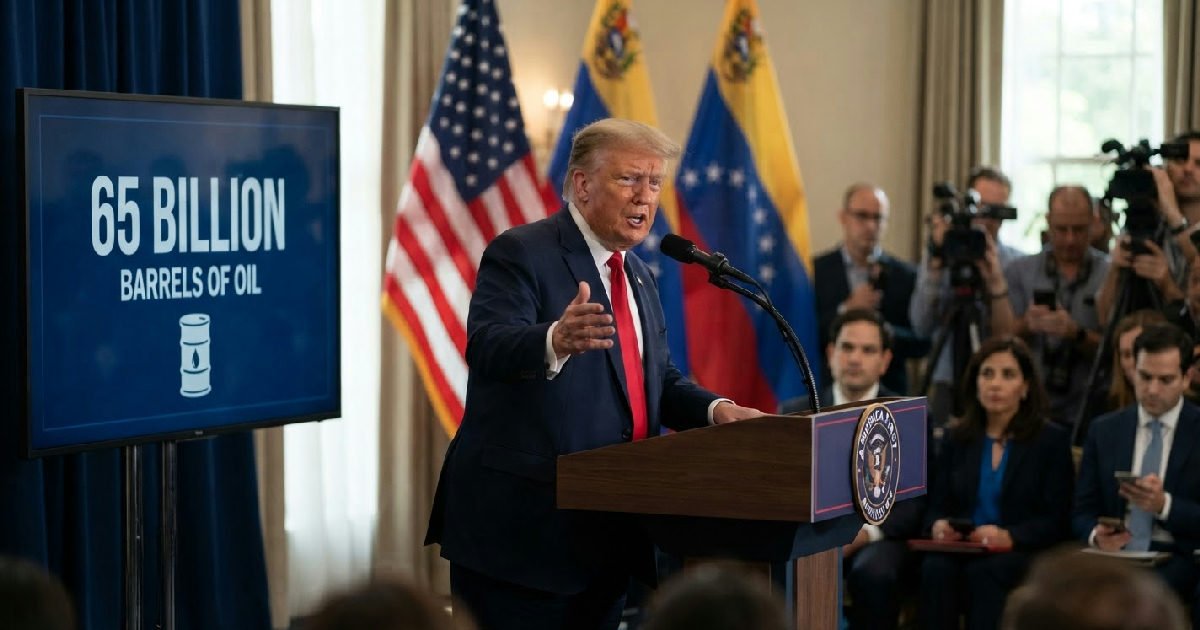
Trump announces US-Venezuela deal for control of 65 billion oil barrels
President Donald Trump announced on Friday, August 28, 2026, that the United States has secured an agreement with Venezuela to take control of 65 billion barrels of the South American nation’s vast oil reserves. In a social media post, Trump hailed the accord as “THE BIGGEST OIL DEAL IN WORLD HISTORY!” and a significant win for his administration’s “America First” energy policy.
The deal was reportedly negotiated with Venezuela’s interim President, Delcy Rodriguez, by a U.S. team that included Secretary of State Marco Rubio and Defense Secretary Pete Hegseth. This agreement comes as the Trump administration faces increasing pressure over high domestic gas prices and dwindling strategic petroleum reserves amidst ongoing global energy disruptions.
Trump announces US-Venezuela oil deal
The core of this agreement grants the United States what President Trump described as “majority” control over 65 billion barrels of proven Venezuelan oil reserves. A U.S. official informed Newsweek that this effectively translates to a 55 percent output from a new joint oil venture, achieved through a combination of equity and oil purchased at cost.
This massive volume forms part of 100-year concessions granted by interim President Rodriguez to a private entity, structured as a joint effort between the U.S. government and a private operator in Venezuela. These specific fields are said to hold 63 billion barrels of proven reserves, closely aligning with President Trump’s announced figure.
The entire deal was reportedly brokered “through a partnership with private business,” although the specific corporate partners remain unnamed.
Separately, on Tuesday, August 29, 2026, President Trump announced that Venezuela’s interim authorities would turn over between 30 million and 50 million barrels of sanctioned oil to the U.S. He has instructed Energy Secretary Chris Wright to immediately execute this transfer.
“This Oil will be sold at its Market Price,” Trump declared, “and that money will be controlled by me, as President of the United States of America, to ensure it is used to benefit the people of Venezuela and the United States!”
A backdrop of intervention and shifting policy
This stunning announcement follows nearly nine months after a U.S. military operation, directed by Trump, captured former Venezuelan president Nicolás Maduro. Maduro was subsequently brought to the United States to face federal narcoterrorism and drug trafficking charges, pleading not guilty during his initial court appearance in New York on January 5, 2026.
This action ultimately paved the way for U.S. recognition of an interim government under Delcy Rodriguez.
For years, President Trump has asserted that Venezuela “stole” assets belonging to American companies. He often cites the 2007 nationalization of hundreds of foreign-owned assets, including major oil operations, by former President Hugo Chavez. This new agreement is being framed by his administration as rectifying a historical injustice and reclaiming American interests.
Secretary of State Marco Rubio lauded the agreement as a landmark achievement. “This deal is a huge win for both the American and Venezuelan people,” Rubio stated. He argued that it demonstrates the effectiveness of Trump’s foreign policy, securing stable, low-cost oil in the Western Hemisphere. Rubio also highlighted that the deal promises nearly “$100 billion in private investment” aimed at rebuilding Venezuela’s struggling economy.
Domestic pressures driving foreign policy
The timing of this Venezuelan oil deal is crucial, as the administration grapples with significant economic challenges at home. The average price for a gallon of gasoline in the U.S. climbed to $4.09 on Friday, August 29, 2026, a sharp increase from $3.21 per gallon at the same time last year. This persistent burden on consumers has become a major political vulnerability for the president.
These rising fuel costs are exacerbated by ongoing international turmoil. The U.S.-Israel war against Iran, now past its six-month mark with no clear resolution in sight, has severely hampered oil tanker traffic through the crucial Strait of Hormuz. This has tightened global supply and put further upward pressure on fuel prices, prompting some to warn on inflation.
Simultaneously, America’s own emergency energy buffer has been shrinking steadily. The U.S. strategic petroleum reserves fell below 300 million barrels in early August 2026, marking a drop of over 100 million barrels since the beginning of the year. The administration views this Venezuelan agreement as a dual solution: both lowering prices for consumers and beginning the replenishment of the nation’s critical energy stockpiles.
A potential lifeline for a crippled oil giant
Venezuela possesses the world’s largest estimated proven oil reserves, totaling 303 billion barrels, which accounts for roughly 17 percent of the global supply. Despite this immense natural wealth, the country’s oil industry is in a state of near-total collapse. Decades of mismanagement, widespread corruption, and a severe lack of investment have crippled its infrastructure.
Currently, Venezuela’s crude oil production stands at a meager 1.25 million barrels per day, a mere fraction of its historical capacity. Rebuilding this dilapidated infrastructure and restoring production potential will require a colossal injection of capital and expertise. The $100 billion in private investment highlighted by Rubio is directly aimed at this challenge, suggesting U.S.
firms could soon be on the ground reconstructing Venezuela’s production capacity. This approach also aligns with earlier rhetoric from Trump, who has sometimes seen foreign policy moves as a means to escalates trade war pressure.
For the Venezuelan people, the deal is being presented as a tangible path toward significant economic recovery. Secretary Rubio projected that it would “support thousands of high-paying jobs, and drive the reconstruction of Venezuela’s economy.” However, the long-term implications of granting a foreign power such extensive concessions over its primary natural resource for a century remain to be seen.
Execution, oversight, and the road ahead
The immediate task for implementing aspects of this deal falls to U.S. Energy Secretary Chris Wright, who is charged with arranging the logistics for the transfer and sale of the initial 30 to 50 million barrels. This first tranche will undoubtedly serve as a critical test case for the broader, more complex agreement involving the 65 billion barrels of reserves.
However, the sweeping agreement is not without potential complications. The legal standing of a deal made with an interim government, especially one involving 100-year concessions, could face significant challenges on the international stage. Furthermore, the plan for the U.S. president to personally control the proceeds from oil sales is an unconventional measure that will undoubtedly attract intense scrutiny from critics and watchdogs alike.
The White House maintains this direct control is necessary to prevent funds from being lost to graft. Combating corruption remains a monumental task in any large-scale energy agreement, particularly given Venezuela’s past. Transparency and accountability will be paramount for the deal’s success and to ensure the intended benefits reach both nations.
Perhaps most telling is a recent comment from Secretary Wright, who stated that the U.S. plans “indefinitely” to have control over Venezuela’s oil. This signals that the Trump administration views this deal not merely as a temporary fix to current energy woes, but as a fundamental and potentially permanent reordering of the U.S.-Venezuela relationship, deeply centered on American energy security objectives.