

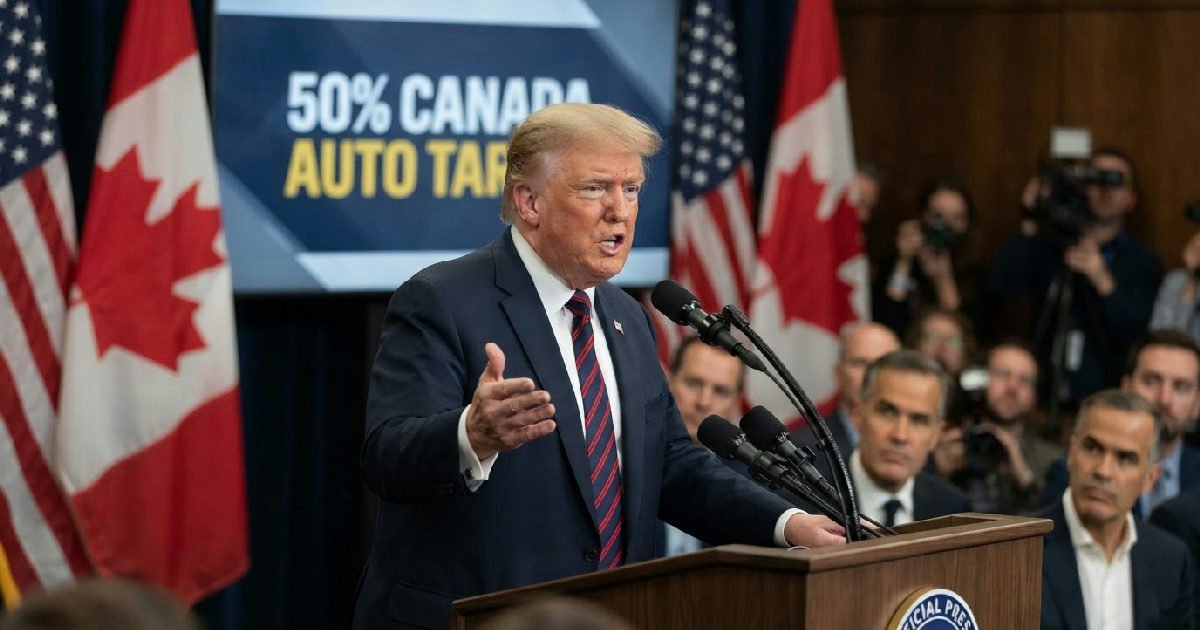
Trump Announces 50% Canada Auto Tariffs as Trade War Intensifies
On August 24, 2026, President Trump announced the U.S. will impose a 50% Canada auto tariff on all Canadian cars, trucks, automotive parts, and steel. S. President Donald Trump dramatically escalated the trade conflict with America’s northern neighbor on August 24, 2026, announcing the U.S.
will impose a staggering 50% tariff on all Canadian cars, trucks, automotive parts, and steel. The new Canada auto tariffs, announced via a post on Truth Social, are set to take effect on January 1, 2027, and follow the collapse of high-stakes trade negotiations last week.
The move represents a massive gamble and a significant blow to one of the world’s most integrated economic relationships. In response, Canadian Prime Minister Mark Carney has already promised to retaliate with equal force, setting the stage for a deepening trade war between the two allied nations.
The impact of Canada auto tariffs
This latest threat would double the top-line U.S. tariffs on Canadian auto imports, which currently stand at 25%, and extends an already-existing 50% tariff on Canadian steel to the entire automotive sector. The announcement came just days after Canadian negotiators left Washington without a new trade deal, an outcome both sides blame on the other for making unreasonable last-minute demands.
In his social media post, President Trump accused Canada of “ripping off the United States of America for years.” He cited what he called “ridiculously high tariffs on our Farmers and farm products” as justification for the move. The President invoked Section 338 of the 1930 Smoot–Hawley Tariff Act, a rarely used provision, as the legal basis for his action, citing Canada’s alleged “discriminatory treatment.”
U.S. Trade Representative Jamieson Greer echoed the White House’s frustration on Monday. He claimed that after being inches from a deal, his Canadian counterparts simply asked for too much. “In the last hours, I think there were things that the Canadians just — you know, they wanted more,” Greer told CNBC, reflecting on the collapse of trade talks.
The President’s rhetoric was characteristically blunt. “WE DON’T NEED CANADA, THEY NEED US!” he wrote, claiming the country “will be treated like a State no longer!” The comments have sent a chill through diplomatic and business circles on both sides of the border, who fear a protracted and economically damaging dispute.
Canada vows ‘dollar for dollar’ retaliation
The Canadian government has met Washington’s aggressive posture with a firm promise of its own. Prime Minister Mark Carney has stated Canada will hit back “dollar for dollar,” ensuring any economic pain inflicted by the U.S. is met in kind. Ottawa is already preparing its own list of tariffs, which are scheduled to take effect on September 8, 2026.
This follows a tense weekend where the U.S. imposed 50% tariffs on approximately $20 billion worth of other Canadian goods, including wine, cement, and even hockey sticks. The new Canada auto tariffs, however, strike at the very heart of the Canadian economy, particularly the manufacturing-heavy province of Ontario.
Widespread political condemnation in Canada
The reaction from Canadian political leaders has been swift and unified in its opposition. Conservative Leader Pierre Poilievre, typically a sharp critic of the current government, joined in condemning the U.S. action, highlighting the bipartisan nature of the concern. The economic security of Canada is seen as being under direct threat.
Ontario Premier Doug Ford, whose province is the hub of Canadian auto manufacturing, expressed grave concern over the potential job losses and economic disruption. The auto sector is a cornerstone of Ontario’s economy, and these tariffs could have a devastating impact on workers and their families.
Integrated auto supply chains brace for impact
The modern automotive industry was built on the foundation of free trade between the U.S. and Canada. Automakers operate deeply integrated supply chains where parts and components cross the border multiple times before a vehicle is fully assembled. A 50% tariff threatens to shatter this model, creating logistical nightmares and massive cost increases.
A single part can be hit with duties repeatedly as it moves from a supplier in one country to a sub-assembly plant in the other and back again for final installation. This complexity means the true cost of the tariff could be far greater than the headline 50% figure, creating enormous uncertainty for manufacturers.
Foreign automakers are central to Canadian production
While the dispute is framed as being between the U.S. and Canada, it will heavily impact global automakers. Japanese giants Toyota and Honda have a larger manufacturing footprint in Canada than America’s traditional ‘Detroit Three’ automakers combined. Together, they accounted for 76.5% of all vehicle production in Canada in 2025.
These companies have invested billions in their Canadian plants, which produce vehicles for both the Canadian and U.S. markets. The new tariffs place them directly in the crossfire. According to GlobalData, roughly 861,000 vehicles produced in Canada were sold in the U.S. last year, representing just 5.4% of a U.S. market that exceeds 16 million vehicles annually.
Economic consequences for consumers and workers
Industry analysts warn that the costs of these tariffs will ultimately be borne by American consumers. Automakers, already dealing with thin margins and complex supply chains, will have little choice but to pass the added expenses on in the form of higher vehicle prices. This could translate to thousands of dollars being added to the sticker price of popular models.
U.S. President Donald Trump previously invoked Section 338 of the 1930 Smoot–Hawley Tariff Act as the legal basis for his action. This signals a willingness to use any tool available to pursue a protectionist agenda, regardless of the consequences for established trade norms. Augustine Lo of law firm Dorsey & Whitney is among the experts monitoring these developments.
The move also sows chaos for future investment. Automakers plan their production cycles years in advance, and this level of uncertainty makes it difficult to commit to new plants or expansions in either country. It puts American and Canadian jobs at risk and could push manufacturers to re-evaluate their entire North American strategy.
What happens next in the US-Canada trade war
With negotiations broken down and harsh rhetoric flying, the immediate path forward points toward escalation. The world will be watching on September 8th to see the details of Canada’s retaliatory package. The composition of that list will signal how willing Ottawa is to target politically sensitive sectors in the United States.
For now, a deep freeze has settled over U.S.-Canada trade relations. Lisa Raitt, a member of a key advisory committee on the bilateral economic relationship, has expressed deep disappointment, noting how quickly a seemingly near-certain deal fell apart. The focus now shifts from negotiation to damage control.
The coming months will test the resilience of the North American economy and the long-standing alliance between the two countries. The core question is whether this is a temporary, if severe, breakdown or the beginning of a permanent realignment of trade and manufacturing across the continent.
For the hundreds of thousands of workers whose livelihoods depend on this cross-border trade, the answer can’t come soon enough.