

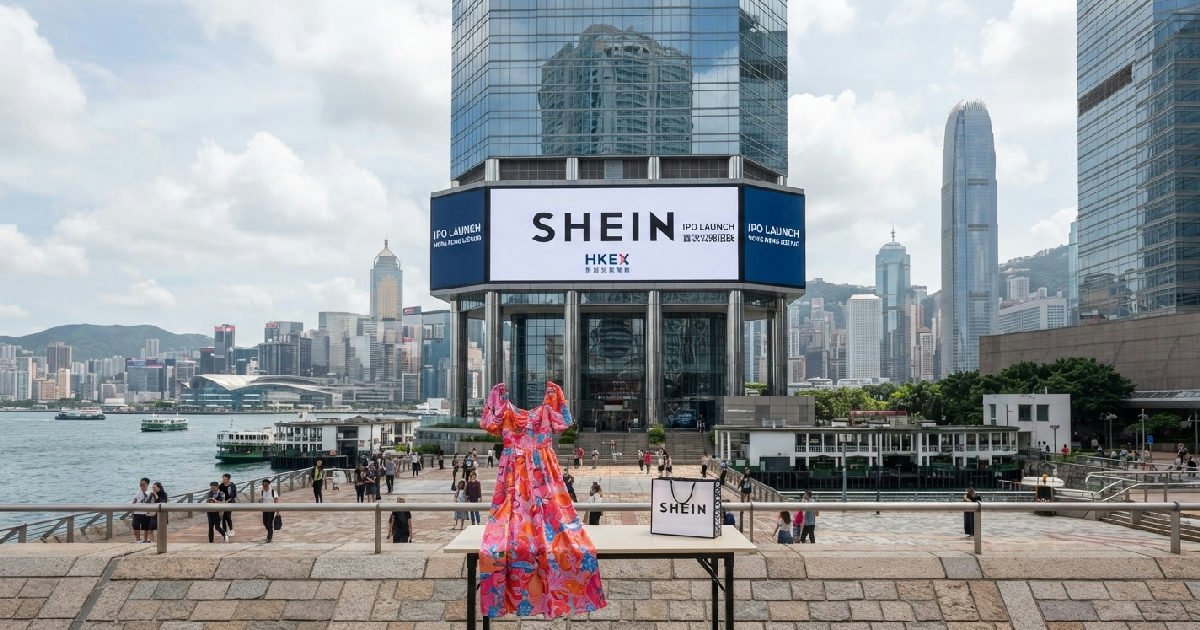
Shein launches Hong Kong IPO targeting $27bn valuation amid market headwinds
Fast-fashion behemoth Shein Global Holdings has officially launched its highly anticipated Hong Kong Initial Public Offering (IPO), seeking a valuation between $26 billion and $27 billion. The Singapore-headquartered company aims to raise up to HK$13.86 billion (approx. $1.77 billion USD) in what is poised to be the city’s largest new share sale of 2026.
The book-building process began on Monday, August 24, with the final price expected to be announced on August 31. The company is slated to make its trading debut on September 1, a slight delay from an earlier target of August 28, attributed to challenging market conditions and some pushback from investors on valuation.
Shein Hong Kong IPO valuation slashed
The targeted $27 billion valuation marks a dramatic comedown from the dizzying heights the company once enjoyed. It represents a staggering 70% drop from its peak private market valuation of nearly $100 billion back in 2022, a figure that symbolised the voracious investor appetite for high-growth tech and consumer companies.
Even as recently as April 2024, Shein was valued at $64 billion in private funding rounds. Initial discussions with investors for the IPO had reportedly floated a more ambitious range of $30 billion to $40 billion. But slowing growth and a host of business challenges have clearly tempered expectations among financiers.
This recalibration reflects a cooler, more risk-averse market. It also points to the specific pressures facing Shein’s business model, from fierce competition to a shifting regulatory landscape that threatens its core operational advantages.
Investor confidence in an evolving market
The days of sky-high valuations for unprofitable growth appear to be over. Investors are now scrutinising business fundamentals more closely, especially in light of broader economic uncertainties.
This cautious approach is evident across various sectors, where market participants are seeking stability. Strong investment inflows into certain assets can indicate shifts in overall sentiment.
Mounting headwinds and rising costs for fast fashion
Several factors are contributing to the deflated valuation. According to its preliminary prospectus, Shein posted a net loss of $99 million in the first quarter of 2026. This is a sharp reversal from the $395 million profit it recorded in the same period a year prior, signalling that its growth trajectory is becoming more expensive to maintain.
A primary driver of this is the intensifying competition from rival PDD Holdings’ platform, Temu, which has replicated Shein’s direct-from-factory model. Temu is aggressively spending on marketing to capture global market share, forcing Shein to increase its own costs to defend its position.
Furthermore, significant changes to international trade rules have eroded a key pillar of Shein’s economic model. The United States recently removed an import duty exemption for small-value packages, which previously allowed Shein to ship individual orders directly to US consumers without incurring tariffs. This change fundamentally alters the cost structure of its largest market.
A new European Union levy on packages worth less than €150 is also expected to add pressure. Combined with higher material costs linked to geopolitical tensions like the Middle East war, Shein has been forced to increase prices for consumers, potentially dampening demand.
The deal’s mechanics and key players
Despite the lower valuation, the IPO remains a landmark event for the Hong Kong Stock Exchange. Shein is offering 280 million shares priced between HK$47.60 and HK$49.50 each. The offering is being arranged by a trio of Wall Street giants: Goldman Sachs Group, Morgan Stanley, and JPMorgan Chase & Co.
This listing follows failed attempts to go public in both New York and London. The company’s plans for a US listing faced significant regulatory hurdles and political opposition, prompting the pivot to Asia. China’s securities regulator, the CSRC, officially approved Shein’s Hong Kong ambitions on July 10, 2026, paving the way for this week’s launch.
The success of the IPO is seen as a crucial test for Hong Kong’s capital markets, which have been in a slump. A strong debut for Shein could help renew confidence and encourage other major companies to list in the city, providing a much-needed boost to its status as a global financial hub.
Cornerstone investors signal early support
To anchor the deal, Shein has secured a powerful lineup of cornerstone investors. These investors have subscribed for approximately $383 million worth of shares. They typically agree to hold their stock for a fixed period, providing stability and a vote of confidence in the offering.
The list includes prominent existing backers like Boyu Capital, Tiger Global, General Atlantic, and Tencent. New institutional capital is also coming in, most notably from the asset management division of UBS Group AG, which is investing in Shein for the first time. The company had planned to reserve at least $400 million of stock for such key investors.
Founders to retain tight grip on control
Public investors should be aware that they won’t have much say in the company’s direction. The shares sold in the Hong Kong IPO will carry significantly diluted voting rights, a common structure for founder-led technology companies. This dual-class share system is designed to protect the long-term vision of the founders from short-term market pressures.
Specifically, the public shares will have one-tenth the voting power of the shares held by the company’s four co-founders: Sky Yangtian Xu, Maggie Gu, Molly Miao, and Tony Ren. This arrangement ensures that the founding team will collectively control an overwhelming 90% of Shein’s voting rights post-IPO, giving them near-total control over board appointments and strategic decisions.
While this ensures leadership stability, it can be a point of contention for corporate governance advocates. Public shareholders will have limited ability to influence the company’s policies on everything from executive compensation to its controversial supply chain practices. The structure means investors are betting on the long-term judgment of the founding team.
Market sentiment can be influenced by such arrangements, sometimes indicating a market risk zone for new investors.
Use of proceeds and future strategy
Shein has earmarked the majority of the IPO proceeds for aggressive expansion and technological improvements. The company stated in its filing that about 80% of the cash raised will be used to enhance its technology, build out its global brand presence, and diversify its supply chain.
Expanding its supply chain beyond China is a key priority, as the company seeks to mitigate geopolitical risks and shorten delivery times in key markets. The fresh capital will also be used to fuel market expansion efforts as it battles Temu and other rivals across the globe. This rapid expansion, coupled with slowing revenue growth and rising operational costs, demands constant investment.
A portion of the funds will also be used to satisfy obligations to early backers. The company has agreed to a cash payout of up to about $3.5 billion to certain investors who purchased special classes of convertible shares in previous private funding rounds. This is essentially a way of making early investors whole before the public listing.
A pivotal moment for Shein and Hong Kong
Ultimately, this IPO is a moment of truth for Shein. It provides a massive injection of public capital but also brings a new level of scrutiny to its business practices, financial performance, and governance. The company’s 2025 revenue hit an impressive $41.9 billion, up from $32.1 billion in 2023, with a net profit of $2.06 billion for the year.
However, the Q1 2026 loss and slowing growth show that the path forward is not without obstacles. The intense competition means that the market selling pressure intensifies daily, forcing constant innovation and expenditure on logistics and marketing. The public listing will give it the war chest to continue that fight.
For Hong Kong, securing what is Asia’s third-largest IPO this year is a significant win. It surpasses the $751 million offering from autonomous driving firm Momenta Global in July. A successful float could help reverse the narrative of a declining market and re-establish the city as the premier destination for major Chinese and international companies to raise capital.