

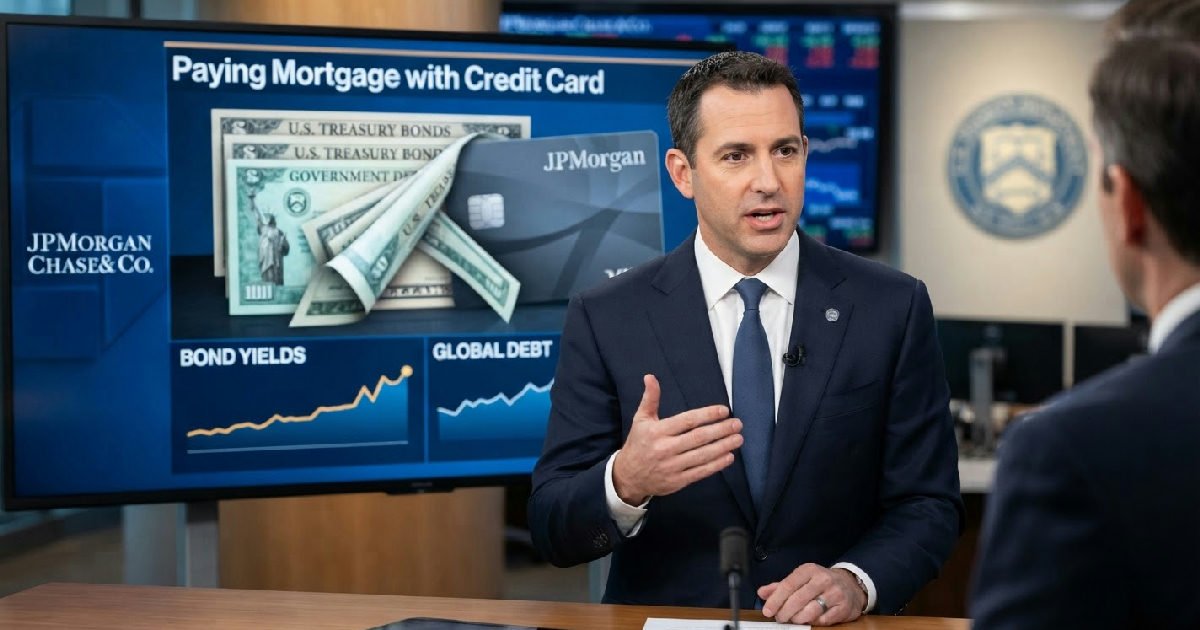
JPMorgan warns U.S. bond intervention ‘paying mortgage with credit card’
The U.S. government’s current strategy for managing its Treasury market is akin to “paying your mortgage with your credit card,” according to James Sullivan, co-head of global fundamental research at JPMorgan. His stark warning, reported by CNBC on Friday, highlights a growing concern that recent U.S. bond intervention offers only temporary relief and sidesteps the nation’s escalating debt problem.
Sullivan’s critique focuses on the Treasury’s approach of buying back longer-duration bonds while simultaneously issuing shorter-dated bills. This tactic, designed to ease immediate borrowing costs and inject liquidity, doesn’t fundamentally reduce the overall debt burden, prompting worries about future financial stability.
Treasury’s U.S. bond intervention for debt
The U.S. Treasury Department, under Secretary Scott Bessent, recently announced plans to significantly expand its government debt buyback program. This operation, set to commence on September 9 and run through November 4, aims to at least double the size of previous efforts, signaling an aggressive push to manage market pressures.
However, Sullivan argues that this strategy merely kicks the can down the road. “It’s a little bit like paying your mortgage with your credit card. It can work for a while, but eventually the mismatch starts to become more obvious,” he explained. Refinancing long-term obligations with short-term borrowing avoids confronting the structural issues driving the national debt.
The underlying debt continues to swell, with approximately $40 trillion in U.S. government debt alone. Across developed-market governments globally, that figure reaches roughly $76 trillion. This immense US Treasury move raises questions about how long temporary fixes can sustain market confidence.
Global shift away from U.S. government debt
The sheer volume of new bond issuance is colliding with a notable decline in foreign demand for U.S. Treasurys, complicating the supply-demand balance. Historically, international buyers were a reliable pillar of support for the American bond market, but that dynamic is changing.
China, a historically significant holder of U.S. debt, has seen its Treasury holdings plummet to an 18-year low. Similarly, U.S. Treasury custody holdings for foreign governments overall are at their lowest point in 14 years. This retreat forces the U.S. to rely more heavily on domestic buyers, potentially driving up borrowing costs.
This shift isn’t happening in isolation. Just last Friday, August 14, 2026, U.S. Treasury Secretary Scott Bessent engaged in a joint currency intervention with Japan. The move, intended to support the struggling yen, reportedly involved Japan selling U.S. bonds, further illustrating the complex interplay within the global Treasury market.
Analyst perspectives on the bond market outlook
Concerns about the U.S. bond market and the broader fiscal situation extend beyond JPMorgan. Several prominent financial institutions and strategists have voiced their opinions on the current trajectory and the effectiveness of interventionist measures.
- James Sullivan, Co-head of Global Fundamental Research at JPMorgan (per Binance News).
- Scott Bessent, U.S. Treasury Secretary (per The Wall Street Journal, Forbes, Barchart.com, Kitco News, AP News).
- Ying Shan Lee, Author of the CNBC article reporting the quote (per Google News, AP News).
- John Briggs, Natixis rates strategist (quoted by The Wall Street Journal).
- ING, Investment firm (analysts likened Bessent’s efforts to “rearranging deckchairs on the Titanic,” per Forbes).
- Greg Ip, from The Wall Street Journal (noted growing US debt and erratic economic policies, per Forbes).
- Mark Cabana, Head of U.S. rates strategy at Bank of America Securities (per AP News).
- Kevin Warsh, Federal Reserve official (appointed by Trump, per AP News).
- Jerome Powell, Former Federal Reserve Chair (per AP News).
- BNP Paribas, Investment bank (strategists commented on an unusual reaction to a Fed meeting, per AP News).
- Macquarie, Investment bank (analysts estimated U.S. government bond issuance needs, per AP News).
- Michael Goosay, Chief Investment Officer of Fixed Income at Principal Asset Management (per Kitco News).
- BNY, Financial institution (strategists expressed doubt about Bessent’s toolkit, per Barchart.com).
- UBS, Financial institution (strategists expressed doubt about Bessent’s toolkit, per Barchart.com).
- Barclays, Financial institution (strategists expressed doubt about Bessent’s toolkit, per Barchart.com).
- Cullen Roche, Financial commentator/analyst (mentioned by Investing.com for his views on the dollar).
Corporate borrowing boom and competitive bond yields
The surge in debt isn’t limited to governments. Corporations are also tapping bond markets heavily, adding another layer of competition for capital. This trend is particularly pronounced in capital-intensive sectors like artificial intelligence infrastructure, reshoring initiatives, and national security investments.
Leading AI companies, for instance, have issued $200 billion of debt so far this year. That figure marks an 80% increase from a year earlier, according to Sullivan. The significant investment required to meet AI chip demand and construct new data centers means private entities are now directly competing with sovereign issuers for investor funds.
This increased competition for capital is pushing bond yields higher. The environment makes fixed-income assets increasingly competitive with equities, especially when stock valuations are elevated. This marks a notable shift from recent years where low bond yields made stocks the undisputed choice for many investors.
Shifting asset allocation decisions for investors
JPMorgan data indicates that bond yields are now higher than the earnings yield on the S&P 500. This development fundamentally alters the calculus for investors weighing their options between asset classes. A higher bond yield offers a more attractive, and often safer, return compared to the average stock.
As these market dynamics play out, “the asset allocation decision becomes significantly more complex going forward,” Sullivan noted. Institutional and individual investors alike must now recalibrate their portfolios, considering the renewed appeal of bonds against the potential growth of the stock market.
The Federal Reserve’s own actions also play a role in this environment. Mortgage rates, for example, tend to follow the 10-year Treasury yield, which surged by nearly 47 basis points since early April 2025. This pushed the 30-year fixed mortgage rate up to 6.89% as of May 29, 2025, impacting housing markets.
Existing home sales, for example, fell 0.5% in April 2025, the weakest April pace since 2009.
The outlook: underlying problems persist
While the U.S. Treasury’s buyback operations might provide some short-term stability to the markets, they don’t address the core issue of mounting national debt. This financial maneuvering, likened to a treasury asset transfer between different maturities, essentially postpones the inevitable rather than resolving it.
JPMorgan Chase CEO Jamie Dimon has previously called the worsening U.S. fiscal situation a “real problem,” predicting a “tough time” ahead for bond markets. The concerns raised by Sullivan echo this sentiment, emphasizing that without addressing the fundamental imbalance of government spending versus revenue, the long-term outlook for the U.S. Treasury market remains challenging.