

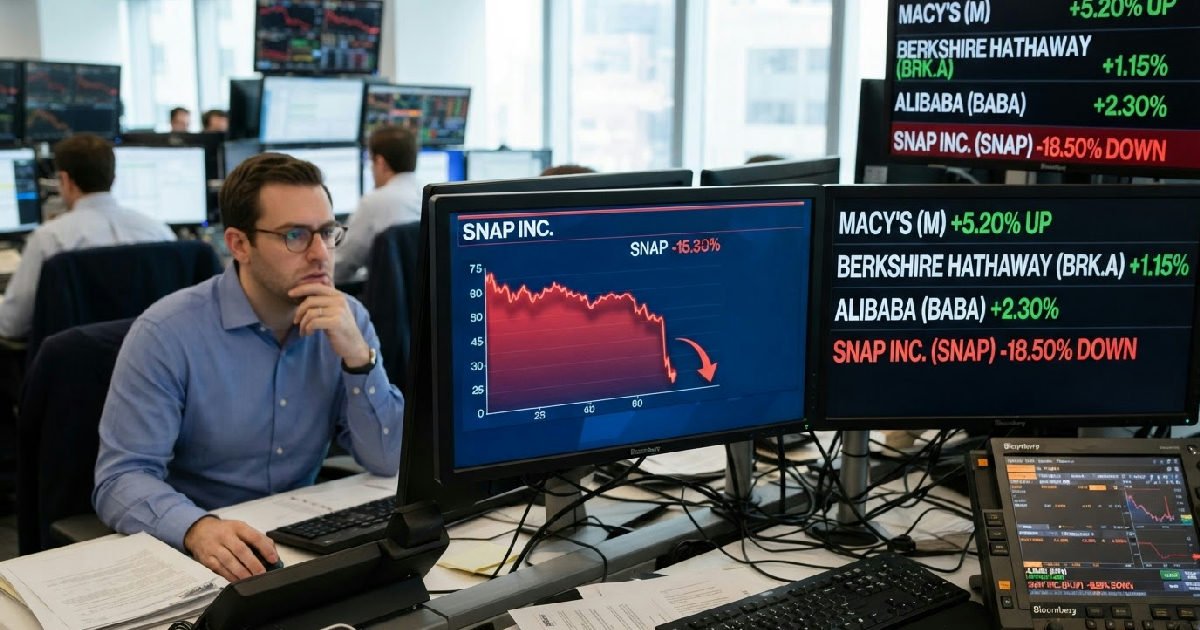
Snap Shares Plunge on Legal Woes as Macy’s Surges on Berkshire Stake
Snap shares plummeted in trading on Monday, August 17, as the social media company confronts a cascade of legal challenges and heavy insider stock sales. plummeted in trading on Monday, August 17, as the social media company confronts a cascade of legal challenges and heavy insider stock sales. In stark contrast, department store Macy’s Inc.
saw its stock jump after a filing revealed a significant investment by a key figure at Berkshire Hathaway.
The divergent paths of the two companies highlight a telling split in market sentiment. While investors are growing wary of the mounting legal and regulatory risks hounding big tech, some are placing new bets on turnaround stories in the traditional retail sector. This dynamic reflects a cautious broader investor sentiment as markets weigh risk and value.
Snap shares tumble amid mounting legal pressure
Snap’s stock was down 3.52% to $5.22 in premarket trading Monday, setting the stage for a difficult session that looks to end a brief two-day win streak. The slide adds to a punishing year for the company, with its stock down roughly 34% year-to-date. The all-time high of $83.34, reached in September 2021, now feels like a distant memory.
The immediate catalyst for the sell-off appears to be a pivotal ruling from the 9th U.S. Circuit Court of Appeals, which Wall Street is still digesting.
This legal setback, combined with ongoing lawsuits like the one from Labaton Keller Sucharow LLP concerning the platform’s alleged negative effects on adolescent mental health, creates a cloud of uncertainty. Investors are bracing for the prospect of protracted litigation, potential settlements, and costly product redesign mandates.
Adding to the pressure are reports of significant insider stock sales, which create negative optics and suggest a lack of confidence from within the company. This multifaceted overhang of legal and internal pressure is threatening to suppress Snap’s valuation multiples for the foreseeable future, overshadowing some otherwise positive operational results from earlier in the year.
The pessimism comes despite a relatively strong second quarter. Snap reported Q2 sales of $1.60 billion, up 19% from the prior year, and beat analyst estimates on both revenue and earnings per share. The company’s digital advertising business even received a boost from the World Cup. But for now, those financial gains are being eclipsed by external headwinds.
A tale of two turnarounds: Macy’s gets the Berkshire nod
While Snap battled headwinds, Macy’s enjoyed a significant tailwind. The retailer’s stock climbed after a public filing disclosed that Greg Abel, Warren Buffett’s designated successor at Berkshire Hathaway, had purchased three million shares. This marks Berkshire’s first-ever investment in the department store, a powerful vote of confidence.
The move aligns with Abel’s stated aim of holding fewer, higher-conviction positions in companies with established brands and reliable income streams. For Macy’s, it’s a major validation of its ongoing turnaround strategy, dubbed the “Bold New Chapter.” The company has seen its stock gain over 43% in the past 90 days, trading around $23.75 on Monday.
That strategy involves closing approximately 150 underperforming stores to redirect capital toward its more successful locations, its luxury nameplates, and new, smaller-format stores. The plan is showing early signs of success, particularly in its upscale segments. In the first quarter, comparable sales grew 10.2% at Bloomingdale’s and 6.4% at the beauty retailer Bluemercury.
The Berkshire investment builds on growing positive sentiment from analysts. In July, Morgan Stanley initiated coverage with an “Overweight” rating and a $30 price target. The company has now beaten Wall Street earnings expectations for five consecutive quarters, suggesting its recovery has durable momentum despite persistent inflation concerns in the wider economy.
Divergent paths in the tech and retail sectors
The day’s trading offered a clear illustration of the different challenges facing various sectors. While Snap struggles with issues endemic to social media, other tech giants are finding ways to excite investors.
Chinese e-commerce leader Alibaba also saw its shares rise on Monday, fueled by news of a deal to sell its gaming arm and impressive claims of over three billion downloads for its open AI model.
Alibaba’s move is seen as a strategic refocusing, shedding non-core assets to double down on the high-growth field of artificial intelligence. It presents a sharp contrast to Snap, which is being weighed down by both its core product’s societal impact and a lukewarm reception to new hardware ventures, such as its recently launched $2,195 smart glasses that Wall Street is reportedly “panning.”
Meanwhile, the enthusiasm for Macy’s signals a potential shift in how investors view the beleaguered retail industry. For years, department stores were seen as a losing bet against e-commerce. But Macy’s focus on luxury, strategic closures, and a solid dividend yield of 3.19% presents an attractive value proposition for investors like Abel, who are looking for tangible assets and proven brands.
What this means for investors
The key takeaway is a market that is increasingly discriminating. A company’s narrative is just as important as its balance sheet. Snap’s story is currently dominated by legal threats, with its stock’s high volatility (beta of 2.75) reflecting the deep uncertainty. Its next earnings report, scheduled for October 15, will be a critical test of whether it can shift the narrative back to growth.
For Macy’s, the narrative is one of a classic American brand finding its way in the modern world. The Berkshire endorsement is a powerful chapter in that story, but the road ahead for retail remains challenging.
While analysts at Morgan Stanley see shares hitting $30, the median forecast among 46 analysts is a more modest $17.30, indicating that not everyone is convinced the turnaround is complete.
The road ahead for Snap and Macy’s
Looking forward, Snap faces a difficult path. The company must navigate a complex legal environment that could fundamentally alter how its products are regulated. With over $4.2 billion in debt, any significant financial penalties or settlements could further strain its resources.
Investors will be watching closely for any updates on litigation and for signs of stabilization in its stock price, which remains far below its 52-week high of $9.28.
Macy’s, on the other hand, must prove its “Bold New Chapter” can deliver sustained growth. The investment from Abel increases both visibility and pressure to execute. The strategy to shrink its footprint while investing in luxury and smaller stores is a calculated gamble that the future of retail is smaller, more curated, and more upscale.
Its success could provide a blueprint for other legacy retailers, though it does little to change the appetite for riskier assets seen elsewhere in the market.
Monday’s market activity serves as a powerful reminder of the forces at play. Tech investors are being forced to price in regulatory risk in a way they haven’t before, while value investors are finding new reasons to believe in old-school industries.
The split between Snap’s stumble and Macy’s surge shows that in 2026, a good story is one of the most valuable assets a company can have.