

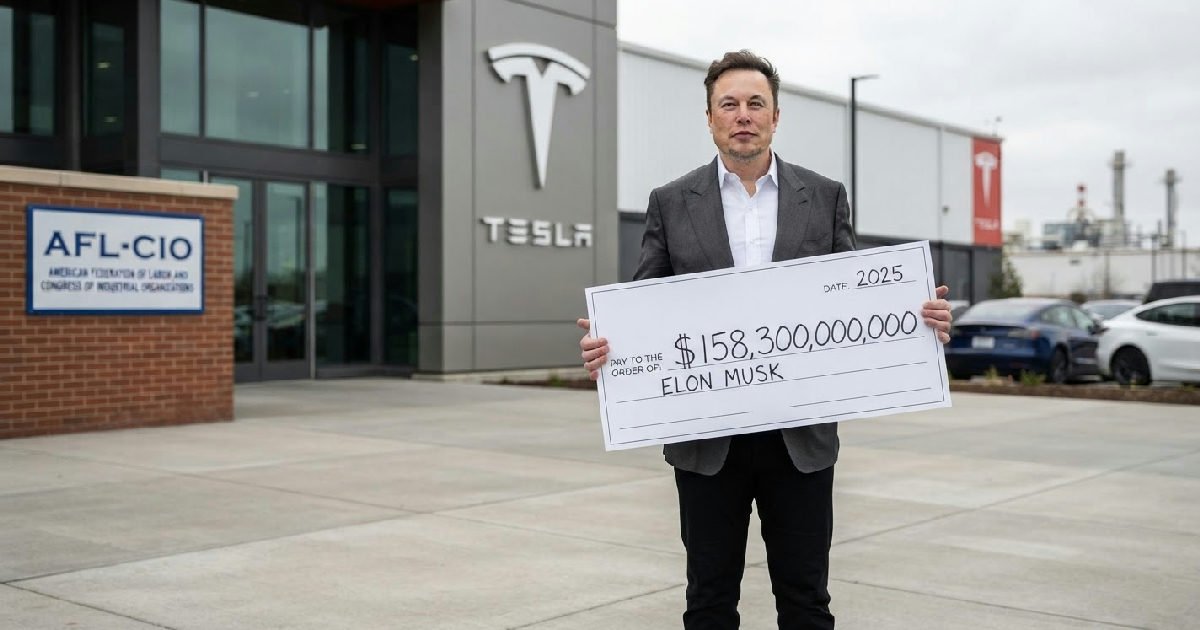
Elon Musk’s $158.3 billion 2025 Tesla pay ignites compensation debate
Elon Musk’s 2025 pay from Tesla was valued at $158.3 billion, according to the AFL-CIO’s 2026 Executive Paywatch report. 3 billion, a sum that eclipses the combined earnings of all other S&P 500 chief executives. This extraordinary payout, detailed in the AFL-CIO’s 2026 Executive Paywatch report, has thrown a harsh spotlight on widening CEO-to-worker pay disparities and ignited fresh debates over corporate governance.
The staggering sum comes even as Tesla reported a challenging 2025, with revenues dipping and profits falling significantly. The report highlights an extreme imbalance where Musk’s earnings alone dramatically skew average CEO compensation figures across America’s largest companies.
Understanding Elon Musk’s 2025 pay package
The AFL-CIO’s analysis of 2025 executive pay laid bare the sheer scale of Elon Musk’s earnings. His $158.3 billion Tesla pay package was reported as 14 times higher than the total compensation received by every other CEO in the S&P 500 combined.
This figure has dramatically altered the overall statistics for executive pay. With Musk included, the average CEO-to-worker pay ratio across S&P 500 companies in 2025 soared to an astonishing 5,387-to-1. Remove his colossal compensation, however, and that ratio shrinks considerably to 312-to-1.
Similarly, the average S&P 500 chief executive’s pay jumped by 1,700 percent from 2024 to 2025 when Musk’s earnings are factored in. Without Tesla, the year-over-year increase was a more modest, though still substantial, 21 percent. This suggests that the reported spike in overall CEO pay is overwhelmingly driven by one individual’s exceptional package.
Record payout amidst Tesla’s economic headwinds
The magnitude of Musk’s 2025 compensation is made even more striking when contrasted with Tesla’s financial performance during the same period. The electric vehicle giant recorded $94 billion in revenue for 2025, marking a 3 percent decrease from the previous year. This was Tesla’s first-ever year-over-year revenue decline.
Moreover, the company’s GAAP profits plummeted by 61 percent in 2025 compared to 2024. The AFL-CIO report emphasized that Musk’s $158 billion payout was not only higher than Tesla’s entire revenue for the year but also exceeded Tesla’s total profits over its entire history. His 2025 compensation was also 41 times larger than Tesla’s net income for that year.
Such figures raise pointed questions about the link between executive compensation and corporate financial health. Critics argue that a CEO’s pay should reflect the company’s performance, especially when workers face different economic realities.
Widening gap: CEO-to-worker pay continues to climb
Musk’s individual pay package isn’t the only concern highlighted by the AFL-CIO report; it also underscores a broader trend of growing pay disparity. Even when his figures are excluded, the average S&P 500 CEO still earned a remarkable $22.8 million in 2025.
This marks a significant increase from $18.9 million in 2024 and represents the highest average CEO pay recorded since the AFL-CIO began tracking these compensation plans in the 1990s. The non-Musk CEO-to-worker ratio also saw a jump, climbing from 285-to-1 in 2024 to 312-to-1 in 2025, according to a recent global stock rally report.
Fred Redmond, secretary-treasurer for the AFL-CIO, commented on this phenomenon, stating that Musk’s compensation “changes the dynamic when other CEO compensation plans come up” and that “boards use it as a reference.” This suggests a ripple effect, where outlier pay packages can influence and potentially inflate compensation expectations across the corporate landscape.
The influence of market movements and board decisions
The discussion around executive pay often involves the role of stock performance. Many CEO compensation packages, including Musk’s, are heavily weighted towards stock options and performance-based incentives tied to market capitalization. The ongoing S&P 500 market movements can significantly impact the realized value of these awards.
Corporate boards play a crucial role in approving these packages. The reinstatement of Musk’s 2018 compensation by the Delaware Supreme Court in December 2025, after a protracted legal battle, underscores the complex interplay between shareholder interests, board decisions, and judicial oversight. That 2018 package alone was valued at $139.2 billion when reinstated, according to Equilar data.
The trajectory of Musk’s wealth
Musk’s staggering 2025 pay comes amidst a tumultuous but ultimately upward trajectory for his personal fortune. He briefly claimed the title of the world’s first trillionaire in June, following the initial public offering of SpaceX. At its peak, his fortune reached an all-time high of $1.45 trillion.
But the rollercoaster ride of extreme wealth continued; by August 13, 2026, his net worth had reportedly fallen to around $880 billion, with Forbes estimating it at $870.6 billion that morning. He even acknowledged this shift on X, writing that he was a “(Former) trillionaire)”.
This fluctuating wealth, largely tied to the valuations of his various ventures like Tesla and SpaceX, provides context for the enormous pay package. Investment in advanced technologies, such as those discussed in reports on AI infrastructure financing, continue to shape the fortunes of tech magnates.
But the focus remains on the cash equivalent value of the Tesla compensation package specifically for 2025 and its implications for the broader economic narrative.
Legal precedents and future governance challenges
The legal battles surrounding Musk’s compensation set important precedents for corporate governance. His initial $56 billion package was first blocked by a Delaware court in January 2024, which found flaws in the approval process and deemed it excessive. The court, led by Chancellor Kathaleen St. Jude McCormick, argued that Musk had influenced the package through “sham negotiations” and that shareholders were not fully informed.
Despite attempts by Tesla’s board to re-ratify the package, the ruling was reaffirmed in December 2024. However, the Delaware Supreme Court ultimately overturned this decision on December 19, 2025, reinstating the 2018 pay package.
The Supreme Court cited “improper remedy” for rescission, stating it would leave Musk “uncompensated for his time and efforts over a period of six years.” This complex legal saga highlights the ongoing tension between shareholder protection and rewarding executive performance.
The outcomes of these legal challenges will continue to shape how other corporations structure their executive incentive plans. Boards and compensation committees will undoubtedly scrutinize these rulings as they craft future packages, especially for high-profile CEOs with significant company control.
The broader implications for economic inequality
The AFL-CIO report and the discussion around Elon Musk’s 2025 compensation are more than just financial news; they touch upon fundamental questions of economic inequality. Musk’s total compensation at Tesla was 2,522,203 times the median Tesla employee’s pay in 2025, a ratio that raises serious ethical and societal concerns.
It suggests an economic system where the benefits of corporate success are overwhelmingly concentrated at the very top.
Such extreme disparities can fuel social unrest, diminish worker morale, and intensify calls for regulatory reform. Policymakers and labor advocates frequently point to these figures as evidence of a broken system that needs recalibration.
The debate is often framed around whether such immense individual wealth is a just reflection of value creation or an indicator of systemic flaws that allow a few to capture disproportionate gains.
Ultimately, the saga of Elon Musk’s 2025 pay package serves as a powerful case study. It illustrates the incredible rewards possible in modern capitalism, the complexities of corporate governance, and the persistent challenge of addressing wealth inequality in a globalized economy. The conversations sparked by this report will undoubtedly echo through boardrooms, legislative chambers, and public discourse for years to come.