

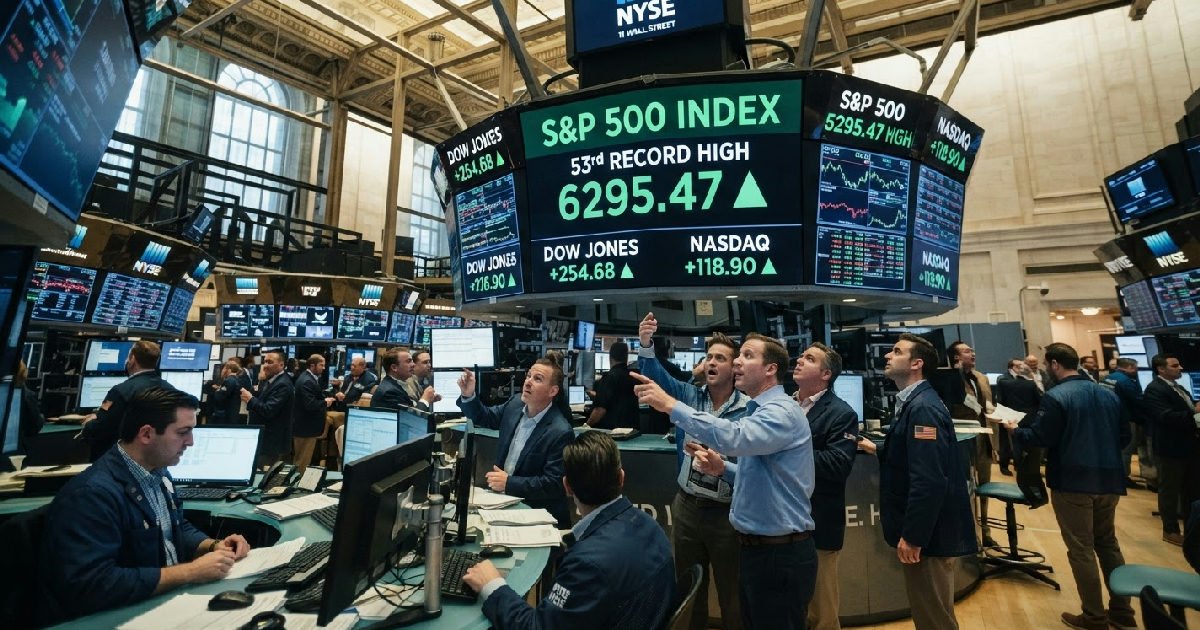
Global stock rally powers ahead as S&P 500 marks 53rd record high
Global financial markets are extending their robust rally this week, with major US indices notching new milestones and Asian stocks following suit. The S&P 500 Index closed at a record 7,758 points on August 7, 2026, and marked its 53rd all-time high of 2024 just two days later.
This sustained ascent comes as investors cheer better-than-expected second-quarter corporate earnings and diminished concerns over Federal Reserve interest rate hikes. Geopolitical developments, particularly those related to Iran, are also contributing to dynamics in the energy markets, subtly influencing broader investor sentiment.
Major US indices break new ground
The S&P 500 has been on an impressive run, demonstrating remarkable resilience and growth throughout 2026. On August 4, 2026, the index gained 91.35 points, rising 1.73% to close at 5,359.40 points, marking an all-time high not seen in two months.
Just three days later, on August 7, the S&P 500 surged 0.6% to reach an even higher record close of 7,758. This impressive climb was partly attributed to weaker-than-expected labor market data, which helped to temper expectations for an imminent Federal Reserve rate hike.
By August 9, 2026, the index hit its 53rd all-time high of the year, having climbed over 27% year-to-date. Looking ahead to August 10, S&P 500 Futures inched 0.1% lower to 7,775.50 points by early Sunday night ET, while the US500 itself fell marginally to 7755 points, losing 0.03% from its previous session.
Over the past month, the S&P 500 climbed 3.19% and now sits 21.68% higher compared to the same period last year. This builds on a strong 2023, where the index gained 26.1%, resulting in a formidable 58% surge since the start of last year.
Should the S&P 500 maintain a gain of 20% or more by the end of 2024, it would signify the first instance of such back-to-back strong performance since 1998.
Dow and Nasdaq momentum continues
The Dow Jones Industrial Average has also shown significant upward momentum. On August 3, 2026, it surged nearly 700 points to an all-time closing high, finishing up 1.32% at 53,178.41 points.
The following day, August 4, saw another substantial gain of 607.62 points, pushing the Dow to 40,201.28. While it dipped slightly on August 6, it rebounded by August 9, gaining 152 points (0.28%) to close at 54037 points.
Dow Jones Futures traded marginally lower at 54,076.0 points on August 10, indicating a stable outlook for the week ahead. Similarly, the Nasdaq Composite and Nasdaq 100 have enjoyed a buoyant period, particularly among technology stocks.
The Nasdaq 100 rose more than 2% on August 3 as investors renewed their interest in tech names. Tech stocks continue to propel markets higher.
On August 4, the Nasdaq Composite gained 323.22 points (1.97%) to close at 16,710.54, while the Nasdaq gained a further 1.3% on August 7. Futures for the Nasdaq 100 were largely muted at 29,83775 points on August 10.
Corporate earnings provide a solid foundation
A significant driver behind the current market optimism is the robust performance seen in second-quarter corporate earnings reports for 2026. Companies across various sectors have largely exceeded analyst expectations, painting a positive picture for the economy.
As of August 7, 2026, 442 S&P 500 companies had already reported their Q2 results. A remarkable 69% of these companies beat estimates on the top line, and an even more impressive 87% surpassed bottom-line expectations.
Overall, the earnings per share (EPS) growth for the S&P 500 is tracking at a substantial 51.44%, with revenue growth at 14.70%. Excluding one-time investment gains, the S&P 500’s EPS growth rate was still tracking a healthy 26-29%.
Key Q2 2026 results highlight sector strength
Energy giant Saudi Aramco reported a net profit of $32.69 billion for Q2 2026, marking a significant 44% increase compared to its $22.67 billion profit in Q2 2025. The company also maintained an impressive supply reliability rate of 98.4%.
Canadian petroleum companies also experienced a booming quarter. The four largest publicly-traded firms saw their combined revenues, net of royalty payments, grow almost 50% in the April-June period compared to the previous year.
Their after-tax profits more than doubled, soaring by 144% compared to Q2 2025, to reach a combined total of $13.3 billion, equating to almost $150 million per day. Share prices for these four companies have collectively increased by an average of 45% since the beginning of the year.
Outside of energy, Keurig Dr Pepper saw its stock rise 1% after reporting earnings and revenue that were ahead of expectations. Molson Coors also enjoyed a 1% increase after revealing encouraging financial results for the quarter.
However, not all companies had a smooth quarter. Honeywell Aerospace experienced a 21% fall in its stock after its results fell short of forecasts. Mobile advertising platform AppLovin slumped 19.6% after delivering mixed financial results.
SpaceX, meanwhile, saw its shares rise 0.6% on August 6, 2026. This occurred as more than 911 million SpaceX shares, held by early investors and employees, became eligible for sale following the expiration of a lockup period.
Interest rate outlook and underlying market strength
Investor sentiment has been notably boosted by shifting expectations regarding future interest rate policies from the Federal Reserve. Recent weaker-than-expected labor market data has been interpreted by many as reducing the likelihood of aggressive rate hikes.
This has provided a tailwind for equities, as lower interest rates generally make borrowing cheaper for companies and increase the present value of future earnings. The market’s reaction on August 7, following the labor data, underscored this sensitivity.
Beyond headline index figures, broader market breadth indicators also suggest underlying strength. As of August 7, 2026, the S&P 500’s (SPX) breadth improved to 71.74% from 69.73% week-over-week.
The Nasdaq Composite (CCMP) breadth moved up to 47.22% from 44.00% week-over-week, while the Russell 2000 (RUT) breadth expanded to 67.01% from 64.03% week-over-week. These figures indicate that a broader base of stocks is participating in the rally, rather than just a few large-cap companies.
Asian markets respond to global shifts
The positive sentiment emanating from Western markets has also rippled across Asia. On August 10, 2026, a gauge of Asian stocks rose 0.4%, reflecting renewed confidence among regional investors.
Leading the charge were South Korean and Japanese chipmakers, whose shares saw notable gains. The Kospi Index in South Korea climbed as much as 2% before trimming its advance, with major players like SK Hynix Inc. and Samsung Electronics Co. among the top performers.
These gains highlight the interconnected nature of global markets, where strong earnings and positive economic signals from one region can quickly influence others. They also point to continued demand for technology components, a key export for these nations.
Geopolitical currents and the energy market
While corporate earnings and monetary policy expectations are clearly driving much of the market’s performance, geopolitical factors continue to play a role, particularly in the energy sector. Concerns and developments surrounding Iran have consistently influenced oil prices and related equities.
The mention of “eased Iran tensions” in broader market discussions suggests that any perceived de-escalation or stability in the region can provide some relief, or at least a clearer outlook, for global energy supplies and prices. Conversely, heightened tensions tend to introduce volatility and upward pressure on oil.
The substantial increase in profits reported by Saudi Aramco and Canadian petroleum companies for Q2 2026 implicitly reflects a period of elevated oil prices. These higher prices can be, in part, a response to a complex interplay of supply and demand factors, including ongoing geopolitical considerations in key oil-producing regions.
Markets remain sensitive to any shifts in the Middle East, as these can directly impact global energy stability and, by extension, economic forecasts worldwide. European stocks gain traction when such tensions ease.
The path ahead for investors
As the global stock rally continues its impressive run, investors are now keenly assessing the sustainability of these gains. The confluence of strong corporate fundamentals and a potentially more accommodative stance from central banks has created a fertile ground for equity appreciation.
However, market participants remain vigilant for potential headwinds. Inflationary pressures, though seemingly under control for now, could resurface, prompting central banks to reconsider their monetary policies. Geopolitical uncertainties, despite recent easing in some areas, always loom as potential disruptors.
The prospect of the S&P 500 achieving back-to-back years of 20% or more growth, a feat not accomplished since 1998, underscores the current bullish sentiment. Analysts will be closely watching upcoming economic data, further corporate guidance, and any shifts in global political landscapes.
For now, the momentum appears to be firmly with the bulls, as markets celebrate a period of robust growth and cautious optimism. Global currency dynamics are also influencing broader market movements, adding another layer of complexity for investors to monitor.
The sustained strength across diverse indices and sectors indicates a broad-based recovery and expansion that goes beyond isolated pockets of growth. This widespread participation is crucial for the long-term health of the market.