

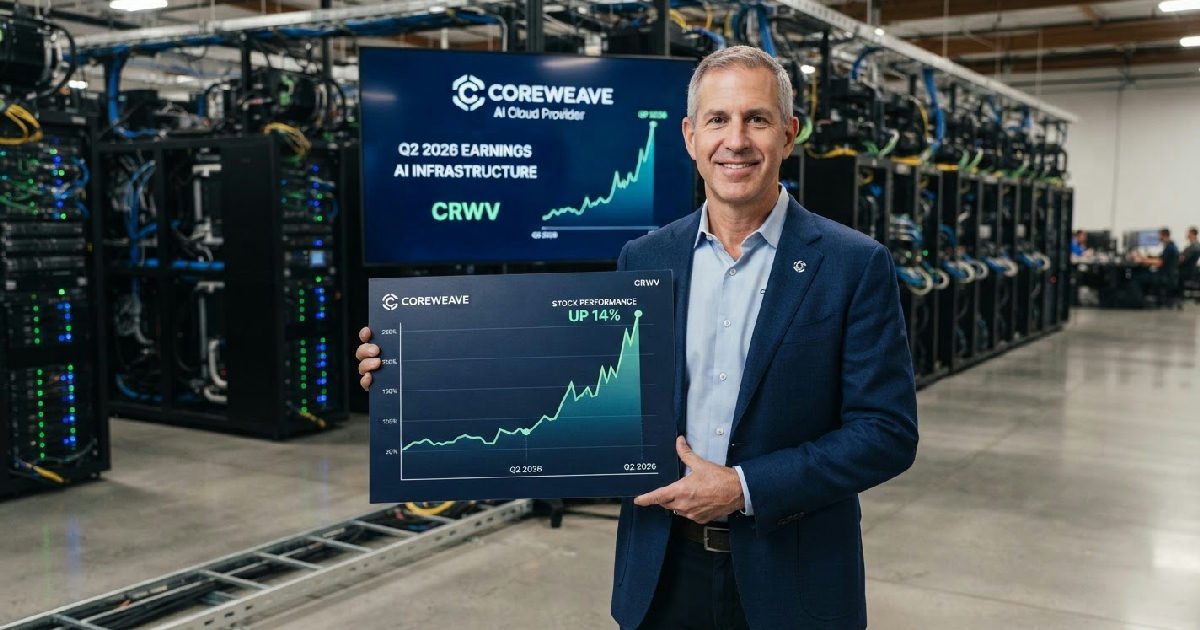
CoreWeave Stock Jumps 14% on Strong Q2 Earnings, AI Infrastructure Demand Soars
Roseland, New Jersey — CoreWeave, the artificial intelligence (AI) cloud provider, saw its stock surge by 14% in after-hours trading on Tuesday, August 11, 2026. This significant jump followed the company’s second-quarter 2026 earnings report, which comfortably exceeded Wall Street expectations for both revenue and adjusted net loss.
CoreWeave’s Chief Executive Officer, Michael Intrator, characterized the period as an “important inflection point” for the rapidly scaling firm.
CoreWeave’s Stellar Q2 Performance Captivates Investors
The stellar financial results, reported for the period ending June 30, 2026, highlighted an insatiable enterprise demand for AI computing power. CoreWeave’s revenue more than doubled year-over-year, alongside a smaller adjusted net loss than anticipated. These figures underscore the company’s pivotal role in the booming AI infrastructure market.
CoreWeave reported revenue of $2.58 billion for the second quarter, a figure that not only represented a 112% increase year-over-year but also surpassed analysts’ consensus estimates of $2.56 billion. The company also posted an adjusted net loss of $567 million, a better outcome than the $677 million analysts had projected.
Investors reacted positively to the news. The stock, trading under the ticker CRWV, surged more than 13% in extended trading on August 11. This latest rise builds on an already strong year, with global stock rally gains continuing for CoreWeave’s stock, which had gained 26% year-to-date through Tuesday’s close.
Michael Intrator explained that the company is achieving significant “operating leverage” as its business continues to scale up. He noted that the temporary margin drag from bringing new data centers online now has a much smaller impact on CoreWeave’s overall financial health. This indicates a growing operational maturity within the firm.
Relentless Demand for AI Infrastructure Fuels Growth
The surging demand from AI labs, hyperscalers, and enterprises has dramatically bolstered CoreWeave’s future prospects. The company’s revenue backlog soared to an impressive $104 billion by the end of the second quarter, marking a substantial 246% increase from a year prior.
Adding to this robust pipeline, CoreWeave secured over $25 billion in net new customer commitments early in the third quarter. This continuous influx of orders highlights the critical need for specialized AI infrastructure across various industries. It suggests that businesses are investing heavily in advanced computing capabilities.
Notable recent customer adds include AI drug-discovery company Isomorphic Labs, an Alphabet subsidiary founded by Google DeepMind Chair Demis Hassabis. Systematic trading firms Flow Traders and IMC Trading have also become new customers.
These additions showcase the diverse applications of CoreWeave’s services across various sectors. The company reported that financial services represent a “major growth area,” indicating a broadening client base.
Strategic Alliances and Expanding Operating Margins
A key strategic advantage for CoreWeave remains its close relationship with Nvidia, a leader in AI chips. The company demonstrated this synergy by becoming the first cloud provider to test and run Nvidia’s next-generation Vera Rubin NVL72 platform during the second quarter. This collaboration ensures CoreWeave stays at the forefront of hardware innovation.
Chief Financial Officer Nitin Agrawal highlighted a significant improvement in the company’s adjusted operating income. It reached a 5% margin in the second quarter, a substantial sequential increase from the 1% margin achieved in the first quarter. This upward trend points to increasing operational efficiency and successful business diversification.
Customers are also increasing their spending on CoreWeave as the company rolls out more margin-accretive businesses. These new offerings include specialized storage, central processing units (CPUs), networking solutions, and software services. This expansion beyond core GPU infrastructure helps to broaden CoreWeave’s revenue streams.
Agrawal specifically pointed to the remarkable growth of CoreWeave’s managed inference business. This service, which allows companies to deploy and run AI applications efficiently, surged from a $1 million to a $100 million annualized revenue run rate in the span of just one quarter. It exemplifies the rapid commercialization of AI applications.
Aggressive Capital Deployment for Future Capacity
To keep pace with overwhelming demand, CoreWeave is investing heavily in expanding its infrastructure. Capital expenditures in the second quarter reached $9.4 billion, exceeding Wall Street estimates of $8.2 billion. This aggressive spending reflects the urgent need for more AI compute resources.
The company also raised its full-year capital expenditure guidance to a range of $35 billion to $39 billion, up from its previous projection of $31 billion to $35 billion. Michael Intrator noted that CoreWeave’s near-term capacity is “effectively sold out,” underscoring the critical need for this extensive buildout.
CoreWeave is committed to significant power expansion, targeting at least 8 gigawatts of power by 2030. This quarter alone, the company expanded its active power by nearly 500 megawatts. Its total contracted power now stands at approximately 3.7 gigawatts, indicating substantial future capacity.
Funding this rapid buildout has required significant financial maneuvering. CoreWeave has successfully raised over $10 billion through unsecured debt and convertible bonds. This cash deployment is vital for future expansion.
While this elevated spending is crucial for growth, it contributed to an increased adjusted net loss of $567 million for Q2 2026. This compares to $130 million for the same period a year ago.
Positive Outlook Amidst Intensifying AI Cloud Competition
Looking ahead, CoreWeave anticipates continued robust growth. The company projects third-quarter revenue to be between $3.45 billion and $3.6 billion, comfortably surpassing analysts’ estimates of $3.4 billion. This forward guidance indicates strong momentum into the latter half of the year.
The full-year revenue guidance was also raised, now expected to be between $12.4 billion and $13.2 billion, up from an earlier range of $12 billion to $13 billion. CFO Nitin Agrawal expects the company’s margins to continue expanding, potentially reaching the “low teens” by the fourth quarter, signaling improved profitability as the company scales.
Broader Market Implications for AI Cloud Services
CoreWeave’s strong performance provides a compelling snapshot of the booming AI industry and the escalating demand for specialized cloud infrastructure. Its success underscores the critical role dedicated AI cloud providers play in enabling advanced AI development and deployment.
Analysts like Christine Ji from Morningstar suggest this trend is unlikely to abate soon. The current market capitalization for CoreWeave stands at $50.67 billion, reflecting its growing importance in the technology landscape. As of August 12, 2026, the stock trades at $90.32, marking a 2.42% increase in the past 24 hours.
The P/E ratio, however, remains negative at -28.02. This indicates that investors are prioritizing future growth potential over immediate profitability. Andrew Rocco, a stock strategist at Zacks Investment Research, notes CoreWeave’s operational efficiency and strategic partnerships position it well.
The company’s ability to secure substantial, long-term customer commitments despite rising capital costs further validates its business model. These results, which demonstrate significant operational success, contribute to overall market confidence, similar to other strong earnings reports elsewhere.
This relentless drive for AI compute capacity will likely continue to reshape the cloud services landscape. Companies capable of quickly deploying and managing cutting-edge hardware, like CoreWeave, stand to benefit significantly. Their performance will remain a key indicator for the health and direction of the broader artificial intelligence industry.