

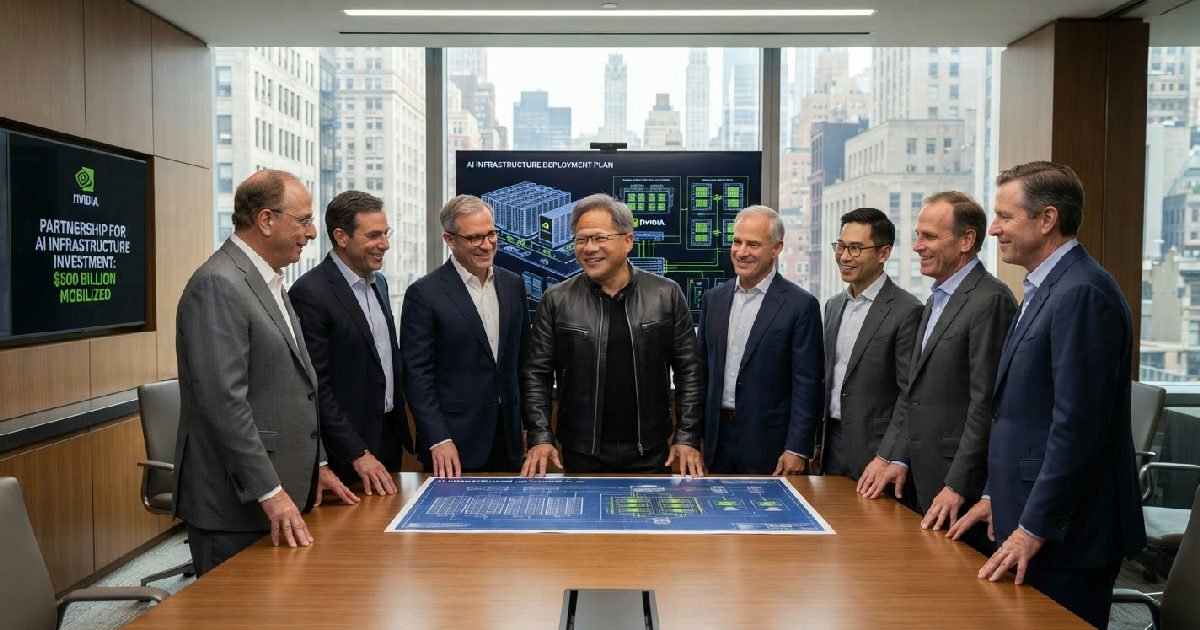
Nvidia mobilizes $500 billion AI infrastructure fund with Wall Street giants
Nvidia mobilizes over $500 billion in third-party capital through a new partnership with six major Wall Street financial institutions to fund AI infrastructure. has announced a groundbreaking partnership with six major Wall Street financial institutions to mobilize more than $500 billion in third-party capital. This colossal fund aims to finance the global buildout of artificial intelligence (AI) infrastructure.
The chipmaking giant, led by Founder and CEO Jensen Huang, formalized memorandums of understanding on Monday, August 10, 2026, with Apollo Global Management Inc., BlackRock Inc., Blackstone Inc., Brookfield Asset Management, Goldman Sachs, and KKR. These agreements are designed to provide Nvidia’s customers with the necessary funding to acquire computing power at an unprecedented scale, spanning frontier AI labs, enterprises, and AI clouds.
Transforming compute into an investable asset class
Jensen Huang views this initiative as a pivotal moment, transforming AI factory infrastructure into a new, investable asset class. He emphasized that AI has reached an inflection point, with its underlying infrastructure becoming one of the world’s most productive assets where “compute is revenue.” This approach seeks to broaden access to Nvidia-based infrastructure for a wide range of developers and providers.
The core mechanism involves these financial institutions establishing dedicated compute financing platforms. These platforms will pool significant capital at attractive rates for Nvidia customers, facilitating the construction of hyperscale data centers and the procurement of essential Nvidia hardware. This means financing for GPUs and data centers will be backed by institutional credit, insurance capital, and private equity.
Nvidia is also showing its commitment by offering to backstop up to 25% of potential deals. This translates to a maximum of $125 billion, providing an added layer of security for investors. Huang clarified that Nvidia’s role is to unlock a large pool of independent capital while maintaining disciplined risk exposure.
The Wall Street architects of AI investment
The collaboration brings together some of the most influential names in global finance, each playing a crucial role in orchestrating this massive capital deployment. This is an ambitious undertaking, reflecting the immense financial commitment required for the AI revolution.
BlackRock, the world’s largest asset manager, sees the AI buildout as demanding unprecedented investment and a skilled workforce. Chairman and CEO Larry Fink underscored his firm’s ability to connect long-term capital with essential infrastructure. He plans to raise additional funds as quickly as possible to support this initiative.
Goldman Sachs CEO David Solomon highlighted the historic AI investment cycle, noting that Nvidia’s full-stack platform is uniquely positioned at its center. He stated that his firm is actively seeking ways to direct capital to accelerate this expansion. The partnership also reflects confidence in Nvidia’s leadership and its potential to create a new market for credit backed by compute power.
Precedent set by Broadcom’s AI platform
This isn’t the first time a major chipmaker has looked to Wall Street for AI financing. Earlier in 2026, fellow chipmaker Broadcom Inc. launched a similar initiative, the AI XPV Platform, in partnership with Apollo Global Management and Blackstone Inc. That platform aims to deploy over 20 gigawatts of AI compute capacity by 2028, with an initial $35 billion tranche supporting Anthropic’s expansion.
These developments underscore a growing trend where AI chips and compute contracts are increasingly serving as collateral for large private credit transactions. It shows how the financial sector is adapting to the unique capital demands of advanced technology. Firms like KKR have also launched their own substantial AI infrastructure platforms, with KKR recently announcing a $10 billion platform in partnership with Nvidia itself and Vistra.
Addressing concerns and the bigger picture
The deal also aims to address concerns sometimes raised about “circular financing” in the AI sector, where interwoven investments might inflate demand or valuations. Jensen Huang emphasized that the demand for AI compute is “real,” with investors making independent financing decisions. He believes this structure creates transparent, market-driven capital deployment.
The sheer scale of capital involved reflects the global scramble for AI dominance. Projections indicate that global AI infrastructure investments are widely expected to exceed $1 trillion in 2026 alone. Big Tech companies, like Microsoft Corp., Meta Platforms Inc., and Amazon.com Inc., are anticipated to spend more than $730 billion combined on AI this year.
The evolving demand for AI infrastructure
As the AI industry matures, the constraints are shifting beyond just chip production. Physical factors such as available power, land, grid interconnection, and advanced cooling systems are becoming the primary bottlenecks for AI buildout. Goldman Sachs analysts noted earlier this year that the U.S. power market could face a 45-gigawatt shortfall for data centers by 2028, highlighting the need for vast new energy capacity.
The rise of “Agentic AI” (AI 2.0), characterized by autonomous, always-on systems, is expected to drive over 90% of future digital infrastructure demand. These next-generation AI systems are estimated to be significantly more energy-intensive than current chatbots, requiring a complete overhaul of physical architecture, not just data centers. This presents both a challenge and an opportunity for diversified infrastructure investments.
The road ahead for AI capital mobilization
This massive mobilization of capital is set to accelerate AI development globally. By removing the significant upfront capital burden from individual AI labs and cloud providers, these financing platforms are intended to foster faster deployment and innovation. The strategy also creates longer-duration, usage-linked investment opportunities for large asset managers, aligning their long-term capital with the sustained growth of AI.
While the investment landscape for AI was once dominated by chip and memory manufacturers, the focus is now expanding downstream. There’s a growing opportunity for “pick and shovel” companies that provide solutions for data centers, power transmission, advanced cooling, and grid-connected generation. This shift means more diversified investment potential across the ecosystem.
The partnership also highlights the critical need for a skilled workforce to manage and innovate within this expanding infrastructure. Companies like SK Hynix are investing heavily in new memory chip plants to meet surging AI demand, but the broader infrastructure requirements extend far beyond silicon.
The sustainability implications of such vast computational power are also coming into sharper focus. The ability of power grids to keep pace with demand and the need for environmentally sound solutions will be crucial challenges for the industry. This will likely drive further innovation in energy efficiency and renewable sources for AI operations.
This initiative represents a strategic move by Nvidia to solidify its central role in the AI ecosystem, not just as a hardware provider, but as a catalyst for its entire infrastructure. It also signals a broader acceptance of AI infrastructure as a legitimate and high-growth asset class for institutional investors.
This influx of capital could fundamentally reshape how AI is built, deployed, and financed for decades to come, potentially even influencing broader capital market trends as seen with growing interest in other asset classes.