

Berkshire Hathaway deploys cash, buys back its own stock
Berkshire Hathaway cash deployment in Q2 2026 reached $31.9 billion, primarily for stock repurchases under CEO Greg Abel. has begun deploying a significant portion of its substantial cash reserves, announcing Saturday that it spent $31.9 billion in the second quarter of 2026. The conglomerate, now overseen by CEO Greg Abel, primarily used this capital to repurchase its own stock.
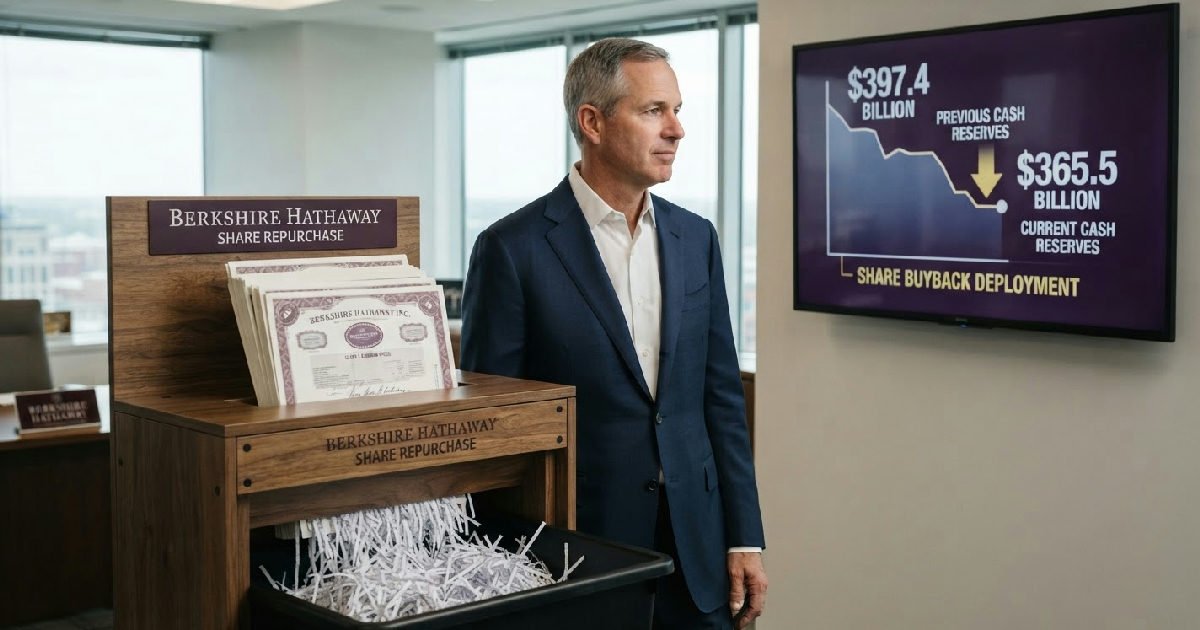
After more than three years of largely sitting on the sidelines, this strategic move signals a fresh approach to capital allocation. The buyback reduced Berkshire Hathaway’s record cash holdings from $397.4 billion at the close of the first quarter to a still considerable $365.5 billion, reflecting a direct belief in the company’s intrinsic value.
Berkshire’s cash deployment marks strategic shift
This recent stock buyback represents a notable pivot for Berkshire Hathaway. The company had amassed a staggering cash pile over several years, largely due to Chairman Warren Buffett’s cautious view.
Buffett often stated that he found equities too expensive in recent years. His philosophy led to a considerable accumulation of liquid assets, primarily held in short-term Treasury bills offering attractive 4-5% interest rates.
Long period as a net seller of equities
For 14 consecutive quarters, from 2022 through the first quarter of 2026, Berkshire Hathaway had been a net seller of equities. This lengthy streak marked one of the longest such periods in the company’s extensive history.
During this time, the company offloaded a net $172.9 billion in equities between 2022 and 2024. A significant portion, $134.1 billion, occurred in 2024 alone, highlighting a prolonged period of divestment.
The enduring legacy of prudent capital allocation
Warren Buffett, known globally as the “Oracle of Omaha,” led Berkshire Hathaway as CEO from 1970 until his retirement from that role on December 31, 2025. Now 95, he remains the company’s Chairman.
His investment philosophy, deeply rooted in value investing, emphasizes purchasing stocks below their intrinsic value. He sought businesses with strong brand loyalty, predictable earnings, and competent management, often finding few external opportunities meeting these stringent criteria.
Greg Abel’s mandate to find value
Greg Abel officially succeeded Warren Buffett as CEO at the start of 2026. Abel, much like his predecessor, favors concentrating Berkshire Hathaway’s investment capital into a select few “best ideas.”
In March, Abel announced that the company saw enough value in Berkshire shares to recommend buying them. This public statement set the stage for the second-quarter repurchases, aligning with a long-standing policy.
Berkshire’s policy permits buybacks whenever Abel, in consultation with Buffett, believes the stock price is below its intrinsic value. This recent move demonstrates his confidence in the company’s current valuation.
Details of the significant share repurchases
Berkshire Hathaway’s buyback program in the second quarter involved both its Class A and Class B stock. The conglomerate spent $349.6 million to repurchase 478 shares of Class A common stock.
Additionally, it allocated a substantial $4.18 billion to buy back 8.6 million Class B shares. These specific share repurchases totaled $4.53 billion, contributing to the $31.9 billion overall reduction in cash reserves when combined with other operational expenditures.
Share performance and market context
Both classes of Berkshire Hathaway shares have seen modest gains this year, climbing just over 3%. Over the past year, they’ve appreciated by roughly 12%.
In comparison, the broader market, as reflected by the S&P 500 index, has performed more strongly. The S&P 500 has surged 13% this year and an impressive 21% over the last 52 weeks.
Differing views on Berkshire’s buyback strategy
Not everyone agrees with Berkshire Hathaway’s recent capital deployment. “Big Short” investor Michael Burry has voiced skepticism, suggesting a successor to Buffett might lack patience for truly opportune investments.
In a Substack post, Burry wrote, “I do not find Berkshire an attractive investment going forward.” He described the initial steps taken by Abel as “more framing moves than investment moves,” implying a need for more substantial deployment.
Analyzing the book value perspective
An investment Substack called Maverick Equity Research calculated that most of Berkshire’s second-quarter repurchases occurred at approximately 1.4 times book value. This figure aligns closely with the stock’s 10-year average book value multiple.
Historically, Berkshire Hathaway has often been more aggressive with buybacks when its stock traded closer to 1 to 1.2 times book value. This suggests the company might require a more substantial market downturn to engage in extensive repurchases at deeply undervalued prices.
Support for the strategic move
Conversely, Macrae Sykes, a portfolio manager at Gabelli Funds, views the $4.5 billion share repurchase positively. He told clients the buyback signals two key strengths for the company.
First, it shows management believes the shares are currently undervalued. Second, it indicates the company is finding opportunities to deploy cash effectively, even in the current market environment where a global stock rally continues.
The path ahead for Berkshire Hathaway investments
This quarter’s buyback activity provides the clearest indication yet of how CEO Greg Abel plans to manage Berkshire Hathaway’s considerable resources. While the $31.9 billion spend is significant, it represents a fraction of the remaining $365.5 billion cash mountain.
Investors will be watching closely to see if this marks the beginning of a more proactive investment era under Abel’s leadership. The company has moved beyond the extremely cautious stance maintained by Buffett in recent years, signaling a shift in approach.
Future capital deployment options
Berkshire Hathaway has several avenues for future capital deployment beyond further share repurchases. The company could pursue large-scale acquisitions, which have been a hallmark of its past growth and a key strategy for diversification.
With its immense cash reserves, the conglomerate possesses the financial firepower to acquire entire companies. These targets would typically align with its value-investing principles, offering durable competitive advantages and predictable earnings.
Another option involves strategic investments in publicly traded companies, similar to its significant past stakes in Apple or Coca-Cola. The challenge, as Buffett often noted, is consistently finding businesses of sufficient quality and scale at attractive valuations.
However, as European stocks gain traction and global markets evolve, new opportunities may emerge for substantial equity positions. Berkshire also has a history of investing in major industrial projects, such as funding new memory chip plants or other infrastructure developments.
Impact on investor expectations
The market has long speculated about how Berkshire would eventually deploy its massive cash pile. This initial substantial buyback confirms management’s confidence in its own business, which can be reassuring to shareholders.
However, the sheer size of the remaining cash hoard means pressure will continue to mount on Abel to find large-scale, value-accretive investments. The delicate balance between patience and aggressive capital deployment will define his early tenure as CEO, shaping Berkshire Hathaway’s financial trajectory for years to come.