

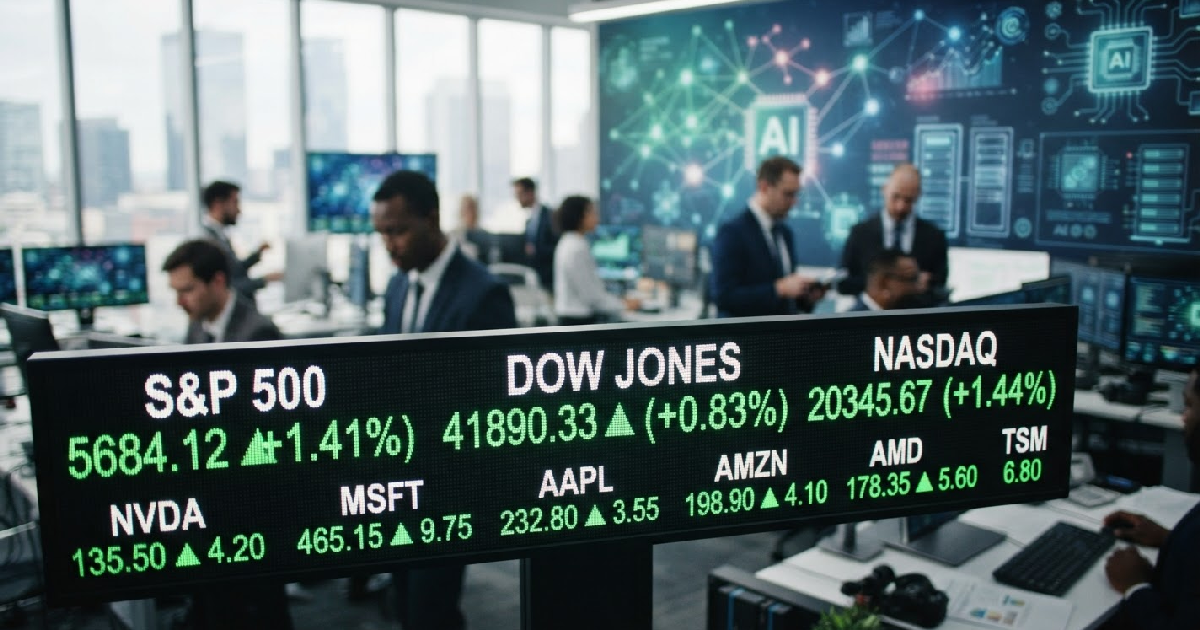
Tech stocks propel markets to fresh record highs amid AI boom
US equity markets have surged to unprecedented levels, with tech stocks propelling the major indices to fresh record highs as of August 4, 2026. The S&P 500, Dow Jones Industrial Average, and Nasdaq Composite all closed at all-time peaks, driven by robust earnings reports and an enduring enthusiasm for artificial intelligence (AI).
This latest rally underscores the dominant role technology firms now play in shaping global market performance and investor sentiment.
Technology sector’s outsized influence on S&P 500
On Tuesday, August 4, 2026, the S&P 500 shot up 1.8%, or 1.79%, to 7,736.52, surpassing its prior all-time high set just a couple of months earlier. The Dow Jones Industrial Average added a significant 907 points, or 1.71%, to reach a record 54,085.88, building on its own record from the previous day.
Not to be outdone, the tech-heavy Nasdaq Composite also soared, gaining 2.6%, or 2.59%, to finish at 26,584.99.
While Wednesday, August 5, saw a mixed bag for the major indices, the underlying strength of technology remained undeniable. The Dow continued its winning streak, gaining 263.24 points (0.49%) to close at 54,349.12, marking another new record closing high. However, the S&P 500 dipped 12.97 points (0.17%) to 7,723.55, snapping a four-day advance.
The Nasdaq Composite registered a 221.55 point (0.83%) decline to 26,363.44, its first drop in five sessions, yet the overall trend points upward.
The Information Technology sector now commands a substantial 39.4% of the S&P 500’s total market capitalization, a figure recorded on June 3, 2026. This proportion significantly exceeds the previous record of approximately 35% seen in March 2000 during the dot-com bubble. This highlights the outsized influence a few technology giants now wield over the broader market’s direction.
Noel Dixon, an equity strategist at State Street, pointed to the continued upside potential for tech stocks. He suggests there’s still ample room for increased investor exposure. This near-term momentum could drive further gains, even with current elevated valuations, as investors look to re-engage with the sector.
Strong earnings reports have reinforced this bullish narrative across the board. Companies within the S&P 500 index were on track to deliver nearly 50% growth in earnings per share for spring 2026, compared to a year earlier. This marks the biggest jump since 2021, showcasing robust corporate health. The actual profit growth rate for the last quarter stood at a robust 47% year-over-year.
Top 10 holdings drive market direction
At the heart of this tech-driven surge are the “Magnificent Seven” mega-cap technology companies: Nvidia, Microsoft, Apple, Amazon, Alphabet, Meta, and Tesla. While these firms are certainly powerful, it’s the top 10 holdings in the S&P 500, including Broadcom alongside the “Magnificent Seven,” that collectively represented 38-40% of the total index weight in early June 2026. Their concentrated performance disproportionately influences the overall market trajectory.
Individual standout performances underpinned this trend, particularly in companies tied to AI infrastructure. Nvidia, a key provider for the AI industry, saw its shares rise 2.6% on August 4, then climbed another 3.4% on August 5. This most recent boost came after Elon Musk announced SpaceX would exclusively use Nvidia processors for its AI computing infrastructure.
Palantir Technologies also experienced a significant jump, surging 29.5% on August 4. This followed CEO Alex Karp’s report of an “otherworldly” 93% leap in overall revenue for the second quarter, along with an increased full-year 2026 revenue forecast. Such strong results from leading players solidify investor confidence in the sector’s growth prospects, particularly for those capitalizing on AI.
AI demand fuels semiconductor stock rally
The renewed enthusiasm surrounding artificial intelligence has been a critical tailwind, particularly for semiconductor manufacturers and related infrastructure providers. This escalating demand for AI-related processing power and infrastructure translated into substantial share price increases across the sector. It points to a deeply embedded, structural growth trend that shows no signs of abating.
Beyond Nvidia’s impressive performance, other chipmakers also experienced significant rallies on August 4. Micron Technology gained 7.6%, while Broadcom was up 6.6%. SanDisk, whose value has soared over 800% since its spin-off from Western Digital, rose more than 8%, showcasing strong investor belief in memory and storage solutions.
The broad impact of this AI-driven rally extended to other key players in the semiconductor ecosystem. Marvel Technology climbed over 12%, ARM Holdings surged more than 11%, and Intel was up over 6%. Advanced Micro Devices, Applied Materials, and Lam Research each saw gains exceeding 5% on August 4, reflecting widespread sector strength.
Even industrial giant Caterpillar climbed 5.6% on August 4, hinting that the AI investment boom’s effects aren’t confined to pure tech companies, but are rippling through sectors providing foundational infrastructure.
Market momentum and looming economic risks
State Street’s Noel Dixon offered a closer look at current market dynamics, providing a nuanced perspective on the rally’s sustainability. He noted that “real money investors” had actually reduced their tech positioning from the 98th percentile down to the 80th percentile since late June. With renewed optimism, these investors are now flowing back into the market, possibly indicating a catch-up trade that still has momentum.
Dixon sees no immediate red flags in key risk metrics, like absorption ratios or correlation surprises, giving him confidence that the current rally “has legs.” He anticipates that hardware, especially semiconductors, will continue to lead within the tech sector. He cited the remaining 16% potential for the stocks index to retrace its previous highs, suggesting further upside.
Despite earlier concerns about hyperscalers, Dixon highlighted opportunities in the software space. He observed that their net income appears sustainable relative to total debt issued. This alleviates some concerns about their aggressive investment strategies and long-term viability, providing a more balanced view of tech’s sub-sectors.
Federal Reserve policy and bond market jitters
A potential constraint, however, looms large in the bond market, raising questions about how long this equity rally can continue unimpeded. Dixon indicated that a 10-year yield reaching 5% would significantly concern equities. This threshold could trigger a shift in investor appetite, moving capital away from riskier assets.
The primary risk event, he explained, could hinge on Federal Reserve Chairman Kevin Walsh’s upcoming decision in September. If Chairman Walsh chooses to hold interest rates steady, markets might perceive it as a policy mistake, especially since the front end of the market currently prices in a hike.
Such a divergence between market expectation and Fed action could introduce considerable jitters into the bond market and potentially undermine equity confidence.
The ongoing geopolitical situation concerning the Strait of Hormuz could also influence the Federal Reserve’s monetary policy decisions, adding another layer of complexity. Dixon noted that a market leading the Fed, rather than the other way around, complicates forward guidance and increases volatility.
The current economic environment, marked by potentially weaker CPI data for June and July, makes every incoming data point determinative for the Fed’s next move.
Dixon emphasized that in this “new regime of volatility,” investors need to look beyond conventional high-frequency data, increasingly relying on alternative data sources to accurately gauge future trends and market shifts.
Investment strategies amid market volatility
Given prevailing concerns about inflation and the unpredictable nature of Fed actions, investors are naturally looking for effective hedging strategies to protect portfolios. Dixon suggested that buying gold could be a particularly good option in the current climate, acting as a traditional safe haven asset. Gold was already showing strength this morning, rising nearly 2% to trade at $41.52, underscoring its appeal.
He also pointed to the current cheapness of volatility itself, recommending strategies such as one-month volatility spreads as worthwhile opportunities. This proactive approach underscores the underlying caution many analysts maintain, even amidst a powerfully bullish run in equity markets, suggesting a need for careful risk management.
As markets continue to react to evolving economic data and policy signals, analysts are keenly anticipating further insights from industry experts. India’s IPO market, for instance, has recently experienced a slowdown, reflecting broader global economic crosscurrents.
Dan Ives of Yorkville Ives & Co is set to provide analysis on investor concerns regarding SpaceX’s aggressive spending plans, which have become a significant talking point among tech investors. Meanwhile, Ashok Bhatia of Neuberger will discuss whether current market valuations truly reflect the pace of disinflation.
He suggests markets might be underestimating this crucial economic trend, potentially offering a different perspective on future interest rate paths. These upcoming discussions highlight the complex interplay of innovation, monetary policy, and geopolitical events that continue to shape today’s dynamic financial landscape.