

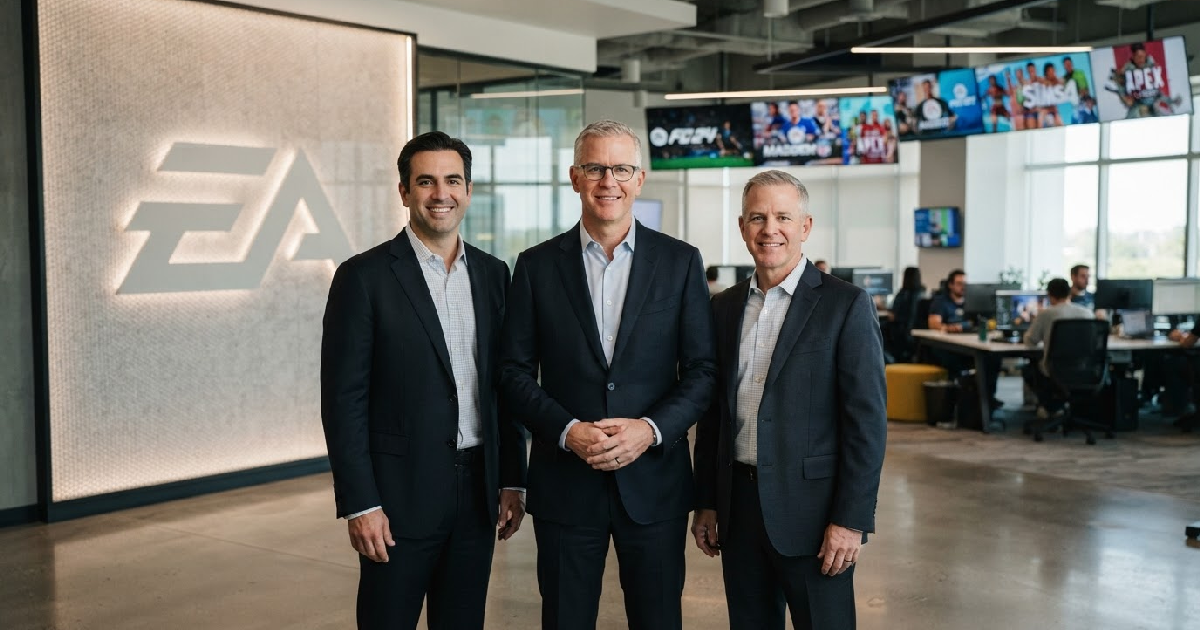
EA leadership changes as Cam Weber, David Tinson take top roles
Electronic Arts has announced significant EA leadership changes at its top executive tier, following the completion of its $55 billion acquisition by a Saudi-led consortium. Cam Weber, formerly President of EA Sports, now steps into the role of President and Chief Studios Officer. David Tinson, previously Chief Experiences Officer, has been appointed President and Chief Operating Officer.
These promotions, publicly revealed on August 5, 2026, come just a day after the Saudi-led consortium officially finalized the leveraged buyout of the gaming giant. The restructuring aims to strengthen alignment across EA’s creative, technology, and business organizations under the leadership of CEO Andrew Wilson.
New executive structure takes shape
Cam Weber’s ascent to President and Chief Studios Officer places him at the helm of EA’s extensive portfolio of franchises and studio organizations. His new responsibilities encompass overseeing all creative and development teams across the company, a crucial mandate in shaping the future game lineup.
This appointment sees a former head of the highly profitable EA Sports division now guiding the broader creative direction of the entire company. Some observers believe this shift signals a potential focus on established, dominant franchises like EA Sports FC and Battlefield.
Expanded responsibilities for key leaders
Meanwhile, David Tinson, in his new capacity as President and Chief Operating Officer, will supervise a wide array of business functions. His remit includes commercial strategy, marketing, communications, fan growth initiatives, business planning, and technology, alongside strategy, ventures, and technology groups.
His role is designed to expand EA’s global community reach and accelerate its overall business growth. These leadership updates were initially communicated to EA employees on June 9, 2026, ahead of the public announcement, underscoring Wilson’s strategic vision.
Laura Miele shifts to enterprise development
Laura Miele, who previously served as President of EA Entertainment, is also transitioning into a new role as President, Enterprise Development. In this position, she will work directly with CEO Andrew Wilson to identify and pursue strategic growth opportunities that extend beyond EA’s existing core business.
This move suggests a push towards diversification and exploring new avenues for revenue in the evolving gaming market. Miele’s focus on broader enterprise development indicates EA is looking to leverage its intellectual property and expertise in areas not directly tied to traditional game releases.
The Saudi acquisition reshapes EA’s future
The executive reshuffle comes on the heels of the Saudi acquisition finalized on August 4, 2026. This monumental $55 billion leveraged buyout saw Electronic Arts delisted from NASDAQ, now officially owned by a consortium spearheaded by Saudi Arabia’s Public Investment Fund (PIF).
Other key players in the acquisition included Silver Lake, an American private equity firm, and Affinity Partners, led by Jared Kushner. Turqi Alnowaiser, the PIF Deputy Governor and Head of International Investments, played a significant role in orchestrating the deal.
Investment in AI amidst financial pressures
Silver Lake CEO and managing partner Egon Durban has publicly stated the new owners plan to “invest heavily” in EA’s growth. This includes significant capital directed towards artificial intelligence (AI) to enhance game development and the overall player experience.
However, the acquisition has also brought significant debt for EA, which casts a shadow over these ambitious plans. This financial burden has led to speculation about potential layoffs as management seeks to optimize operations and reduce costs.
The commitment to AI technology integration aligns with broader industry trends. Still, the need to manage substantial debt places considerable pressure on EA’s new leadership team to deliver strong financial performance and sustained growth.
Andrew Wilson’s vision under scrutiny
CEO Andrew Wilson’s internal message to employees on June 9, 2026, while intended to be reassuring, struck some as corporate platitudes. He emphasized EA is “entering one of the most exciting and transformative moments our industry has ever seen,” highlighting innovation and the “courage of our teams.”
This language, often heard in shareholder communications, faces increased scrutiny given the recent acquisition and the financial challenges. Wilson reiterated that EA would require “bold creativity and exceptional execution” moving forward, confident in the experience of his leadership team.
Implications for EA’s game development
The appointment of Cam Weber, a veteran of EA Sports, to oversee all studios strongly suggests a strategic prioritization of EA’s most profitable franchises. While this could mean more resources for beloved sports titles and the Battlefield series, it might also mean less creative freedom for smaller, non-sports studios within the EA ecosystem.
The gaming industry has recently seen a trend where publishers streamline their portfolios to focus on guaranteed revenue generators. This new leadership structure, particularly with Weber’s background, appears to reinforce that trend at Electronic Arts.
Gamers and developers alike will be watching closely to see if this shift leads to a more concentrated output or stifles innovation in less commercially dominant genres. The coming months will reveal how EA navigates these complex challenges and opportunities under its newly defined leadership and ownership.