

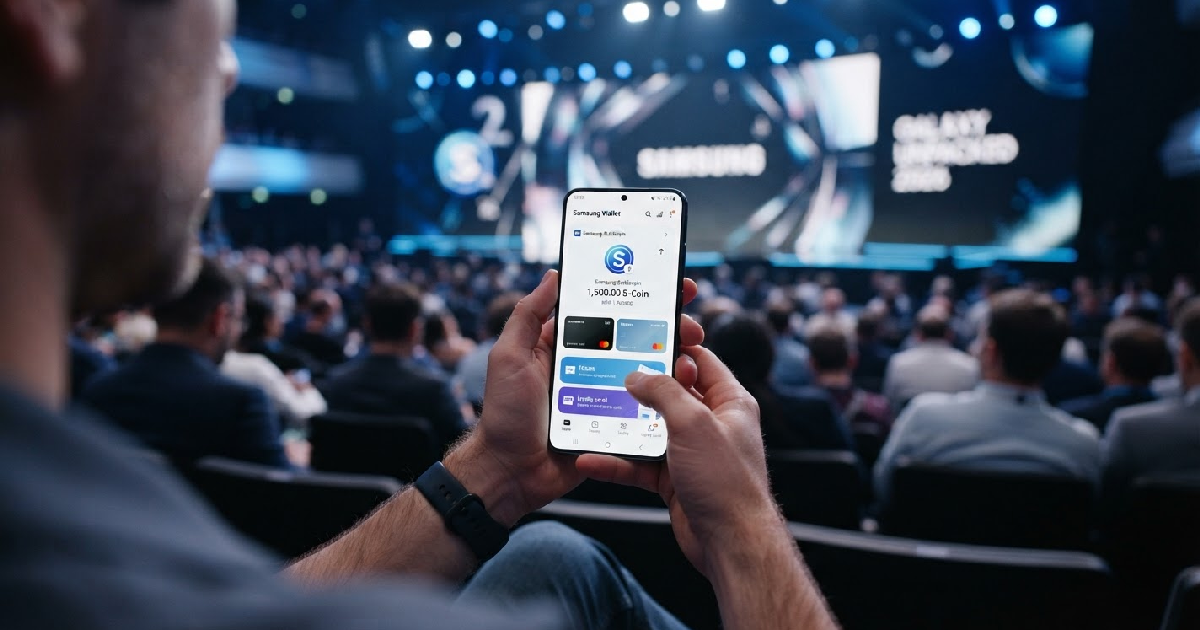
Samsung Electronics announces native stablecoin
Samsung Electronics is making a significant push into the digital asset space, announcing native stablecoin support for its ubiquitous Galaxy smartphones. This strategic move, revealed during the Galaxy Unpacked 2026 event in London, U.K., on July 22, 2026, could position the South Korean tech giant as a dominant distributor of stablecoins to potentially hundreds of millions of users.
The company plans to integrate fiat-pegged savings and payment accounts directly into Samsung Wallet. It aims to transform 800 million Galaxy phones into powerful platforms for digital assets and blockchain payments. This integration promises to streamline how users manage payments, rewards, and digital assets, all within a single, unified experience.
Samsung Wallet’s expanded stablecoin features
During the Galaxy Unpacked 2026 event, smartphone specialist product manager Lee Dinham emphasized Samsung’s commitment to embracing new forms of digital value. He highlighted stablecoins specifically, stating that this initiative would make Samsung one of the first major mobile phone brands to offer native stablecoin functionality directly on smartphones. This move will facilitate fast and reliable digital value transfers.
Mr. Dinham pointed out that Samsung Wallet already boasts nearly 19 million users in South Korea alone and operates across 61 countries. The company says integrating stablecoin support means up to 800 million Galaxy devices could gain access to these features without needing separate crypto applications or exchange accounts, vastly expanding the potential user base.
Distribution: the key to crypto adoption
Industry experts are quick to point out the immense implications of Samsung’s move for wider crypto adoption. Joseph Goh, Director and Head of Asia Pacific at Areta, a crypto investment banking and advisory firm, told CoinDesk that Samsung will “emerge as a dominant distributor of stablecoins such as USDC.”
Mr. Goh stressed that “distribution is the scarce asset here, and Samsung owns a great deal of it.” Joel Hugentobler, a Cryptocurrency Analyst at Javelin Strategy & Research, echoed this sentiment. He stated that “The biggest hurdle for stablecoins hasn’t been technology, it has been distribution,” a challenge Samsung appears poised to overcome.
Ben Nadareski, CEO and co-founder of Solstice, views this development as a positive step for wider crypto adoption. He noted that for years, crypto had deep venues in places like South Korea, but weak paths into daily spending. Now, retail crypto interest could rise with stablecoins inside a hub people open for cards and checkout.
Building robust digital asset infrastructure
Samsung’s vision extends beyond just user-facing features. It’s also investing heavily in the underlying digital asset infrastructure. Samsung SDS, the IT services arm of Samsung Group, confirmed discussions with Dunamu, the operator of South Korea’s largest cryptocurrency exchange, Upbit, regarding joint infrastructure development.
During Samsung SDS’s Q2 earnings call on July 30, 2026, CEO Lee Jun-hee revealed these talks. He indicated a strategic investment to bolster stablecoin and AI-powered payment systems. This aligns with a May 2026 agreement where three Samsung affiliates—Samsung SDS, Samsung Securities, and Samsung Card—jointly acquired a 4% stake in Dunamu for $408 million.
Mr. Goh sees this infrastructure play as the crucial “other half” of Samsung’s strategy. He explained that while the Wallet announcement secures distribution, the collaboration with Dunamu and Samsung SDS will build the essential infrastructure beneath it. Samsung SDS has already completed end-to-end testing for the full stablecoin process, from issuance to settlement, including robust AI software applications.
South Korea’s evolving regulatory landscape
Samsung’s timing seems deliberate, according to Mr. Goh. The company aims to position itself in both dollar and won-denominated stablecoins while South Korea continues to develop its regulatory framework for digital assets. This proactive approach could give them a significant advantage.
In April, South Korea unveiled a draft of its Digital Asset Basic Act. This legislation is designed to establish foundational rules for digital assets, including trading, custody, supervision, and stablecoin issuance. However, the lack of a firm deadline for the act’s approval or new crypto rules provides Samsung with a window to solidify its infrastructure.
Broader implications for global finance
The integration of stablecoins into Samsung Wallet represents a significant step towards mainstream crypto adoption and could reshape aspects of global finance. Robby Yung, CEO of Investments at Animoca Brands, believes this is unequivocally good news for the crypto sector. He emphasized that increased distribution of cryptocurrencies is always beneficial, particularly given the historically closed nature of mobile ecosystems.
Mr. Yung also suggested that Samsung’s move might not immediately grant it an advantage over established crypto-native platforms, but it significantly broadens the reach of digital currencies. Yat Siu, Executive Chairman of Animoca Brands, viewed Samsung’s initiative as an enhancement to its feature set rather than an attempt to create a “super app.”
Beyond consumer adoption, Samsung’s stablecoin strategy could yield substantial internal benefits. Analysts estimate that by adopting stablecoins for its internal cross-border transactions, Samsung could save over $100 million annually across its various affiliates. This internal efficiency gain highlights a practical application of stablecoins within large corporate structures.
The broader stablecoin market itself is projected for substantial growth. Ark Investment forecasts the global stablecoin market will expand five- to tenfold over the next five years, potentially reaching $1.4 trillion by 2030. This represents a compound annual growth rate of 38%, similar to how data center demand drives robust performance in other sectors.
Samsung’s long history with digital assets
This isn’t Samsung’s first foray into the world of cryptocurrency; the company has been a quiet but consistent player for years. Back in 2019, Samsung introduced its dedicated digital asset wallet through Knox, its hardware-isolated security vault.
This early adoption allowed users to securely store and manage various cryptocurrencies, including Bitcoin (BTC), Ethereum (ETH), and Tron (TRX), and connect to external hardware wallets like Ledger’s Nano S and Nano X.
More recently, in October 2025, Samsung partnered with Coinbase. This allowed eligible U.S. Galaxy users to purchase cryptocurrencies directly through Samsung Wallet. The collaboration offered new Coinbase users promotional incentives, including a three-month Coinbase One subscription and trading credits, further cementing Samsung’s presence in the crypto buying market.
Additionally, Samsung has been expanding its broader financial ecosystem, exemplified by the launch of the Samsung Galaxy Card in collaboration with Barclays and Visa. Designed to encourage spending at Samsung stores and within Samsung Wallet, this initiative shows the company’s strategy to create an interconnected financial experience across its devices and services, where digital assets like stablecoins are a natural fit.
While Samsung has not officially identified which stablecoins, blockchain networks, or reserve-backed assets it will support, a demo screen at the Galaxy Unpacked 2026 event reportedly showed Circle’s dollar stablecoin “USDC” with send, receive, and top-up functions. Jeremy Allaire, CEO of Circle, also shared Samsung Electronics’ USDC demo screen on social media, hinting at potential collaborations.