

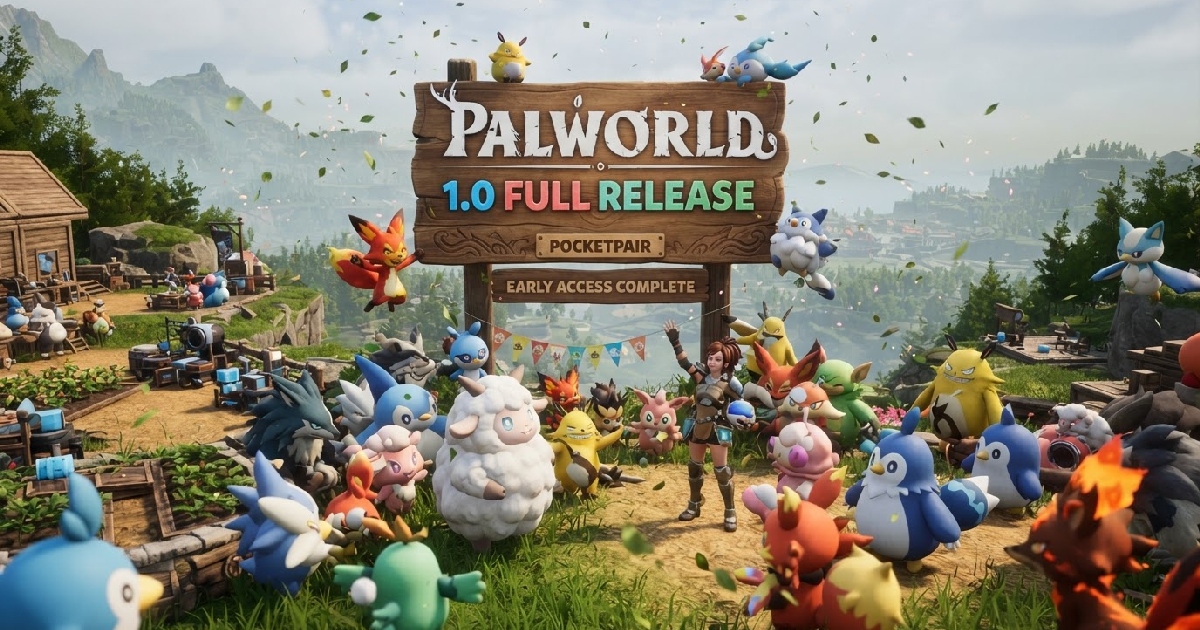
Palworld’s Official 1.0 Launch Solidifies Post-Early Access Momentum
Palworld 1.0, Pocketpair’s monster-collecting game, officially launched on July 10, 2026, after a successful Early Access period. 0 on July 10, 2026, marking its full release after a highly successful Early Access period. This Palworld 1.0 milestone follows significant player activity, with the game reaching nearly 1 million concurrent Steam players shortly after its launch.
The journey from its viral Early Access debut in January 2024 to this full release has seen the Japanese developer, Pocketpair, grow considerably. John Buckley, Head of Publishing and Communications, offered insights into the studio’s strategy at CGDC during ChinaJoy 2026, emphasizing community engagement and resilience against media scrutiny.
Palworld’s explosive Early Access debut
Palworld’s Early Access launch on January 19, 2024, was nothing short of explosive, quickly becoming a global phenomenon. It sold over 1 million copies in its first eight hours and an astonishing 8 million within six days. This initial rush culminated in a peak of 2.1 million concurrent players on Steam by February 2024, becoming the second-highest all-time peak concurrent player count on Steam.
This unprecedented success for a relatively small studio, which had only 20 to 25 staff prior to Palworld’s development, came with significant operational challenges. John Buckley candidly described the launch as “crazier” than anticipated, as overwhelming player demand caused servers for Discord, Epic Services, and Steam to crash. He called it a “very surreal time” for the development team.
Navigating player retention after initial hype
Following its blockbuster debut, Palworld experienced a natural decline from its peak concurrent player count. Buckley noted a fall from 2.1 million peak players to 300,000, a figure he said most developers would be happy with. The studio initially struggled with media backlash suggesting “the game is dead” due to this drop.
But Pocketpair ultimately decided to shift its focus away from external criticism and squarely onto its burgeoning player base. They recognized that maintaining engagement and building a strong community was paramount for the long-term health of the game and crucial for the eventual success of Palworld 1.0. This community-centric strategy would define their path forward.
Controversy and legal challenges for Palworld
Palworld’s rapid ascent was deeply intertwined with controversy, largely fueled by its “Pokémon with guns” concept. Accusations of plagiarism regarding monster designs and the alleged use of AI in art generation became pervasive talking points. These discussions played out across social media and the gaming press.
Pocketpair CEO Takuro Mizobe maintained that the game had cleared legal reviews, asserting the studio had no intention of infringing on intellectual property. John Buckley also clarified that generative AI was not utilized in Palworld’s creation, noting its development predated the recent AI craze. Despite these assurances, The Pokémon Company initiated an investigation into potential copyright infringement in January 2024.
The legal pressure intensified when Nintendo and The Pokémon Company filed a lawsuit in September 2024 in the Tokyo District Court. They sought 5 million yen (approximately $32,846 USD) each, along with an injunction against Palworld, citing patent infringement. The Japanese Patent Office reportedly rejected a patent attached to the Palworld lawsuit in April 2026. This development adds another layer to the complex legal battle.
Strategic marketing drives Palworld 1.0 launch
Leading up to the July 10, 2026, version 1.0 launch, Pocketpair executed a meticulous, multi-pronged marketing strategy. A primary goal was to re-engage players who had become inactive since the game’s 2024 Early Access period by prominently showcasing its substantial evolution and numerous updates.
They also actively engaged with content creators who had previously streamed or produced videos about Palworld, encouraging them to revisit the title.
A third, highly effective tactic involved daily reveals of new Pals, fresh content, and unexplored areas across various social media platforms. This consistent drip-feed of information proved particularly successful in China, where Pocketpair’s “super short” content on BiliBili saw its initial slow engagement blossom into significant viewership.
Buckley highlighted the power of persistence, noting, “if you just keep doing it, keep talking about it… it just starts taking over.”
New content and player reception for the full release
The strategic efforts bore fruit with the full game release. Version 1.0 attracted 900,000 concurrent players at its launch and achieved a robust 93.45% rating from over 443,000 reviews. Expected new content included the previously distant landmark, The World Tree, new Pals, and new areas/islands, such as a new set of islands floating above Palpagos, alongside gameplay and story improvements.
As of August 1, 2026, the game continues to command a strong player base, maintaining 445,000 concurrent players, making it the third most-played title on Steam. This sustained interest builds on its Early Access success, where Palworld surpassed 40 million cumulative players across all platforms by July 8, 2026, encompassing Steam, Xbox, and PlayStation users.
Palworld’s impressive sales figures and reach
Palworld’s commercial performance has been remarkable, solidifying its status as one of the most significant game launches in recent memory. As of July 21, 2026, lifetime sales are estimated at 30.5 million copies worldwide. This translates to nearly $700 million in gross revenue from direct software sales, a staggering figure for a relatively new intellectual property.
The vast majority of these sales, approximately 86%, originated on Steam, underscoring the PC platform’s critical role in the game’s viral spread and enduring popularity. Following the 1.0 launch, sales continued to climb, with an estimated 1.8 million additional copies sold in the first ten days. Steam contributed nearly 1.5 million of these new sales, generating $25 million in gross revenue.
Player distribution across platforms further highlights the game’s reach: 64.9% on Steam (PC), 31.1% on Xbox (including Game Pass), and 4% on PlayStation. This factual breakdown indicates the presence of Palworld across different gaming ecosystems.
IP expansion and future ventures
Pocketpair is working on “small” spin-offs to capitalize on Palworld’s immense popularity, aiming to expand the brand beyond the core game. These include the cozy game Palfarm and the romance-focused title Palworld – More than Just Pals. These projects hint at a diversification of gameplay experiences under the familiar Palworld umbrella.
To further extend the franchise into other entertainment sectors, Pocketpair has strategically established Palworld Entertainment. This spin-off company, formed in collaboration with industry heavyweights Aniplex and Sony Music, is dedicated to intellectual property expansion outside of video games. Early ventures include merchandise such as plushies and toys, alongside a recently released card game.
A mobile version of Palworld, in collaboration with Krafton, is also anticipated; John Buckley stated the release date would be “soon,” without providing further updates.
This multi-faceted expansion strategy illustrates Pocketpair’s long-term vision for Palworld, aiming to transform it from a viral game into a comprehensive entertainment franchise. The involvement of major partners like Aniplex and Sony Music underscores the significant commercial potential seen in the Palworld IP, projecting its influence far beyond its initial gaming success.
Pocketpair’s philosophy and industry impact
John Buckley concluded his address at CGDC with a clear piece of advice for other developers: “Don’t worry about trends, what’s popular,” and instead “make what you want, and someone will probably enjoy it.” This philosophy champions creative freedom and unique vision, traits that undeniably contributed to Palworld’s distinctive appeal, even amid a crowded gaming market.
He also addressed the persistent debate surrounding originality versus inspiration, a conversation frequently sparked by Palworld’s perceived similarities to other monster-taming games. Buckley affirmed the studio’s position, stating that while seeking inspiration is a natural part of creating games with broad appeal, they are “not in the business” of stealing designs or ideas.
This stance highlights the fine line developers walk between drawing on established tropes and forging a unique identity.
The rapid transformation of Pocketpair, from a modest 20-person team to one employing 90 staff and 20 contractors, is a direct consequence of Palworld’s unprecedented virality.
This growth not only signifies a remarkable entrepreneurial journey but also offers a case study in how bold concepts, strategic community engagement, and resilient development can transform a small studio into a formidable force within the global gaming industry, particularly in the wake of a highly successful product launch.